
Introduction
Located in the cultural heart of Sri Lanka, the Dambulla Cave Temple—also known as the Golden Temple of Dambulla—is one of the country’s most impressive and well-preserved Buddhist sites. Perched on a massive rock 160 meters above the surrounding plains, this UNESCO World Heritage Site is home to a series of caves filled with ancient murals, intricate carvings, and over 150 statues of the Buddha. It’s a peaceful, atmospheric place that offers both spiritual insight and sweeping views over the countryside.
Whether you’re visiting as part of a larger cultural triangle itinerary or just stopping by on your way to Sigiriya, Dambulla Cave Temple is an essential stop to understand the religious and artistic heritage of Sri Lanka.
We visited the Dambulla Cave Temple on our way to Sigiriya and chose to base ourselves there, which made it easy to explore the site early in the morning before the heat and the crowds.


Here are all your accommodation options in Sigiriya.
Why visit?
We visited Dambulla Cave Temple on our way to Sigiriya, and it turned out to be one of the most surprising highlights of our Sri Lanka trip. You climb up a massive rock under the blazing sun, take off your shoes at the top, and suddenly step into a world of painted ceilings, serene Buddhas, and centuries of spiritual history.
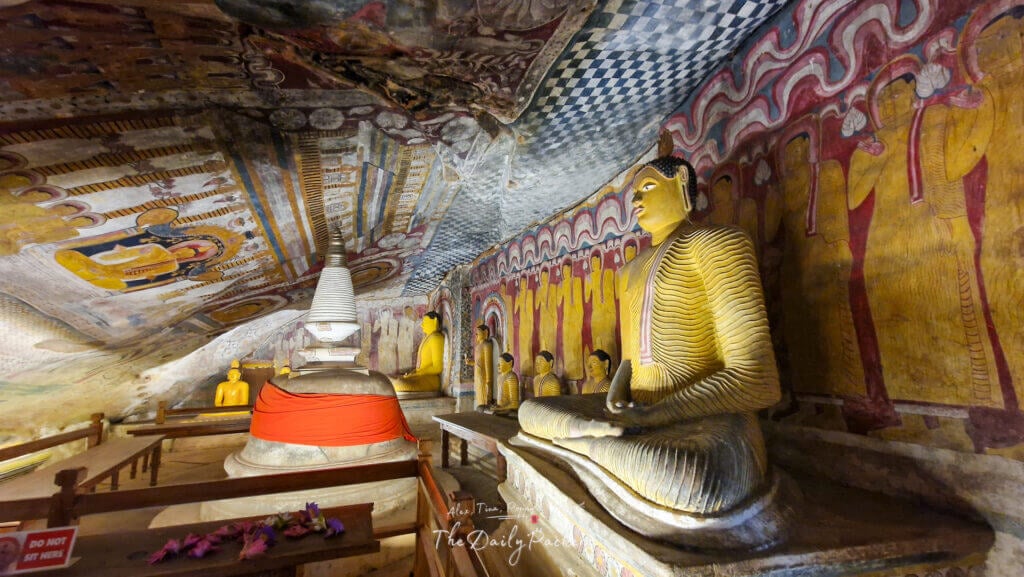
What makes Dambulla Cave Temple so special isn’t just its age or scale — it’s the atmosphere. There’s something incredibly peaceful about being surrounded by 2,000-year-old murals and over 150 Buddha statues, all nestled inside five natural caves carved into the rock. The light is dim, the air cool, and the silence calming — it’s a place that makes you pause without trying too hard.
And let’s not forget the view. Once you’re up there, you also get a wide, open panorama of the surrounding plains. It’s a stop that offers both cultural insight and a moment to breathe. If you’re already in the Cultural Triangle, this one is a no-brainer.


Read: All the best things to do in Sigiriya
How to get
Dambulla Cave Temple is located in the heart of Sri Lanka’s Cultural Triangle, making it easily accessible whether you’re coming from Kandy, Anuradhapura, or Sigiriya.
We visited Dambulla Cave Temple while traveling from Negombo to Sigiriya. Our driver arranged a short stop on the way, which was ideal — no need for a detour, just a smooth break in the journey with something spectacular to see.
If you’re doing the same route:
- From Sigiriya: It’s only a 25-minute drive (about 18 km). Tuk-tuks and local taxis are easy to arrange through your accommodation.
- From Kandy: Around 2.5 to 3 hours by car or bus (roughly 75 km). Buses run frequently, but it’s a longer trip if you’re relying on public transport.
- From Colombo or Negombo: Plan for a 4–5 hour drive. If you have a driver, it’s a great first cultural stop before heading deeper into the country.
Buses also run directly to Dambulla town, which sits right below the cave complex. From there, it’s just a short tuk-tuk ride or a 15-minute walk to the temple entrance.


Tip: We never travel without our DJI Mini 3 PRO drone anymore — it’s totally worth having to capture places from a whole new perspective.
When to visit
Dambulla Cave Temple can be visited all year round, but like most places in Sri Lanka, the experience varies a lot depending on the season. Since the temple involves a bit of uphill walking and is often hot and humid, the weather does make a difference.
- Dry Season (May to September): This is the best time to visit. Expect sunny days, dry paths, and clearer views from the top of the rock. Temperatures hover around 27–32°C (80–90°F), and while it’s hot, it’s manageable—especially if you go early morning.
- Inter-monsoon Season (October to November): Rain becomes more frequent, but it’s still possible to visit. Showers tend to be short and intense, usually in the afternoon. Temperatures stay similar, around 26–31°C (79–88°F).
- Northeast Monsoon (December to February): This season affects the north and east more, so Dambulla Cave Temple can see occasional rain, but it’s generally still a good time to visit. The climate cools down slightly, with temperatures averaging 25–30°C (77–86°F).
- First Inter-monsoon (March to April): Hot and dry, with temperatures reaching up to 34°C (93°F). These are the warmest months in the area, and mid-day visits can feel intense—especially with the rock heating up under the sun.
Our tip: Visit early in the morning, ideally before 9 AM. It’s quieter, cooler, and the light makes for better photos. Avoid mid-day if possible—the sun and heat bouncing off the rock can be draining.

Tip: We use the DJI Action 4 to film our vlogs — compact, durable, and perfect for capturing every adventure.
How to Visit
Visiting the Dambulla Cave Temple is pretty straightforward, but there are a few things to know before you go—especially if, like us, you’re traveling with bags or in between destinations.
There are two entrances, and both involve stairs. We would recommend starting your visit from the second entrance, located behind the hill (often used by locals and less touristy). It’s a short uphill hike that brings you straight to the top, where the cave temples are located. The path is shaded and scenic, making the 10-15 minute climb a bit easier, though in the heat, it’s always good to carry some water with you.

Once at the top, remove your shoes at the designated spot and take your time exploring the five caves. The interior is peaceful and cool, with incredible statues, wall paintings, and a spiritual atmosphere that makes it worth the effort. You’ll move from one cave to the next, each filled with more Buddha figures and murals than the last.
After visiting the caves, we suggest walking down the opposite side toward the Golden Buddha statue and the museum. It’s a well-maintained staircase that gives you a full view of the golden temple complex below. Once at the bottom, you can explore the museum or just admire the 30-meter-tall seated Buddha from the base—it’s a great photo stop and a nice way to wrap up your visit.

This route lets you experience both entrances without doubling back, and it feels more like a loop than an up-and-down trip. If you’re arriving by tuk-tuk or car, just let your driver know the plan—many are used to dropping visitors at one entrance and picking them up at the other.
Photography is allowed inside (without flash), and you’ll want to take your time here. Each cave has something unique, from the reclining Buddha to walls covered with ancient paintings.

Tickets & Opening Hours
The Dambulla Cave Temple is open daily from 7:00 AM to 7:00 PM, though the last ticket sales typically end around 5:00 PM, so make sure to plan your visit accordingly.
The entry fee for foreigners is 2,000 LKR (approximately €6 / $6.50 USD). The ticket office is located at the beginning of the hike, before you start walking up to the cave temple. Make sure to have cash on you, as card payments are not always accepted.
To access the temple caves, you’ll need to leave your shoes at the designated area near the entrance. While there’s no official charge, a small tip is expected when picking them up. If you prefer, you can also carry your shoes in a bag.
Note that modest dress is required to enter—shoulders and knees must be covered. If you didn’t bring anything to cover up, the temple offers sarongs and scarves, but they’re not free, and cost 200 LKR (0,6€ / / $0,65 USD)
The museum next to the giant golden Buddha is free and can be visited either before or after the temple, but if you’re short on time, you can skip it and focus on the caves.
Tip: Bring socks—the stone path gets extremely hot, especially during midday, and it’s quite painful to walk barefoot on it.


Travel Tips
- Start early: The temple gets busy by mid-morning, especially with tour groups. Arriving early (around 8 AM) makes for a quieter, more pleasant visit—and it’s cooler for the uphill walk.
- Dress appropriately: Shoulders and knees must be covered. Bring your own scarf or sarong to avoid rental charges at the site.
- Leave your shoes respectfully: Shoes must be left outside the temple. There’s a designated spot before entering, and while it’s technically free, a small tip is expected.
- Bring water: The climb to the top isn’t long but can be steep and sweaty, especially in the heat. There’s no shade on the stairs.
- Mind the monkeys: There are plenty of monkeys around the stairs and entrance areas. Keep your snacks hidden and don’t leave your belongings unattended.
- Go on your way between Negombo/Colombo and Sigiriya: Dambulla Cave Temple is perfectly located for a stop between the west coast and the cultural triangle. It’s a great break in the drive and adds depth to your visit.
- You can skip the museum: While the Golden Temple and giant Buddha statue are worth a look from outside, the museum itself isn’t a must-see.

Is it Worth It?
Absolutely. The Dambulla Cave Temple is one of those places that quietly leaves a mark. Beyond the UNESCO status and the impressive numbers—over 150 Buddha statues, 2,000 square meters of murals—what really stands out is the atmosphere. Inside the caves, it’s silent and dimly lit, the cool air scented with incense, the walls covered in centuries-old paintings. It’s peaceful, authentic, and somehow very human.
For us, visiting Dambulla Cave Temple felt like stepping into a living part of Sri Lanka’s spiritual history. It was a beautiful contrast to the heat and bustle outside. Even if you’re not usually drawn to temples, this one has something special. And if you pair it with a visit to Sigiriya, it rounds out the story of this cultural heartland in a really satisfying way.
So yes, if you’re already in the area or doing the cultural triangle, Dambulla Cave Temple is not just worth it—it’s unmissable.

Where to stay
We would recommend staying in Sigiriya. It’s worth spending at least a night or two there to enjoy the area without rushing. From peaceful guesthouses to charming mid-range hotels and stylish resorts, here are a few great places to stay depending on your budget:
(€) Shady Mango Villa: A quiet and cozy guesthouse surrounded by nature, perfect for budget travelers looking to relax in a peaceful garden atmosphere not far from Sigiriya Rock.
(€€) Il Frangipane: A charming mid-range stay with a lush tropical vibe, pool access, and warm hospitality—great for couples or families seeking comfort and style.
($$$) Sigiriya King’s Resort: A more luxurious option with elegant rooms, views of the rock fortress, and all the amenities you’d want for a relaxing, high-end experience in Sigiriya.

Here are all your accommodation options in Sigiriya.
About the authors
We are Alex and Tina, a French-Serbian couple who met in China back in 2014. We spent three incredible years there before making France our home. Our shared passion for travel has been the heartbeat of our relationship for over 12 years, taking us across 44 countries and counting.
We launched TheDailyPackers in 2019 as a way to document our adventures. In 2026, we reached a major milestone by officially turning our blog into our full-time job. While we are still growing toward financial independence through this platform, every article we write is fueled by our mission to make your voyages easier through in-depth guides, honest advice, and the lessons we’ve learned from our own mistakes.
Our journey has not been without its storms. In 2023, our world changed forever when our first son, Poppy, was stillborn on November 25th. It was, and remains, the hardest chapter of our lives. In 2025, we were blessed with our second little boy, Milo. He has since joined our traveling tribe, and you’ll be seeing him—and the reality of traveling with a little one-on the blog more and more.
We hope to inspire you to explore the world with curiosity and resilience. Thank you for being part of our story.
You may also like those related posts
The Ultimate Aconcagua Provincial Park 1-Day Hiking Guide
10 Best things to do in Krabi, Thailand, in 3 to 4 days
12 Best Things to do in Chiang Rai, Thailand, in 3 to 4 days
10 Best things to do in Tartu, Estonia, in 1 day or more
10 Best Things to Do in Freiburg, Germany, in 1 Day or more
Te Ara o Te Ao Trail: Hike to Rano Kau and Orongo, Easter Island
11 Best things to do in Chiang Mai, Thailand, in 3 to 4 days
16 best things to do in Budapest, Hungary, in 1 day or more
Pssst, did you know that…
If you purchase something through our links, we earn a small fee. However, you still pay the same. Win-win! And one day we may get to be full-time travel bloggers =)
Find Hotels with Booking.com
Do Yoga with KVY
Buy us a Coffee
Rent a car with DiscoverCars
Find Attractions with GetYourGuide
Find Flights with Expedia
Buy an eSIM with Airalo
Get insured with World Nomads
Get ready with Amazon.com