

Introduction
If you only have one full day to explore Easter Island National Park, you can still experience some of its best caves, moai platforms, and volcanic landscapes—all on foot. This route combines the Te Ana coastal trail, a visit to the famous Ahu Akivi (the seven moai facing the ocean), and a final climb up Terevaka Volcano for the highest panoramic view on the island.
You won’t need to rush or wake up at sunrise here. Days on Easter Island start slowly, and so should you. When we visited it, sunrise felt incredibly late—sometimes it was still pitch-black at 7 a.m. Clouds hang low in winter, so mornings tend to be muted and atmospheric.
After a slow breakfast and a long coffee overlooking Easter Island, it’s time to pack your day bag. Bring plenty of water and prepare your own sandwiches—there’s only one place to find food along this route, and that’s near Ahu Akivi, which you won’t reach until early afternoon.
This 1-day hike will take you through lava-tube caves, ancient ceremonial sites, rolling fields dotted with wild horses, and finally the summit of a dormant volcano. It’s one of the most rewarding ways to experience Easter Island: on foot, at your own pace, surrounded by silence, wind, and thousands of years of Rapa Nui history.


How to Get There
To start this 1-day hiking loop, you’ll first need to reach the trailhead of the Te Ana coastal caves, located a few kilometers north of Hanga Roa. The easiest way is to take a taxi from town directly to the starting point. Taxis on Easter Island don’t use meters, but the prices are straightforward—just confirm the cost before hopping in.
Tell your driver you’re going to Ana Kakenga (the two-windows cave). They’ll know exactly where to drop you. From Hanga Roa, the ride takes about 10–15 minutes, and you’ll be left on a gravel road with nothing around you except wind, waves crashing below, and a sign pointing toward the coastal trail.
Once the taxi leaves, that’s it—you’re on your own for the entire day. There’s no public transport inside Rapa Nui National Park, so the whole hike is done on foot until you eventually loop back to the Ahu Akivi area and walk into town or catch a taxi from there.
If you prefer to start from Ahu Akivi instead of Ana Kakenga, you can also taxi straight to the moai and do the route in reverse. Both options work, but starting on the Te Ana side feels more peaceful and wild, and it’s the best way to build up to the dramatic view from Terevaka Volcano later in the day.


Read: Easter Island itinerary, 5 days of Moai, magic, and wonders
Easter Island National Park Hiking Step-by-Step
Ana Kakenga — The “Two Windows” Cave
Your full day of hiking in Easter Island National Park begins along the rugged coastline north of Hanga Roa. You simply follow the shore until you reach the national park checkpoint. Sometimes a ranger is there to check tickets, sometimes not — but you still need a valid Rapa Nui National Park pass to enter. Once past the checkpoint, the trail becomes straightforward: just follow the coastal path and look for the wooden signs marking each archaeological site.

Your first stop is Ana Kakenga, also known as the Cave of the Two Windows. It’s one of the most dramatic places on the island. This 50-meter volcanic tube was formed by flowing lava thousands of years ago and later used as a secret refuge during inter-clan conflicts — a place where families hid when danger approached.

From above, the entrance looks like nothing more than a small hole in the ground. You literally have to crouch and squeeze through a narrow opening to enter the cave. Once inside, the tunnel widens, and you walk slowly toward the end where it splits into a Y-shape.
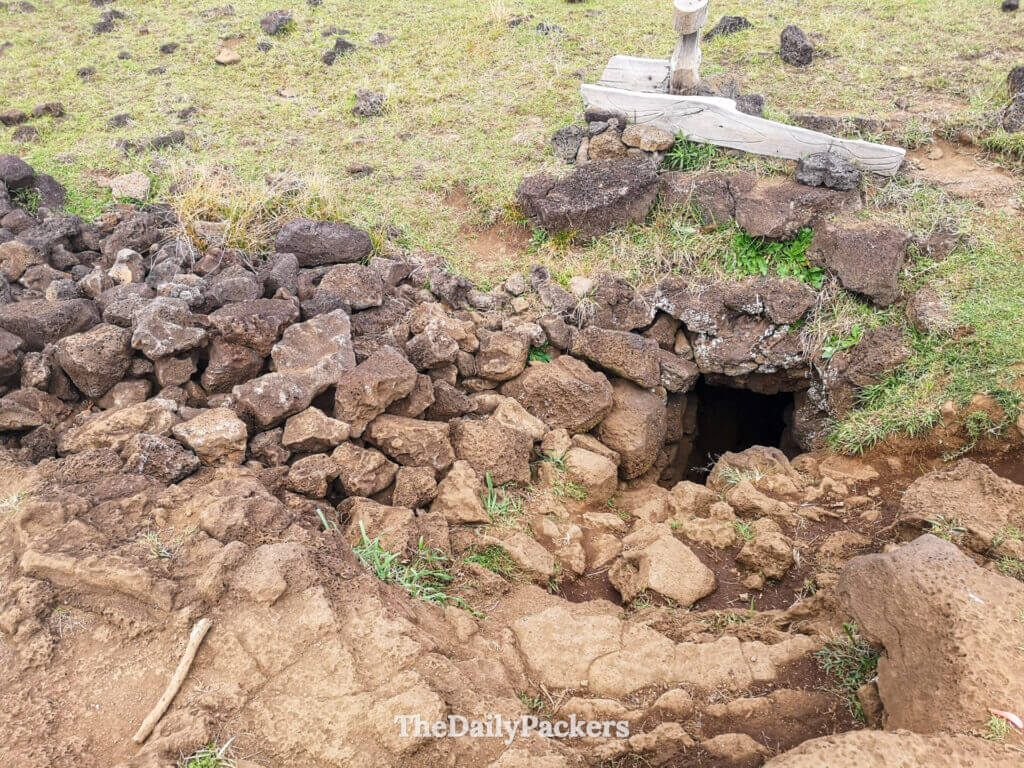
Each branch leads to a natural “window,” two rocky openings suspended above the Pacific Ocean. Waves crash against the cliffs below, and from inside the cave you get an incredible framed view of the sea. It’s one of those places that feels a bit adventurous, a bit surreal, and absolutely worth the stop.


Ana Te Pora — The Cave of the Reed Canoe
Your second stop while hiking Easter Island National Park is Ana Te Pora, a lava-tube cave known as the “Cave of the Reed Canoe.” Compared to Ana Kakenga, this one feels wider, calmer, and almost ceremonial.

The entrance is easy to spot from the trail, and once you step inside, you’ll notice the arch of the cave is unusually smooth — almost polished. This unique shape and texture are what make Ana Te Pora so special. Archaeologists believe it served both as a shelter and a ritual space, possibly connected to fertility ceremonies or symbolic rebirth.

Even without knowing the history, you feel a sense of intimacy here. Light filters through the entrance, illuminating the soft curves of the walls, and for a moment you can imagine what it must have been like for Rapa Nui families who once sought protection or performed sacred rites in this hidden place.
It’s a quick stop, but one that adds cultural depth to your hike before you continue toward the next cave
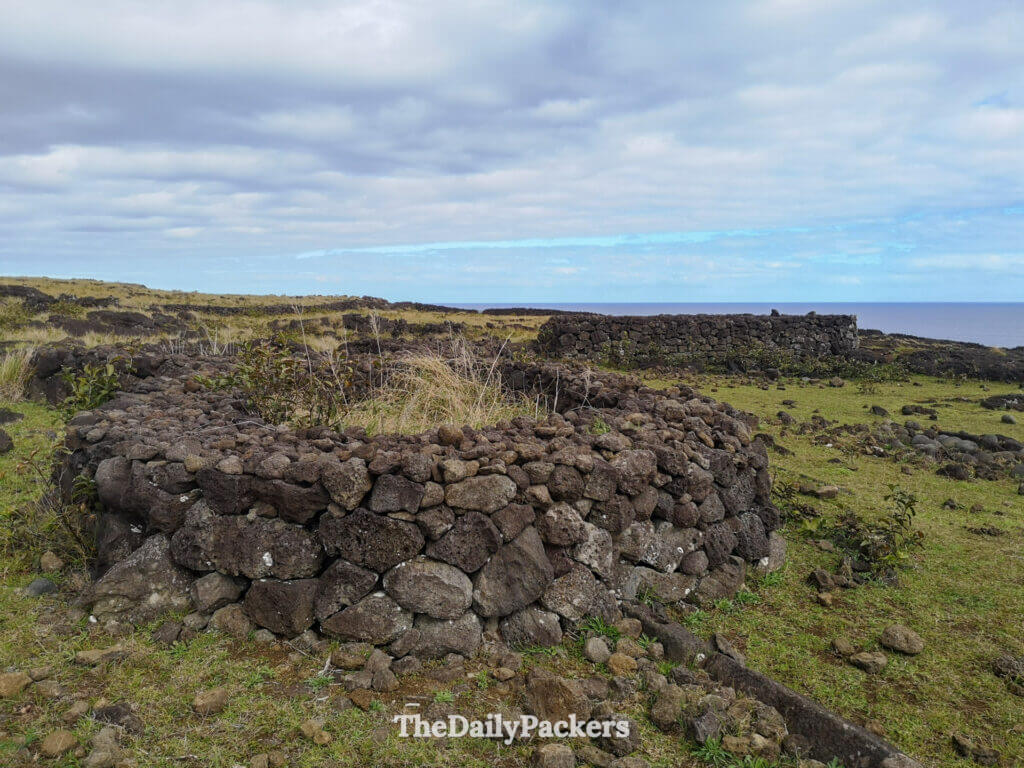

Ana Te Pahu – The Banana Cave
Your third stop while hiking Easter Island National Park is Ana Te Pahu, often called the Banana Cave. It’s the largest of all the caves on this route, and it definitely feels like it. The entrance sits inside a huge collapsed crater filled with banana trees — which is how the cave got its name. You reach it by walking down a set of stone steps into the cool, shaded opening.
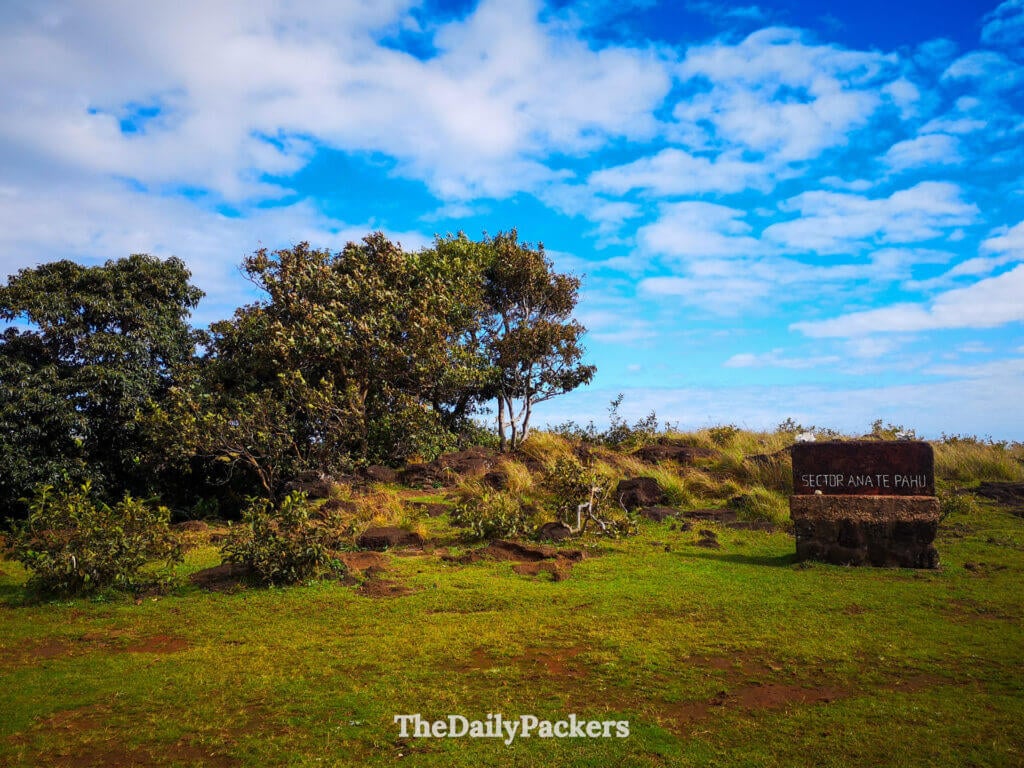
Once inside, the cave stretches far into the hillside. As you walk, you’ll notice several skylights created by sections of the ceiling that collapsed over time. Make sure you go all the way to the final opening — there are two of them — because each one offers a different play of light and shadow that completely transforms the atmosphere.

Ana Te Pahu was formed by solidified lava, and its original name is believed to mean “the cave of the drum”. As the largest lava tube on the island, it wasn’t just used as a shelter during conflict — it also served as a natural water reservoir for the Rapa Nui people. You’ll understand why once you’re inside; the temperature drops, the humidity rises, and everything feels calm and protected.

When we finished exploring, we climbed back up toward the banana trees and found a quiet spot nearby to sit down for lunch. It was already around 1 PM, and honestly, there’s no better place to take a break than surrounded by ancient lava, greenery, and total silence.

Ahu Akivi — The Seven Moai Facing the Ocean
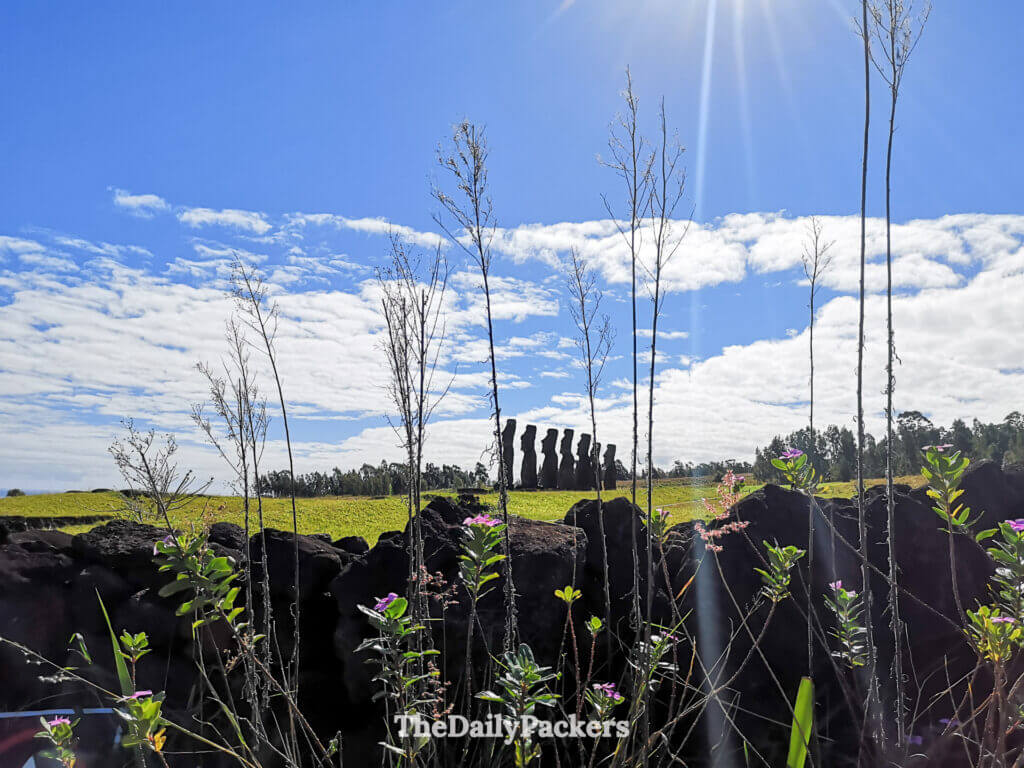
After leaving the caves behind, you keep following the path until the end of the national park. There’s another small checkpoint you’ll pass through, and from there it’s just a five-minute walk straight ahead to reach one of the island’s most meaningful sites: Ahu Akivi, the Seven Moai.

Unlike most moai on the island that face inland, the seven moai of Ahu Akivi stand in a perfect line looking toward the ocean. They’re almost identical in size and shape, and the symmetry feels intentional and powerful — because it is. This ahu is considered a sacred astronomical site, carefully aligned with the movements of the sun.

One of the coolest details about Ahu Akivi is how perfectly it lines up with the equinoxes.
- During the spring equinox, all seven moai face directly toward the setting sun.
- During the autumn equinox, they stand with their backs to the sunrise.
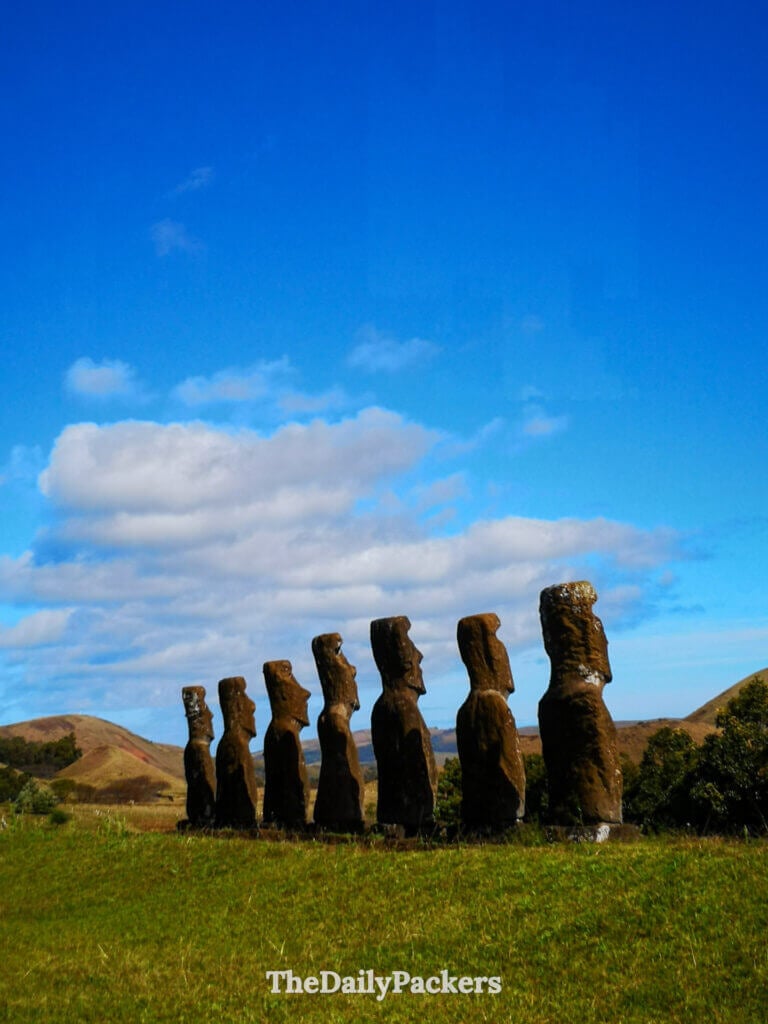
You don’t need to be into astronomy to feel how special the place is — the harmony between the statues and the horizon is something you notice right away.
For us, arriving here felt like entering a quieter, more contemplative part of the island. There are fewer visitors compared to the southern sites, and the open field around the ahu makes it easy to just sit, breathe, and take in the history.
Climb Terevaka — The Highest Viewpoint on Easter Island
From Ahu Akivi, you can continue all the way up to Terevaka, the highest point on Easter Island — and honestly, it’s one of the most rewarding hikes on the island. We started the climb around 2 pm, and it took us about 1 hour and 15 minutes to reach a smaller volcanic cone just before the summit. And here’s the truth: we stopped there, happily. The final push to Terevaka’s actual summit was only about 15 minutes more, but after a long day exploring caves and moai, the smaller volcano already felt like the perfect viewpoint.

The trail has no stairs and no drama — just a steady, gentle ascent. But don’t be fooled: every time you think you’ve reached the top, another hill rises in front of you. It’s almost comical… in a good way. It gives the hike a sense of mystery, because you truly never see the final destination until the very end.
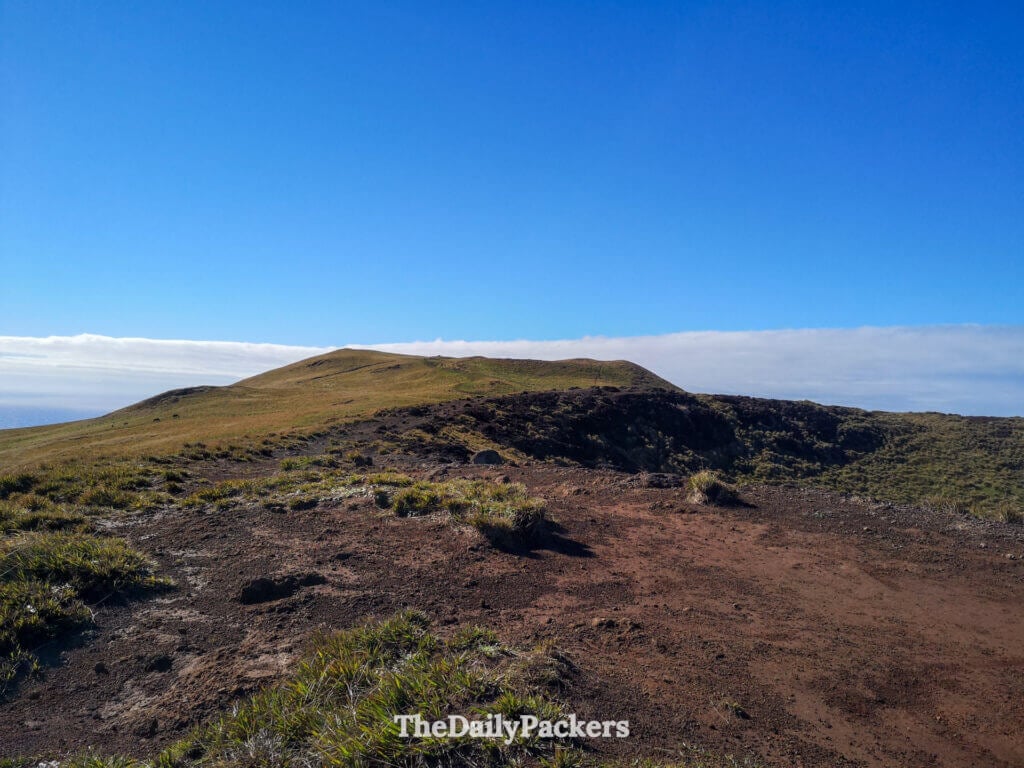
By the time we reached our chosen spot, the wind had picked up — something you should absolutely expect up here. But the view? Completely worth it. You’re surrounded by grass, silence, and a 360° panorama that feels like the island is floating in the Pacific. We were completely alone and ended up lying down on the grass just soaking in the moment before hiking back down.
If you prefer not to hike, you can also ride up on horseback, which looked like a fun and relaxed option. Tours need to be booked in advance: Terevaka Horse Excursion.
We were back at Ahu Akivi around 4:15 pm, happily tired and full of that “I can’t believe this place is real” feeling.

Here are all your accommodation options in Hanga Roa (Easter Island)
Return to Town
After finishing the hike down from Terevaka, all that was left was the walk back to Hanga Roa. It’s an easy, straightforward route — just follow the same road you used earlier in the day or go straight back to town following the main road for about 5km. By late afternoon the light softens, the air cools down, and the whole landscape feels peaceful. You’ll likely cross paths with a few horses, maybe a couple of locals, but overall it’s a quiet walk back toward civilization.
We reached the paved road just before sunset and took our time strolling back into town, enjoying that end-of-day glow you only get on Easter Island. If you’re tired, you can always try hitchhiking — it’s very common (and safe) on the island, and locals often stop for hikers. Otherwise, the walk is totally doable.
By the time you arrive back in Hanga Roa, you’ll be ready for a hot shower, a big dinner, and maybe a well-deserved pisco sour. After a full day exploring caves, moai, volcanoes and viewpoints, you’ll definitely feel like you earned it.

Tip: We use the DJI Action 4 to film our vlogs — compact, durable, and perfect for capturing every adventure.
What to Bring & Tips
Hiking Easter Island National Park is not difficult, but it is a full day out with very little shade, no shops, and almost no facilities. A bit of prep makes the whole experience smoother (and much more enjoyable).
What to Bring
- Water — at least 1.5–2L per person. There is nowhere to refill on the trail.
- Lunch + Snacks — sandwiches, fruit, nuts, cookies… you’ll thank yourself at Ahu Akivi or after crawling out of the caves.
- Sunscreen & Hat — the sun hits hard and there’s no protection once you’re out of the caves.
- Good Walking Shoes — nothing extreme, but avoid flip-flops (you will be crawling into caves).
- Headlamp or Phone Light — especially for Ana Kakenga and Ana Te Pora; the caves are pitch-black inside.
- Windbreaker — it gets extremely windy on the way to Terevaka.
- Cash — for park checkpoints or an emergency cab/hitchhike back.
- Park Ticket — you can’t enter without it.
Tips for a Smooth Day
- Start around 9:30–10:00 AM. There’s no need to rush at sunrise — it’s usually cloudy early, and most viewpoints look better later in the day.
- Do the caves first. They’re the most unique part of the route and perfect to enjoy while you’re fresh.
- Take your time at Ahu Akivi. It’s one of the most spiritual spots on the island and a great lunch break.
- Terevaka is windy year-round. If you walk it instead of horseback, expect strong gusts at the top.
- Hitchhiking is normal here. Locals often pick up hikers, especially on the way back to town.
- Watch your step in the caves. Entrances are narrow, volcanic rock is sharp, and it’s dark inside.
- Bring a backup layer. Weather changes quickly — sun, wind, clouds, all within minutes.
With the right gear and a bit of planning, this becomes one of the most memorable days you can have on Easter Island — caves, Moai, volcanoes, wild landscapes… all in one loop.
Where to stay on Easter Island
Even though you can easily hike Easter Island National Park in one full day, choosing the right place to stay in Hanga Roa makes your whole experience so much better. The town is small, so you’ll never be far from restaurants, shops, or the coastal sunset spots — but comfort, views, and style vary a lot.
Here are three great options depending on your travel style:
Cabaña del Mar Rapanui: A super charming, cozy stay right by the ocean. Perfect if you want your own space, a kitchen, and that easy “home on the island” feeling. Great for couples or slow travelers who want peace and privacy.
Hare Nua Hotel Boutique: A beautiful boutique hotel with a warm atmosphere and lovely décor. They have a wellness vibe, friendly staff, and one of the best breakfasts in town. Ideal if you want comfort without going full luxury.
Nayara Hangaroa: If you’re looking for a stunning, eco-luxury stay — this is the one. Gorgeous architecture, beautiful ocean views, spa services, and high-end comfort. A splurge, but absolutely memorable.

About the authors
We are Alex and Tina, a French-Serbian couple who met in China back in 2014. We spent three incredible years there before making France our home. Our shared passion for travel has been the heartbeat of our relationship for over 12 years, taking us across 44 countries and counting.
We launched TheDailyPackers in 2019 as a way to document our adventures. In 2026, we reached a major milestone by officially turning our blog into our full-time job. While we are still growing toward financial independence through this platform, every article we write is fueled by our mission to make your voyages easier through in-depth guides, honest advice, and the lessons we’ve learned from our own mistakes.
Our journey has not been without its storms. In 2023, our world changed forever when our first son, Poppy, was stillborn on November 25th. It was, and remains, the hardest chapter of our lives. In 2025, we were blessed with our second little boy, Milo. He has since joined our traveling tribe, and you’ll be seeing him—and the reality of traveling with a little one-on the blog more and more.
We hope to inspire you to explore the world with curiosity and resilience. Thank you for being part of our story.
You may also like those related posts
Travelling with a Newborn: Our First Road Trip with a Baby
Saleccia & Lotu: Best Beaches of Corsica’s Agriates Desert
9 Best things to do in Ouarzazate, Morocco, in 3 days
12 best things to do in Osaka, Japan, in 4 days or more
Half TMB Guide: Hike the Best of Tour du Mont Blanc
How to Eat Healthier and Change your Diet in 4 easy steps
3-Week Chile Itinerary: From the Atacama Desert to Patagonia
Morocco SIM card: Stay Connected in Just 10 Minutes
Pssst, did you know that…
If you purchase something through our links, we earn a small fee. However, you still pay the same. Win-win! And one day we may get to be full-time travel bloggers =)
Find Hotels with Booking.com
Do Yoga with KVY
Buy us a Coffee
Rent a car with DiscoverCars
Find Attractions with GetYourGuide
Find Flights with Expedia
Buy an eSIM with Airalo
Get insured with World Nomads
Get ready with Amazon.com