
Introduction
Traveling from Colonia del Sacramento to Buenos Aires is quick and easy, thanks to several ferry companies operating across the Río de la Plata and doing the route from Colonia to Buenos Aires. This route is one of the most popular ways to connect Uruguay and Argentina, offering a scenic and comfortable journey that takes around 1 to 2 hours, depending on the ferry service you choose.
A total of three companies operate the route between Colonia and Buenos Aires:
All three companies offer similar services, but from what we observed, the Colonia Express ferry is smaller than the Buquebus ferry.


How to buy ferry tickets
You can buy your Colonia to Buenos Aires ferry ticket either online through the ferry company’s website or directly at the Colonia port terminal. Since the terminal is conveniently located near the historic center, you can easily walk there to check schedules or buy your ticket in person.
If you want to secure your spot in advance between Colonia to Buenos Aires, it’s better to book online — especially during weekends or holidays when ferries can fill up fast. Payments are available in Uruguayan pesos (UYU), Argentine pesos (ARS), or USD, but we recommend choosing UYU, as it’s a more stable currency than the Argentine peso.
For 2026, Colonia Express offers several ticket options from Colonia to Buenos Aires:
- Super Económica: 1,700 UYU one way
- Super Express: 1,870 UYU one way
- Super Flex: 2,151 UYU one way
- GetYourGuide Buenos Aires to Colonia roundtrip ticket: 56€
Ferries from Colonia to Buenos Aires typically depart at 8:30 AM, 10:00 AM, 4:15 PM, 6:00 PM, and 8:15 PM, though schedules can vary depending on the season.

We decided to buy our Colonia Express tickets from Colonia to Buenos Aires directly at the counter for the 10:30 AM ferry the next morning. You’ll need to show your passport for each passenger, and after purchasing, you’ll be asked to arrive at least one hour before departure for check-in and immigration procedures.
If you are taking the ferry from Buenos Aires to Colonia, it might be best to get your ticket days in advance as this route is filled with day-tripper to Colonia.


Read: 14 best things to do in Colonia del Sacramento, Uruguay
The ferry terminal in Colonia
We hadn’t given it much thought beforehand, but it makes total sense to arrive at the Colonia ferry terminal at least one hour before departure. You’ll need that time to go through both Uruguayan and Argentine customs, which are handled right inside the terminal before you board.
Our ferry from Colonia to Buenos Aires with Colonia Express was scheduled for 10:30 AM, so that morning we took it easy — enjoyed a relaxed breakfast at our guesthouse, chatted with a Dutch couple, and only left around 9 AM. We arrived at the terminal by 9:20 AM, which turned out to be just right.
Check-in: The check-in process for the ferry from Colonia to Buenos Aires was smooth and well-organized. At the counter, we received our boarding passes (three per person, oddly enough) and were allowed to keep our backpacks with us throughout the journey.

Immigration & Security: Next came the usual airport-style checks — we passed our bags through a scanner and then went through immigration. First, we got our Uruguayan exit stamp, and instead of moving forward, were directed to another counter just a few steps back to complete the Argentinian entry stamp.
By 9:30 AM, we were already in the waiting area, which is shared by all three ferry companies from Colonia to Buenos Aires. It was calm, clean, and had plenty of seating. Once boarding was called, the process was quick and orderly — we simply followed the signs to the dock.

Onboard the Ferry
Boarding for the Colonia to Buenos Aires ferry began about 15 minutes before departure. The process was simple and efficient — just follow the line, scan your boarding pass, and head down the walkway to board.
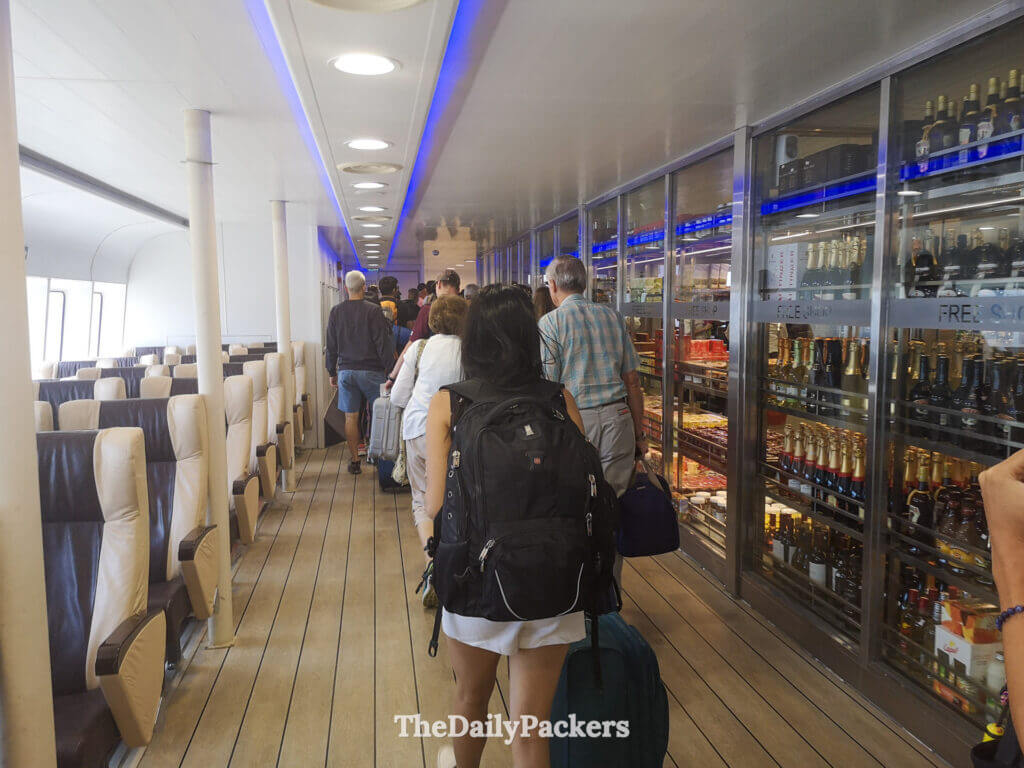
Once inside, seating was open, so we could sit wherever we wanted. The Colonia Express ferry had two decks — a lower indoor area and an upper deck with both seating and an outdoor space. We chose the lower deck for comfort, but it was nice to be able to walk outside for some fresh air and enjoy the views of the Río de la Plata.

The ride itself was smooth and comfortable, with plenty of legroom, air conditioning, and clean restrooms. Passengers were free to move around the boat during the trip, and the staff were friendly and helpful.
After about 1 hour and 20 minutes, we arrived at the Buenos Aires port around 11:50 AM, right on schedule.

Arriving at the Buenos Aires Ferry Terminal
Once we docked, disembarkation was quick and straightforward. We walked off the Colonia Express ferry and followed the crowd toward the Buenos Aires ferry terminal, where immigration officers briefly checked our entry stamps.

Just outside the terminal, we realized we needed Argentinian pesos, so we stepped back inside through a side door a few meters away. There’s an ATM in the terminal, but we preferred to exchange euros directly at a small shop inside, as it offered a better rate. If you need to do the same, just ask one of the shopkeepers — most of them will handle small exchanges.
From the terminal, you can either take a taxi or hop on a local bus to reach the city center. Since we were short on time and didn’t yet have a SUBE card (the public transport card used in Buenos Aires), we decided to take a taxi straight to our accommodation. It was the easiest option and a nice, smooth end to the journey from Uruguay.
Read: 32 best things to do in Buenos Aires, Argentina
Travel Tips for the Colonia to Buenos Aires Ferry
- Buy your ticket early if you’re traveling during the weekend or high season. You can get it online or directly at the Colonia ferry terminal. If possible, pay in Uruguayan pesos (UYU) — the rate is usually more stable than the Argentinian peso.
- Arrive at least one hour before departure to allow time for check-in and immigration. Both Uruguayan and Argentinian border controls are done before boarding, which makes arrival in Buenos Aires faster.
- Bring snacks and water if you’re traveling on a budget. There’s a small café onboard, but prices are higher than in town.
- Exchange a small amount of cash before arrival in Buenos Aires — either in Colonia or at the ferry terminal — since ATMs in Argentina often charge high fees or run out of cash.
- If you’re continuing your trip in Argentina, consider buying a SUBE card once you arrive. It’s used for all public transport in Buenos Aires and can be topped up at kiosks or subway stations.















Hi, which ferry company did you use? Because when I check online now return tickets cost around 154,625.00 ARS it’s 4-5 times more than what you paid. Is it cheaper to get tickets in person?
Hi! We traveled with Colonia Express and bought our ticket directly at the port the day before, which allowed us to get the super economy fare.
We just checked their website and saw that tickets now cost around 1,900 UYU, which is still quite a bit lower than the price you mentioned, though higher than what we paid. We think the difference might come down to travel dates, available fare types, and inflation. The 1,900 UYU fare is listed as economy, while the super economy fare doesn’t seem to be available online.
Also, if you’re seeing prices in ARS, keep in mind that inflation and currency fluctuations in Argentina can make prices look a lot higher, especially when converting.
It’s definitely worth checking both the Uruguayan and Argentine versions of the site, or trying different currencies like UYU or USD, to see if you get a better deal.
We were super flexible and didn’t have a set plan, so we were okay with taking the ferry a day later (or more) if needed — that gave us the chance to buy our tickets directly at the port and grab the best fare (but that also will depend on the date, and seat availability). If you are not that flexible, we would recommend buying it online.
Hope that helps and safe travels! 😊