
Introduction
Lisbon is the capital of Portugal and its biggest city, home to about 505,000 people. Spread across 100 km², it’s a coastal city built on hills, with the Atlantic never far away.
It’s the kind of place that wins you over quickly — old streets covered in Azulejos tiles, churches and monuments at every turn, and the ruins of São Jorge Castle perched above the city. Add to that evenings in Bairro Alto, where music drifts out of bars and restaurants, and you’ve got the perfect mix of history and energy.
We spent a few days here and loved every moment. One of our favorite memories? A tiny local restaurant on our last night. No one spoke English, we barely managed to order, and the food ended up being one of the best meals of the trip.


Here are all your accommodation options in Lisbon
Getting there
Getting to Lisbon is easy, whether you’re flying in or already traveling around Portugal.
Most visitors arrive through Lisbon Airport (Humberto Delgado Airport), which is just 7 km from the city center. From the airport, you can hop on the metro (about 30 minutes to downtown), grab a taxi or ride-share, or take the Aerobus shuttle.
If you’re coming from elsewhere in Portugal or Spain, trains and long-distance buses are great options. The Santa Apolónia and Oriente stations connect Lisbon to cities like Porto, Faro, and Madrid.
Driving is possible too, but once you’re in the city, parking and narrow streets can be tricky—public transport is often the easier choice.

Moving Around
Getting around Lisbon is part of the fun and sometimes a little adventure on its own.
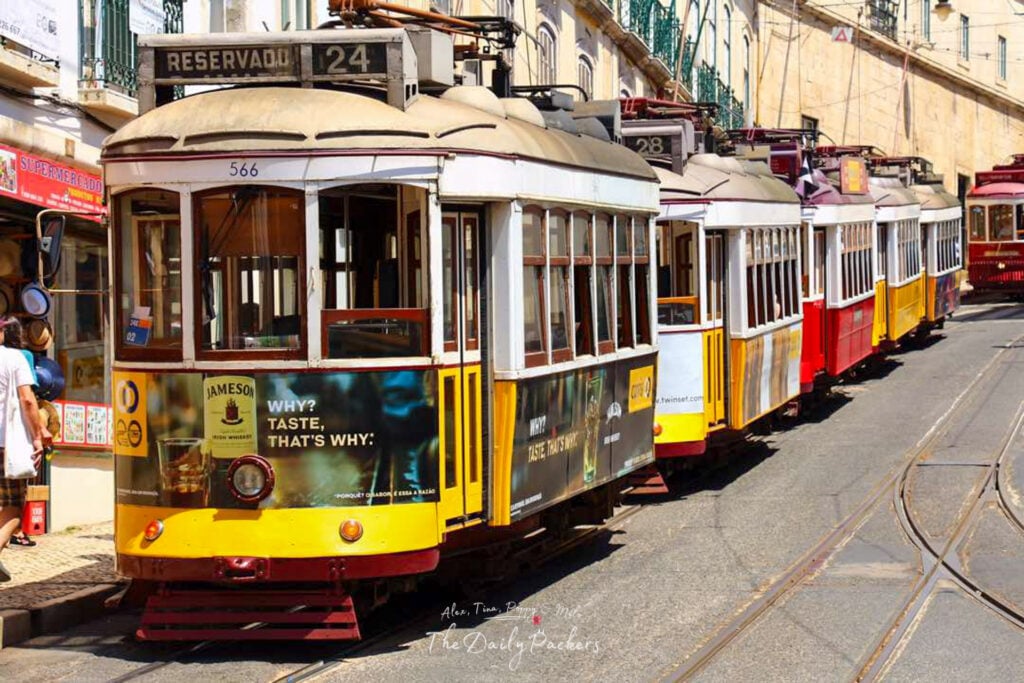
The city’s trams are iconic and still one of the best ways to get up and down the hills. The famous Tram 28 winds through the prettiest parts of town, but it’s also packed with tourists, so try catching it early or late in the day.
Lisbon’s metro is modern, fast, and easy to use, perfect for reaching neighborhoods further out like Parque das Nações or the airport. There are also plenty of buses and funiculars (like the Elevador da Glória) that save you from some of the steeper climbs.
We mostly walked when we could; it’s the best way to see the streets and tiles up close, but be ready for cobblestones and some serious uphill stretches.
When to Visit
Lisbon is one of those cities you can enjoy year-round, but each season has a different feel.
- Spring (March to May): Warm days (15–22 °C / 59–72 °F) and blooming jacaranda trees make spring one of the nicest times to visit. Crowds are lighter, and cafés spill out onto sunny sidewalks.
- Summer (June to August): Expect heat — 26–35 °C (78–95 °F) — and the busiest tourist season. It’s lively and fun, with festivals and long evenings, but also pricier and more crowded.
- Autumn (September to November): A sweet spot. The weather is still warm (18–28 °C / 64–82 °F), the light is golden, and there are fewer visitors.
- Winter (December to February): Mild but cooler (10–16 °C / 50–61 °F), with some rain. It’s the quietest time and perfect if you want to wander without crowds.


Where to Stay
We’d recommend giving yourself at least three or four nights in Lisbon — enough time to wander the old neighborhoods, hop on a tram, and take a few day trips without rushing. Here are a few great places to stay for different budgets:
(€) Chalet D´Ávila Guest House – A friendly, affordable guesthouse with comfortable rooms and a welcoming vibe. It’s simple but cozy, and the location makes it easy to get around.
(€€) Solar dos Poetas – Right on one of Lisbon’s pretty squares, this spot mixes charm and comfort. Rooms have a classic feel, and you’ll be steps from cafés and viewpoints.
(€€€) Torel Palace Lisbon – A splurge-worthy boutique hotel spread across historic mansions. It’s elegant, quiet, and offers incredible views over the city — the kind of place you stay if you want something really special.

Here are all your accommodation options in Lisbon
What to Eat
The food in Lisbon is one of the best parts of visiting, and there are a couple of dishes you really can’t leave without trying.
- Pastel de Nata – These famous egg tart pastries are everywhere in Lisbon, and for good reason. Flaky, creamy, and usually sprinkled with cinnamon, they’re the perfect excuse to stop at every café you see.
- Grilled Sardines – A Lisbon classic, especially in summer during the Santo António festival. You’ll see them grilling on street corners, and the smell alone will make you hungry.
There’s plenty more to taste — from bacalhau (salt cod cooked a dozen different ways) to hearty stews — but if you only try two things, make it these.


Tip: Try the Food and Wine Walking tour
Things to do in Lisbon
Get Lost in Alfama District
Alfama is Lisbon’s oldest neighborhood and feels like stepping back in time. It’s a tangle of narrow cobbled streets, tiny squares, and weathered houses with laundry hanging from the balconies. The district stretches from the São Jorge Castle down to the Tagus River, and wandering here is more about soaking in the atmosphere than checking off sights.

You’ll hear fado music drifting from tucked-away bars, find little cafés where time seems to stand still, and constantly stumble across unexpected views over the city. It’s the kind of place to just get lost — and enjoy it.

Ride the Iconic Tram 28
Tram 28 is Lisbon’s most famous tram ride, rattling its way through some of the city’s most beautiful districts — Graça, Alfama, Baixa, and Estrela. It’s a classic Lisbon experience, the kind you’ll see in every guidebook and postcard.

But here’s the thing: it’s always crowded. If you don’t feel like squeezing in with a hundred other tourists, hop on one of the other vintage tram lines instead. You’ll get the same charming wooden trams and winding streets — just without the crush of people.

Here are all your accommodation options in Lisbon
Explore St. George’s Castle (Castelo de S. Jorge)
Perched high above the city, St. George’s Castle is one of Lisbon’s most striking landmarks. The first fortifications were built here in the 1st century, and over the centuries the castle played a key role in Lisbon’s history — from the Moors to the Portuguese kings.

Today you can wander its ancient walls, climb the towers, and take in some of the best views over the city and the Tagus River. It’s a must-stop for the history and the panorama alike.

Stroll Through Praça do Comércio
Praça do Comércio is Lisbon’s grandest square, opening right onto the Tagus River. In the late 18th century, it reflected the wealth and ambitions of Portugal — a place where captains and merchants gathered to plan voyages and trade goods from across the world.
Today, it’s still one of the most striking spots in the city, surrounded by yellow arcaded buildings and buzzing with cafés. It’s the perfect place to pause, look out over the river, and imagine what it must have felt like when ships returned from distant lands.
Visit Lisbon Cathedral (Sé)
The Lisbon Cathedral, simply called the Sé, is the city’s oldest church and the seat of the Patriarchate of Lisbon. Dating back to the 12th century, it has survived earthquakes, restorations, and centuries of history.
Step inside and you’ll find a mix of architectural styles — Romanesque, Gothic, and baroque touches — showing how the cathedral has evolved over time. It’s one of those places that reminds you just how old Lisbon really is.

Here are all your accommodation options in Lisbon
Discover the Church of São Vicente of Fora
The Church of São Vicente of Fora is a 17th‑century church and monastery, and one of Portugal’s most important religious monuments. Dedicated to Lisbon’s patron saint, it’s an impressive mix of history and architecture, with white stone walls that stand out against the city’s hills.
Inside, you’ll find beautiful tile work, peaceful cloisters, and sweeping views from the rooftop — a spot that feels both grand and quiet at the same time.
Relax at Parque Eduardo VII
Parque Eduardo VII is Lisbon’s largest central park and the perfect spot to catch your breath after walking up the Avenida da Liberdade. Stretching across a hillside, it’s one of the city’s main green spaces, with long lawns, tree‑lined paths, and views that sweep all the way down to the Tagus River.

Our favorite thing to do in the park was to discover all the graffiti.

Walk Along Avenida da Liberdade
Often called the Champs‑Élysées of Lisbon, Avenida da Liberdade is one of the city’s most elegant streets — and one of the most expensive shopping avenues in Europe.
Lined with luxury boutiques, historic buildings, and shady trees, it’s a place to window shop, people‑watch, or just stroll the wide pedestrian path that runs right up the center of the avenue.

Explore the Aqueduto das Águas Livres
The Aqueduto das Águas Livres is an 18th‑century engineering marvel that once carried fresh water into Lisbon. The main section stretches an impressive 18 km, but the entire network of canals reaches almost 58 km across the region.
You can walk along parts of the aqueduct today, taking in its massive stone arches and incredible views — a reminder of just how much history runs through Lisbon’s streets.

Experience Bairro Alto
Bairro Alto is Lisbon’s bohemian heart — a maze of steep, cobbled streets, vintage funiculars, and centuries‑old houses splashed with street art. By day, it feels laid‑back and a bit sleepy, but when the sun goes down, the neighborhood transforms.

The streets fill with people, quirky bars open their doors, and the sound of fado music drifts from traditional restaurants. It’s one of those places where you can wander aimlessly, find a hidden café, and end up staying out far later than you planned.

Here are all your accommodation options in Lisbon
Ride the Old Funicular – Elevador da Bicaa
Lisbon’s hills are no joke, and that’s where the city’s old funiculars, or elevadores, come in. The most iconic is the Elevador da Bica, which has been running since 1892 and still climbs one of the steepest streets in the city.

The ride itself is short — just a few minutes — but it’s a fun glimpse of daily Lisbon life. As the little yellow car creaks up and down the hill, you pass balconies draped with laundry, walls covered in street art, and cafés that spill onto the sidewalks.
It’s both practical and charming, and honestly, half the joy is just standing at the bottom of the hill watching it slowly make its way up.
Take the Santa Justa Lift
The Santa Justa Lift is one of Lisbon’s quirkiest landmarks — and a very handy shortcut. Built in 1902, this neo‑Gothic iron elevator connects the lower streets of Baixa with the higher Largo do Carmo, saving you a steep climb.
The ride up is quick, but the real highlight is stepping out onto the viewing platform at the top. From there, you get sweeping views over the city’s rooftops, the Tagus River, and even the castle in the distance. It’s touristy, yes, but it’s also one of those classic Lisbon experiences you won’t forget.

Visit the Basílica da Estrela
The Basílica da Estrela — also known as the Estrela Basilica or the Royal Basilica and Convent of the Most Sacred Heart of Jesus — is one of Lisbon’s most beautiful churches. Built in the late 18th century, it combines Baroque and Neoclassical architecture, with an impressive white dome that can be seen from across the city.

Inside, you’ll find intricate marble work, stunning chapels, and a peaceful atmosphere that makes it worth stepping away from the busy streets outside.

See the Monumento aos Restauradores
The Monumento aos Restauradores stands proudly in Lisbon’s Restauradores Square, honoring Portugal’s victory in the Restoration War (1640–1668). This conflict ended decades of Spanish rule under the House of Habsburg and restored Portuguese independence under the House of Braganza.
The obelisk, built in 1886, is topped with statues and inscriptions marking key battles of the war. It’s more than just a monument — it’s a reminder of a turning point in Portugal’s history, and you’ll likely pass it while exploring central Lisbon.

Here are all your accommodation options in Lisbon
Visit Belém Tower
The Belém Tower, also called the Tower of Saint Vincent, is one of Lisbon’s most iconic landmarks. Built in the 16th century, this fortress once guarded the entrance to the city and served as the ceremonial gateway for ships heading out on Portugal’s great Age of Exploration.

Standing on the edge of the Tagus River, it’s easy to imagine the explorers who once departed from here. Today, you can climb its narrow staircases, explore the battlements, and take in views over the river and Lisbon’s waterfront.

Climb the Padrão dos Descobrimentos
The Padrão dos Descobrimentos is a striking monument on the Tagus River, built to honor Portugal’s great explorers of the Age of Discovery. From the outside, you’ll see 33 towering statues of sailors, monarchs, and visionaries carved into its prow-shaped structure — it’s impressive even if you just stop for a quick look.

But you can go further: take the elevator to the top for a panoramic view over Belém, the river, and the 25 de Abril Bridge. Down below, there’s a small museum that dives into Portugal’s maritime history, making the stop even more worthwhile.

Explore the Jerónimos Monastery
The Jerónimos Monastery, also known as the Hieronymites Monastery, is one of Lisbon’s greatest architectural treasures. Built in the early 16th century, it’s a masterpiece of the Manueline style — Portugal’s own take on late Gothic, with ornate carvings, nautical motifs, and intricate stonework everywhere you look.

Originally home to the Order of Saint Jerome, the monastery is now a UNESCO World Heritage site. You can wander through its stunning cloisters, step inside the grand church, and see why it’s one of the most visited landmarks in Portugal.

Visit the National Coach Museum
The National Coach Museum holds one of the finest collections of historical carriages in the world — and it’s easy to see why it’s one of Lisbon’s most visited museums.
Inside, you’ll find beautifully preserved coaches from the 16th to the 19th centuries, many of them used by royalty, popes, and nobility. The detailing is incredible — gold leaf, painted panels, and intricate carvings turn these carriages into rolling works of art. It’s a unique stop that offers a glimpse into a very different era of travel.

Lisbon Itinerary
Day 1:
- Wander the Alfama district and get lost in its narrow streets
- Hop on the Old Tram 28 for the classic Lisbon ride
- Explore St George’s Castle (Castelo de S. Jorge) for the views
- Stroll through Praça do Comércio by the river
- Step into the Lisbon Cathedral (Sé)
- Visit the Church of São Vicente of Fora
- Experience the lively Bairro Alto
- Ride the Elevador da Bica funicular
- End the day at the Santa Justa Lift for a sunset view
You could also split this day in two and take your time 😊
Day 2
- Start at the Monumento aos Restauradores
- Walk through Parque Eduardo VII
- Stroll the length of Avenida da Liberdade
- See the Aqueduto das Águas Livres
- Finish with the beautiful Basílica da Estrela
Day 3:
- Visit the iconic Belém Tower
- Climb the Padrão dos Descobrimentos for its views
- Explore the stunning Jerónimos Monastery
- Wrap up at the National Coach Museum
Here are all your accommodation options in Lisbon
About the authors
We are Alex and Tina, a French-Serbian couple who met in China back in 2014. We spent three incredible years there before making France our home. Our shared passion for travel has been the heartbeat of our relationship for over 12 years, taking us across 44 countries and counting.
We launched TheDailyPackers in 2019 as a way to document our adventures. In 2026, we reached a major milestone by officially turning our blog into our full-time job. While we are still growing toward financial independence through this platform, every article we write is fueled by our mission to make your voyages easier through in-depth guides, honest advice, and the lessons we’ve learned from our own mistakes.
Our journey has not been without its storms. In 2023, our world changed forever when our first son, Poppy, was stillborn on November 25th. It was, and remains, the hardest chapter of our lives. In 2025, we were blessed with our second little boy, Milo. He has since joined our traveling tribe, and you’ll be seeing him—and the reality of traveling with a little one-on the blog more and more.
We hope to inspire you to explore the world with curiosity and resilience. Thank you for being part of our story.
You may also like those related posts
Lavezzi islands: Corsica’s best secluded island in 2025
How to Spend 1 Perfect Day in Cacheuta and Potrerillos
French Riviera: How to See the Best in Just 1 Week
15 Best things to do in Hue, Vietnam, in 2 days or more
The perfect Indonesia Itinerary: 2 & 3 Weeks for first timers
Hoi An Tailor Guide: Our Experience at Blue Eye
7 Proven Tips to travel blog at home
12 Best things to do in Ischgl, Austria in winter
Pssst, did you know that…
If you purchase something through our links, we earn a small fee. However, you still pay the same. Win-win! And one day we may get to be full-time travel bloggers =)
Find Hotels with Booking.com
Do Yoga with KVY
Buy us a Coffee
Rent a car with DiscoverCars
Find Attractions with GetYourGuide
Find Flights with Expedia
Buy an eSIM with Airalo
Get insured with World Nomads
Get ready with Amazon.com