

Introduction
Machu Picchu is one of those places you don’t just visit — you prepare for it, dream about it, and remember it long after you leave South America. Sitting high in the Andes, hidden between steep green mountains, this ancient Inca city is one of the most iconic sights in Peru and a highlight of many trips through the continent.
If you’re planning a trip to Machu Picchu, chances are it will be the emotional peak of your journey. It was certainly one of the highlights of our three-week adventure in South America, right alongside the Uyuni salt flats. After Cusco and before heading south toward Arequipa, this stop felt unreal — almost like stepping into a postcard.
Today, visiting Machu Picchu requires a bit more planning than it used to. Entry is regulated, circuits are fixed, and tickets sell out quickly. Between choosing the right Machu Picchu circuits, deciding whether to climb Machu Picchu or Huayna Picchu, and figuring out transport from Cusco, it can feel overwhelming at first.
That’s exactly why this guide exists. Here, you’ll find everything you need to know to plan your visit properly: how to get there, when to go, how to visit, which Machu Picchu tours make sense, and whether it’s really worth the effort (spoiler: it is).


Why Visit Machu Picchu?
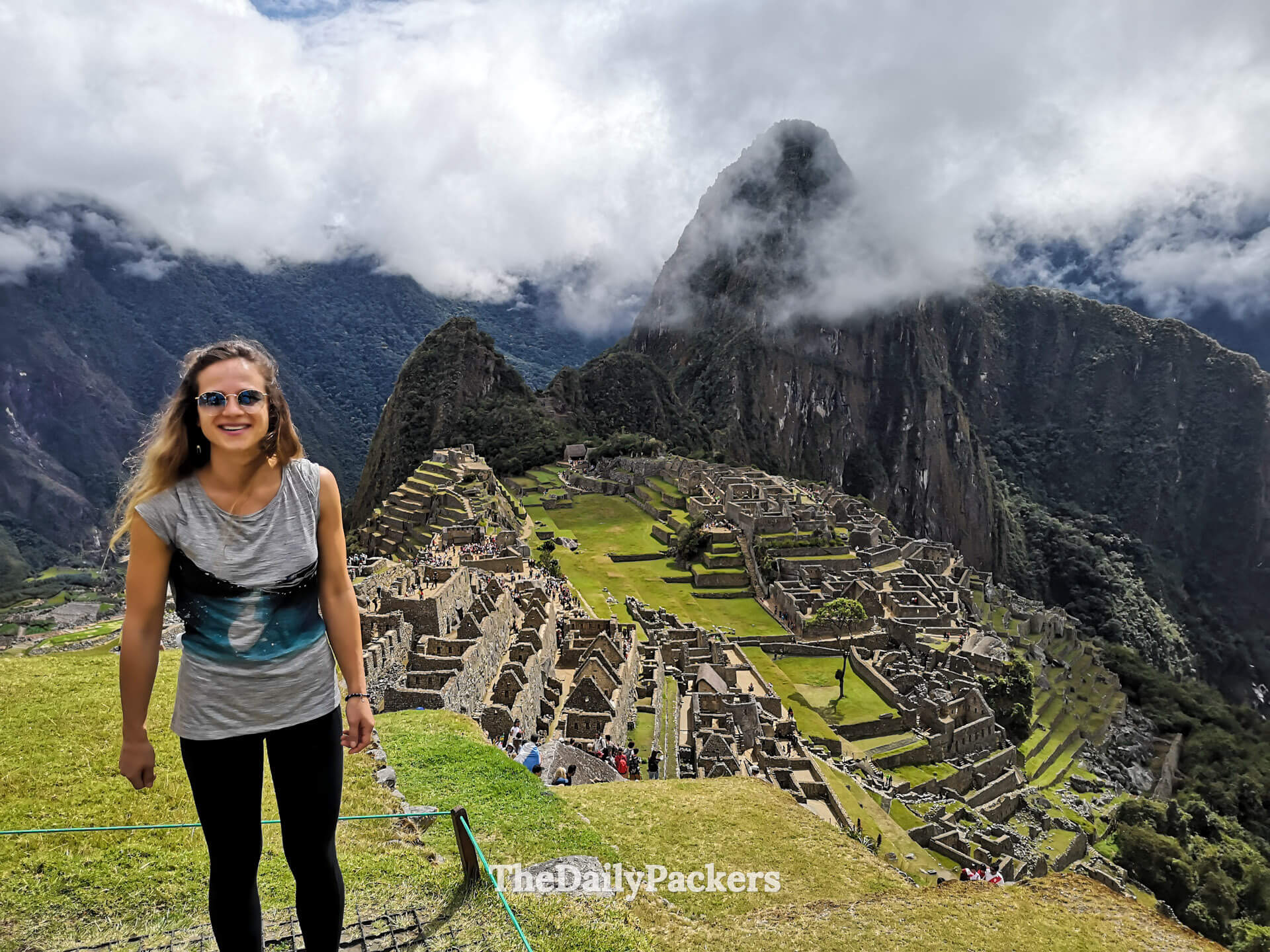
Machu Picchu is not just another archaeological site — it’s one of those rare places that lives up to every expectation. Long before you arrive, you’ve probably seen the photos: the stone terraces, the mist rolling through the mountains, the dramatic setting above the Urubamba River. But being there in person is something else entirely.
What makes Machu Picchu so special is its location. The city was built at nearly 2,430 meters above sea level, balanced on a mountain ridge and surrounded by jungle-covered peaks. Even today, it’s hard to understand how the Incas managed to build something so precise, durable, and perfectly integrated into the landscape without modern tools. Walking through the site, you quickly realize that nothing here was placed randomly.

Beyond the scenery, Machu Picchu is also a place full of unanswered questions. Was it a royal estate? A religious sanctuary? A seasonal retreat for the elite? Historians still debate its true purpose, and that mystery is part of what makes the visit so powerful. You’re not just looking at ruins — you’re walking through a story that was never fully written down.
If you enjoy history, nature, and places that make you stop and think, Machu Picchu delivers on all fronts. Add to that the possibility to climb Machu Picchu Mountain or Huayna Picchu, explore different Machu Picchu circuits, or even arrive via one of the classic treks, and it becomes much more than a quick stop.
Simply put, if there’s one place in Peru that deserves careful planning and a bit of effort, it’s Machu Picchu.


How to Get to Machu Picchu
Getting to Machu Picchu is part of the adventure, and there are a few different ways to do it depending on your time, budget, and travel style. No matter which option you choose, the journey almost always starts in Cusco.
The most common route is to travel through the Sacred Valley from Cusco to Ollantaytambo, then take a train to Aguas Calientes, the small town at the base of Machu Picchu. From Cusco, you can reach Ollantaytambo by taxi, shared van, or tour transfer. The drive takes around 1.5 to 2 hours and passes through the Sacred Valley, which already feels like a warm-up for what’s coming.
From Ollantaytambo, trains run regularly to Aguas Calientes and take about 1.5 hours. Companies like Inca Rail and PeruRail operate the route, offering different comfort levels. Booking train tickets in advance is essential, especially in high season, as seats sell out quickly.
Once you arrive in Aguas Calientes, you’re just below Machu Picchu. From there, you can either take the shuttle bus up to the entrance or hike all the way up if you’re feeling motivated. Most people opt for the bus, especially for early morning entry times.

Another way to reach Machu Picchu is by trekking. Routes like the Inca Trail, Salkantay Trek, or Lares Trek allow you to arrive on foot after several days in the Andes. These treks must be booked well in advance and are often included as part of guided Machu Picchu tours.
If you’re short on time, a trip from Cusco to Machu Picchu is the most efficient option. If you enjoy hiking and want a deeper connection with the landscape, a trek can turn the journey itself into one of the highlights of your trip.

When to Visit Machu Picchu
Machu Picchu can be visited all year round, but the experience changes a lot depending on the season. Weather, crowds, and visibility all play a role, so choosing the right time can make a real difference in how you experience the site and which Machu Picchu circuits you’re able to enjoy comfortably.
- Dry season – May to September: This is the most popular time to visit Machu Picchu. Days are generally dry and sunny, with clearer views over the ruins and surrounding mountains. Daytime temperatures usually range between 18–22°C (64–72°F), while mornings can be cold, especially early on. June, July, and August are peak months, meaning more visitors and higher prices, but also the best chances for clear skies.
- Shoulder seasons – April and October: These months are often considered the sweet spot. You still get decent weather, fewer crowds, and greener landscapes than in the heart of the dry season. Temperatures are similar to the dry months, around 17–21°C (63–70°F), and rain is usually light and short. This is a great time if you want to enjoy Machu Picchu without feeling rushed or overwhelmed by crowds.
- Rainy season – November to March: Rain becomes more frequent, especially in January and February. Days are warmer, with temperatures around 20–24°C (68–75°F), and the surrounding mountains turn lush and green. Clouds and mist are common, which can add a dramatic atmosphere but may limit visibility. February is also when parts of the Inca Trail close for maintenance.
Tip: If you want a balance between good weather and manageable crowds, aim for April, May, September, or October. You’ll still need to book tickets in advance, but the overall experience tends to be calmer and more enjoyable.

Best hours to visit Machu Picchu: The site opens at 6:00 am, and early entry is generally considered the best option. You avoid the biggest crowds, temperatures are cooler, and there’s a real sense of anticipation as the gates open. That said, early mornings often come with fog, especially in the dry season (June–August). If you’re lucky, the clouds lift dramatically mid-morning, which is exactly what happened to us.
If you prefer clearer views right away and don’t mind more people, late morning (around 9:00–10:00 am) can also be a good compromise. Midday tends to be the busiest.


How to Visit Machu Picchu
Reaching the entrance
Visiting Machu Picchu today is more structured than it used to be, and knowing how it works in advance will save you a lot of stress. Entry to the site is strictly regulated, and you must choose a specific circuit and time slot when booking your ticket.
Your day usually starts early in Aguas Calientes. From there, you can either hike up to the entrance or take the shuttle bus. Most visitors choose the bus, especially if they have an early entry time or plan to climb Machu Picchu or Huayna Picchu later in the day. Buses run continuously from early morning, and the ride takes about 25 minutes.
The bus station is easy to find, located near the river on Avenida Hermanos Ayar, just a few minutes’ walk from most hotels. If you’ve already bought your bus ticket the day before (highly recommended), you just line up and wait for the next shuttle.
We woke up at 4:30 am, grabbed a quick breakfast, and walked to the bus stop around 5:20 am. Even at that hour, there was already a long line—but buses run constantly, so things move faster than you might expect. We reached the Machu Picchu entrance just before 6:00 am, right as the site was opening.


Tip: We use the DJI Action 4 to film our vlogs — compact, durable, and perfect for capturing every adventure.
First entry into Machu Picchu
Once at the entrance, access to Machu Picchu follows a one-way system. You can’t freely wander or backtrack, which is why choosing the right circuit matters. Each circuit focuses on different parts of the site: panoramic viewpoints, the classic postcard angles, or the lower and more intimate sections of the ruins. Some circuits also include access to additional hikes like Huayna Picchu, Machu Picchu Mountain, or the Inca Bridge.
You can visit Machu Picchu either with a guide or on your own. Hiring a guide at the entrance is possible and useful if you want historical context and explanations, especially if you haven’t read much beforehand. If you prefer visiting independently, bring a good map and take your time reading the information panels along the route.

Once inside, you follow your assigned circuit, and there’s no turning back. This is important to understand: Machu Picchu is strictly one-way. If you want explanations and context, you can hire a guide directly at the entrance. That’s what we did.
As you walk through the site, you’ll see agricultural terraces (which also function as an advanced drainage system), temples, ceremonial spaces, royal residences, and open plazas. You’ll likely spot llamas and alpacas, and if you’re lucky, even a viscacha (a long-tailed Andean rodent).
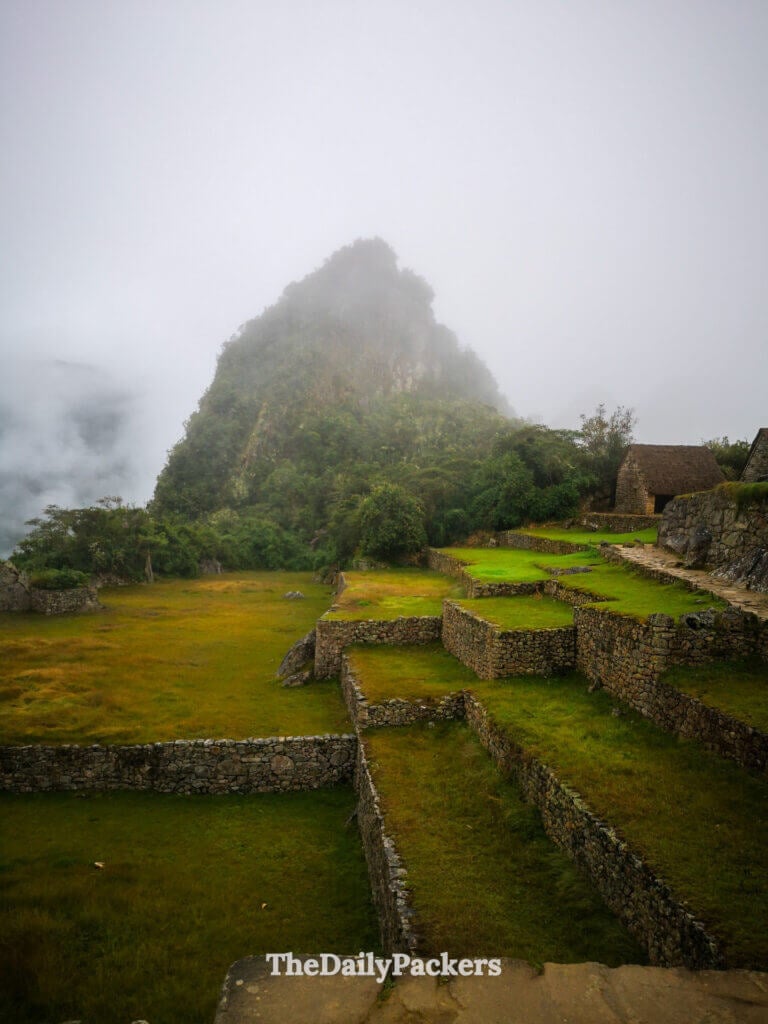
Weather can change quickly. Our morning started misty, turned into heavy rain, and then suddenly cleared later in the day. Pack accordingly.


Here are all your accommodation options in Aguas Calientes
Hiking Huayna Picchu
If your ticket includes one of the mountain hikes, you’ll enter Machu Picchu first, follow your assigned circuit, and then branch off toward the mountain at the designated checkpoint. Timing is important here, as entry windows for the hikes are strictly controlled.

After completing part of your main circuit with your guide, you’re directed to the Huayna Picchu checkpoint. Entry is strictly controlled by time slot, and once you pass that gate, you’re on your own for the hike.
Huayna Picchu rises steeply behind Machu Picchu and reaches 2,639 m, about 260 m higher than the citadel. The hike takes 45 minutes to 1 hour up, depending on your pace and how well you’re handling the altitude. The trail is narrow, steep, and can be slippery, especially after rain, but it’s manageable if you take your time.

At the top, views depend entirely on the weather. We waited nearly 45 minutes at the summit before the clouds briefly opened, revealing Machu Picchu below—only for it to disappear again moments later. Frustrating, yes, but also unforgettable.
The standard hike is about 2 hours round trip. If you have more time and the right ticket, you can continue toward the Great Cave, turning it into a much longer and more demanding hike.

Second entry and viewpoints
One of the advantages of the Huayna Picchu ticket is that it allows a second entry into Machu Picchu. After descending, you exit the site, get your Machu Picchu stamp if you want it, and re-enter to explore viewpoints like the Guard House, where the classic postcard photos are taken.

From here, you can also access additional routes if included on your ticket:
- Inti Punku (Sun Gate): a moderate hike, 3–4 hours round trip
- Inca Bridge: an easy walk, about 1–1.5 hours round trip
We didn’t have time for these, as we needed to catch our train, but they’re great options if your schedule allows.

Returning to Aguas Calientes
Leaving Machu Picchu is straightforward—just follow the path out and queue for the bus back to town. We caught a bus around 12:00 pm and were back in Aguas Calientes shortly after. Lines can sometimes take 30–45 minutes, depending on how many people are leaving at the same time.
From there, most people grab lunch, collect their bags, and head to the train station for the return journey to Ollantaytambo or Cusco.

Depending on your circuit and whether you climb one of the mountains, you’ll spend between 3 and 6 hours inside the site. After finishing your route, you exit Machu Picchu and return to Aguas Calientes the same way you came, usually by bus.

Tip: Don’t try to see everything in one go. Pick a circuit that matches your energy level and interests, and enjoy the experience rather than rushing through it.
Tickets & Opening Hours
Visiting Machu Picchu is no longer something you can do spontaneously. Tickets are limited, circuit-based, and time-specific, so booking ahead is essential—especially if you want to hike one of the mountains.
Opening hours: Machu Picchu is open daily from 6:00 am to 5:30 pm, with entry slots every hour starting at 6:00 am. Your ticket gives you a fixed entry time, and once you enter, you must follow your assigned circuit without turning back.
Most visits last 3 to 4 hours, and up to 6 hours if you include a mountain hike like Huayna Picchu or Machu Picchu Mountain.

Machu Picchu circuits (important): When buying your ticket, you must choose a specific circuit. You cannot switch circuits once inside.
- Circuit 1 – Panoramic routes: Best for viewpoints and classic photos from above. Some options include Machu Picchu Mountain, Intipunku (Sun Gate), or the Inca Bridge (seasonal).
- Circuit 2 – Classic Machu Picchu: This is the most complete and popular option. It takes you through the main urban area, temples, terraces, and iconic viewpoints. If it’s your first visit and you don’t plan a mountain hike, this is usually the best choice.
- Circuit 3 – Royal Machu Picchu: Includes access to Huayna Picchu, Huchuy Picchu, or the Great Cave (seasonal). These routes focus more on the lower part of the site and royal sectors.

Huayna Picchu & Machu Picchu Mountain. Mountain hikes require separate tickets and sell out fast.
- Huayna Picchu: Only 400 visitors per day, split into two entry windows (morning slots). It’s steep, narrow, and rewarding, but not for those afraid of heights.
- Machu Picchu Mountain: Longer and less crowded than Huayna Picchu, with wide paths and sweeping views. A good alternative if Huayna Picchu is sold out.
If hiking is important to you, book at least 2–3 months in advance, especially in high season.
Where to buy tickets
- Official government website (best option if you speak Spanish)
- Authorized agencies and tour operators
- Machu Picchu tours that include transport and entry (more expensive but simpler)
Tickets are non-refundable and non-transferable, and your passport name must match exactly.

Is It Worth It?
Absolutely. Even with the crowds, the early wake-up call, the strict circuits, and the planning required, a trip to Machu Picchu is still one of those once-in-a-lifetime experiences that truly lives up to the hype.
Seeing Machu Picchu in person feels very different from seeing it in photos. The scale of the site, the way it’s tucked between steep green peaks, and the sheer precision of the stonework make it hard to fully grasp how the Incas built this place in such a remote location. Walking through the terraces, temples, and ancient paths, you quickly realize this wasn’t just a city—it was a carefully planned spiritual, political, and agricultural center.

If you’re willing to wake up early and accept a bit of rain or fog (which can actually add to the atmosphere), the reward is huge. Even on a cloudy morning like ours, when the ruins slowly appeared through the mist, the moment felt surreal. When the clouds finally lifted later in the day, the view was everything you imagine Machu Picchu to be.
That said, it’s not a budget-friendly stop, and it does require effort. Between trains, buses, entrance tickets, and possibly a guide, costs add up quickly. But if you’re already in Peru—and especially if you’re following a Cusco itinerary—it would honestly feel incomplete to skip it.
If you’re short on time or don’t want to deal with logistics, doing a guided Machu Picchu tour is a solid option. But if you enjoy planning and want flexibility, organizing the trip yourself gives you more control over circuits, entry times, and hikes.
In short: yes, it’s worth it. Machu Picchu isn’t just another famous attraction—it’s a place that stays with you long after you leave.

Here are all your accommodation options in Aguas Calientes
Travel Tips for Visiting Machu Picchu
Planning ahead makes all the difference when it comes to Machu Picchu. This isn’t a place you can fully improvise, and a few smart choices will save you time, stress, and money.
First, book everything as early as possible. Machu Picchu tickets, especially those that include Huayna Picchu or specific Machu Picchu circuits, sell out weeks or even months in advance during high season. The same goes for trains to Aguas Calientes. If your dates are fixed, lock these in early and build the rest of your Cusco itinerary around them.
Try to enter the site early in the morning, ideally with the first slots between 6:00 and 7:00 am. Early hours mean fewer people, softer light for photos, and a higher chance of seeing the ruins wrapped in mist, which honestly adds to the magic. Midday is usually the busiest and can feel rushed, especially on the classic circuits.
If you plan to climb Huayna Picchu, know that it’s short but steep. Wear proper shoes with good grip, especially if it has rained. The path can be slippery, and some sections are narrow with exposure. Take your time, bring water, and don’t underestimate the altitude. Even if you feel fine in Cusco, the climb can still take your breath away.
Pack light but smart. You’re only allowed a small daypack inside the site. Bring water, sunscreen, a rain jacket, and snacks. Weather changes fast, even in the dry season. We experienced heavy rain followed by bright sun within the same morning.

Cash is useful in Aguas Calientes, especially for buses, snacks, or small restaurants. Credit cards aren’t accepted everywhere, and ATMs can be unreliable or crowded.
Be aware of one-way circuits inside Machu Picchu. Once you move forward, you usually can’t go back. If you have a ticket that allows a second entry (like with Huayna Picchu), use it wisely to revisit viewpoints or areas you might have rushed through earlier.
Lastly, Sundays are free for Peruvian residents, which means noticeably bigger crowds. If you can be flexible, avoid visiting on a Sunday to enjoy a calmer experience.
Machu Picchu rewards patience and preparation. With a bit of planning, you’ll be able to focus on what really matters—being present in one of the most extraordinary places in South America.

Where to Stay Near Machu Picchu
When planning your trip to Machu Picchu, you’ll almost certainly spend at least one night in Aguas Calientes (also called Machu Picchu Pueblo). Staying here allows you to catch the early buses up to the site and avoid a very rushed day coming from Cusco.
Aguas Calientes is small, busy, and very touristy, but it does the job for one night. Hotels range from simple guesthouses to comfortable boutique stays, often with river or mountain views. Here are a few solid options depending on your budget and travel style:
Inti Pacha Palace Machupicchu: A comfortable mid-range hotel close to the bus station and train tracks. Rooms are spacious, clean, and quiet considering the location. It’s a good balance between comfort and price, especially if you want to be near everything without overpaying.
Hatun Inti Boutique: One of the better boutique-style hotels in town, offering larger rooms, modern design, and great views of the river. Breakfast is usually included, which is helpful if you’re heading out very early in the morning.
Casa del Sol Machupicchu: A more upscale option with spa facilities and a riverside setting. Ideal if you want to treat yourself after long days in Cusco, the Sacred Valley, and Machu Picchu. It’s more expensive, but the comfort level is noticeably higher.

If you prefer to avoid staying in Aguas Calientes, another option is to stay in Ollantaytambo and take one of the earliest trains in the morning. This works best if you’re not planning to hike Huayna Picchu and don’t mind a very early start. Or even to take a tour from Cusco to avoid changing accommodations altogether.
Wherever you stay, choose a place close to the bus stop or train station. Aguas Calientes is compact, but saving even 10 minutes in the early morning makes the experience smoother and less stressful.
One night is usually enough. Machu Picchu is the highlight here — the town itself is simply the gateway.

Here are all your accommodation options in Aguas Calientes
About the authors
We are Alex and Tina, a French-Serbian couple who met in China back in 2014. We spent three incredible years there before making France our home. Our shared passion for travel has been the heartbeat of our relationship for over 12 years, taking us across 44 countries and counting.
We launched TheDailyPackers in 2019 as a way to document our adventures. In 2026, we reached a major milestone by officially turning our blog into our full-time job. While we are still growing toward financial independence through this platform, every article we write is fueled by our mission to make your voyages easier through in-depth guides, honest advice, and the lessons we’ve learned from our own mistakes.
Our journey has not been without its storms. In 2023, our world changed forever when our first son, Poppy, was stillborn on November 25th. It was, and remains, the hardest chapter of our lives. In 2025, we were blessed with our second little boy, Milo. He has since joined our traveling tribe, and you’ll be seeing him—and the reality of traveling with a little one-on the blog more and more.
We hope to inspire you to explore the world with curiosity and resilience. Thank you for being part of our story.
You may also like those related posts
Te Ara o Te Ao Trail: Hike to Rano Kau and Orongo, Easter Island
7 Best things to do in Quimper, France, in 1 day or more
Southern Thailand: The Perfect 2-week Itinerary
7 best things to do in Hvar, Croatia, in 1 day
18 best things to do in Shanghai, China, in 6 days
How to get from Puerto Natales to Ushuaia by bus
Hanoi to SaPa: Luxury Van Transfer in 6h
3 Best Places to Visit in April
Pssst, did you know that…
If you purchase something through our links, we earn a small fee. However, you still pay the same. Win-win! And one day we may get to be full-time travel bloggers =)
Find Hotels with Booking.com
Do Yoga with KVY
Buy us a Coffee
Rent a car with DiscoverCars
Find Attractions with GetYourGuide
Find Flights with Expedia
Buy an eSIM with Airalo
Get insured with World Nomads
Get ready with Amazon.com