

Introduction
We’re back from an unforgettable trip to the Maldives—and after soaking up the sun, snorkeling with nurse sharks, and exploring two beautiful islands, we’ve gathered all the essential Maldives travel tips you need to know before your adventure.
In this article, we’re sharing 12 practical tips based on our 6-day experience in the Maldives. From understanding the difference between public and private islands, to tips on transportation, food, religion, and even where you can wear a bikini—we’ve got you covered.
Here’s a sneak peek at what we’ll be diving into with our Maldives travel tips:
- Maldives travel tips 1: Atoll and Island
- Maldives travel tips 2: Private and public islands
- Maldives travel tips 3: Weather
- Maldives travel tips 4: Visa
- Maldives travel tips 5: Drone and recording
- Maldives travel tips 6: Currency (USD, MVR), ATM, money exchange
- Maldives travel tips 7: Religion and Bikini beach, Cats
- Maldives travel tips 8: Foot washing
- Maldives travel tips 9: Transportation
- Maldives travel tips 10: Cost
- Maldives travel tips 11: Food (Vegetarian/vegan options) & Supermarkets
- Maldives travel tips 12: The essentials (sun cream, mosquitoes’ repellant, snorkeling…)
- Maldives travel tips 13: Drink and Fruits
Whether you’re planning a budget-friendly island escape or simply wondering how to dress and pay in the Maldives, these are all the Maldives travel tips we wish we had known beforehand—and now we’re passing them on to you!

Read: The perfect 6-day Maldives Itinerary on a budget
Maldives Travel Tips
Maldives tips: Atoll and island
When traveling to the Maldives, it’s important to know that this isn’t your typical destination. The Maldives is a stunning archipelago made up of 26 atolls, which are large ring-shaped formations of coral reefs and islands surrounding beautiful turquoise lagoons.
An atoll isn’t just one island—it’s a collection of coral islands and sandbanks that form a ring in the ocean, creating a unique and dramatic landscape. When you look at it on a map, each atoll appears as a cluster of islands floating in a lagoon.
In total, the Maldives is made up of 1,192 islands scattered across 26 atolls. And fun fact: the Maldives is the smallest country in Asia—but what it lacks in size, it more than makes up for in beauty!

Maldives tips: Private and public islands
In the Maldives, you’ll often hear about local islands and private islands—and it’s important to understand the difference.
Local islands are public islands managed directly by the government. These are the places where Maldivian communities live, and where travelers are free to visit without restrictions. For our Maldives trip, we chose to explore these islands, which offer a more authentic and budget-friendly experience. There are currently 187 inhabited local islands across the Maldives.
Private islands, on the other hand, are home to luxury resorts. Access to these islands is restricted—you can only go there if you are a guest of the resort or join a specific day tour organized by them.
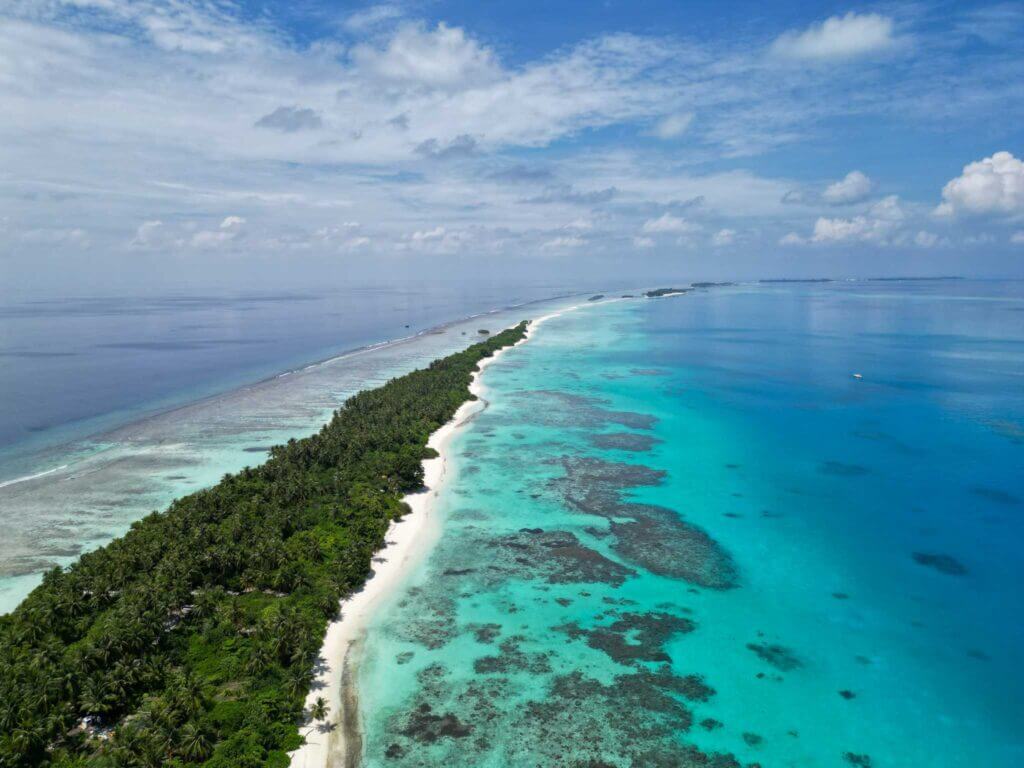
For example, we stayed on Dhigurah, a beautiful local island. At the tip of Dhigurah, a sandbank stretches out toward a nearby private island where the LUX Resort* is located. While we were allowed to walk along the sandbank, entering the LUX* island itself was not permitted unless we were staying at the resort.
Maldives tips: Weather
The Maldives is a year-round destination, with hot and sunny conditions throughout the year. Temperatures remain reasonably consistent, with highs ranging between 28°C and 32°C and lows rarely dropping beneath 24°C.
There are two seasons in the Maldives:
- November to April, the Dry season: It is the peak season, and most resorts runs from January to April which is also the driest time of year. The conditions are optimum for a dreamy Maldives holiday.
- May to October: the Wet season: During this time, there is a higher risk of rain, however heavy rain tends to be short. With the peak rainfall being typically in June
Therefor it is mostly recommended to travel to the Maldives between January and April. We travelled to the Maldives end of March and we had mostly a great weather. We only got one cloudy day and some rainfall either in early morning or at night.

Maldives tips: Visa
The Maldives is a year-round destination, blessed with hot and sunny weather throughout the year. Temperatures remain fairly consistent, with highs between 28°C and 32°C, and lows rarely dropping below 24°C.
There are two main seasons to consider:
- Dry Season (November to April): This is the peak travel season, with most resorts running at full swing between January and April—the driest months of the year. Expect blue skies, calm seas, and perfect beach weather, making this the ideal time for that dreamy Maldives holiday.
- Wet Season (May to October): During this period, there’s a higher chance of rain, especially in June. However, rainfall usually comes in short bursts, and you’ll still enjoy plenty of sunshine in between.
For the best overall experience, it’s recommended to plan your Maldives trip between January and April. We visited at the end of March, and the weather was mostly perfect—sunny and warm, with just one cloudy day and a few brief showers in the early morning or late evening.

Maldives tips: Drone and recording
If, like us, you’re traveling with a drone, you might be wondering whether you can fly it freely in the Maldives. We entered the country via Dubai and had no issues during transit or at Malé Airport when it came to carrying our drone.
One of the first things we asked upon arrival was: Can we fly our drone here? We got a very clear yes, along with confirmation that there are currently no major restrictions on flying drones over public islands in the Maldives.
We used our DJI Mini 3 Pro on both Maafushi and Dhigurah, and even saw some locals flying their drones—especially when searching for whale sharks.
That said, some private islands and luxury resorts do enforce restrictions. In those cases, drone usage may be limited to designated areas or even prohibited entirely to protect guest privacy. If you’re staying at a private resort, it’s always best to ask in advance.


Tip: We never travel without our DJI Mini 3 PRO drone anymore — it’s totally worth having to capture places from a whole new perspective.
Maldives tips: Currency, ATM, money exchange
The currency used in the Maldives is the Maldivian Rufiyaa (MVR). When we visited, 1€ was worth around 16.5 Rufiyaa, and 1 USD around 15.45 Rufiyaa.
That said, USD is widely accepted across the country, especially in hotels, restaurants, tour agencies, and most tourist-related services. In fact, many prices are listed in USD rather than MVR. This is largely because taxes from hotels and tourism businesses are paid in USD directly to the Maldivian government.
Credit cards were our go-to payment method, and we used them almost everywhere without any issues. We only exchanged a small amount of euros to buy snacks at local supermarkets—where prices were shown in Rufiyaa—but even there, credit card payment was possible.
As for ATMs, both Dhigurah and Maafushi had one. However, the ATM on Dhigurah didn’t work for us or didn’t accept our cards. If you need to exchange cash, you can usually do it at a supermarket or a bank (if your island has one).
💡 Tip: It’s still a good idea to carry a bit of local currency for small purchases or emergencies, especially on less developed islands.


Don’t forget to book your accommodations in advance – the best places always fill up quickly.
Maldives tips: Religion and Bikini Beach, Cats
An important thing to know when traveling to the Maldives, especially on local and public islands, is that the official religion is Islam. This means there are cultural and dress codes to respect, particularly outside of tourist areas.
You’re not allowed to wear bikinis or go topless in public places, including local beaches and town areas. For example, even if you’re coming back from a snorkeling or boat tour where swimwear is allowed, you’ll need to cover up when stepping off the boat—especially at the harbor, which is always a non-bikini zone.
To make things clear, there are two types of beaches:
- Bikini beaches: clearly marked and designated for tourists.
- Non-bikini beaches: where modest clothing is required.
Thankfully, these areas are well signposted, so you’ll know where swimwear is permitted.
Because the Maldives is a Muslim country, you’ll also hear the call to prayer throughout the day. It’s part of the local culture and honestly, we didn’t find it disturbing at all.
Lastly, don’t be surprised to see lots of cats around! In Islam, cats are highly respected for their cleanliness and calm nature. They’re considered to carry baraka (blessing) and are even allowed in homes and mosques. We loved seeing them peacefully strolling around the islands.

Here are all your accommodation options in Dhigurah
Maldives tips: Foot washing
One of the little things we really loved about traveling in the Maldives? The foot-washing stations!
It might seem like a small detail, but it makes such a difference. With all the sand from the beaches, being able to wash your feet before entering your hotel or room is a game changer. Trust us—sand really does get everywhere.
On Dhigurah, we had a more traditional setup outside our guesthouse. At first, we actually thought it was a decorative basin… until we realized it was there to clean your feet the local way. It turned out to be both charming and super useful!
In Maafushi, where we stayed in a more modern hotel, it was a bit more straightforward—a water hose at the entrance, simple and effective.
Whichever way, it’s a thoughtful touch you’ll appreciate after a day on the beach.

Maldives tips: Transportation
The Maldives is made up of over a thousand islands spread across 26 atolls, so getting from one island to another is a part of the adventure. To give you a clear idea of your options, let’s take the journey from Malé to Dhigurah as an example:
Speedboat (Best for Budget & Convenience): This is the option we chose and the one we recommend for most travelers.
- Travel time: 2 to 3 hours
- Departure times: Daily at 11:00 AM and 4:30 PM from Malé; return boats leave Dhigurah at 6:30 AM and 1:30 PM
- Cost: $60 USD per person, one way
- Note: Timetables may change on Fridays, so always double-check with your accommodation.
Domestic Flight + Boat: If you want to save time and don’t mind the higher price tag:
- Flight: 20 minutes from Malé Airport to Maamigili Airport (via FlyMe)
- Boat: 15 minutes from Maamigili to Dhigurah
- Cost: $175 USD per person, one way
Seaplane + Boat: The most scenic—and most expensive—option:
- Seaplane: 30 minutes from Malé to a platform in the South Ari Atoll
- Boat: 10 minutes to Dhigurah
- Cost: $250 USD per person, one way
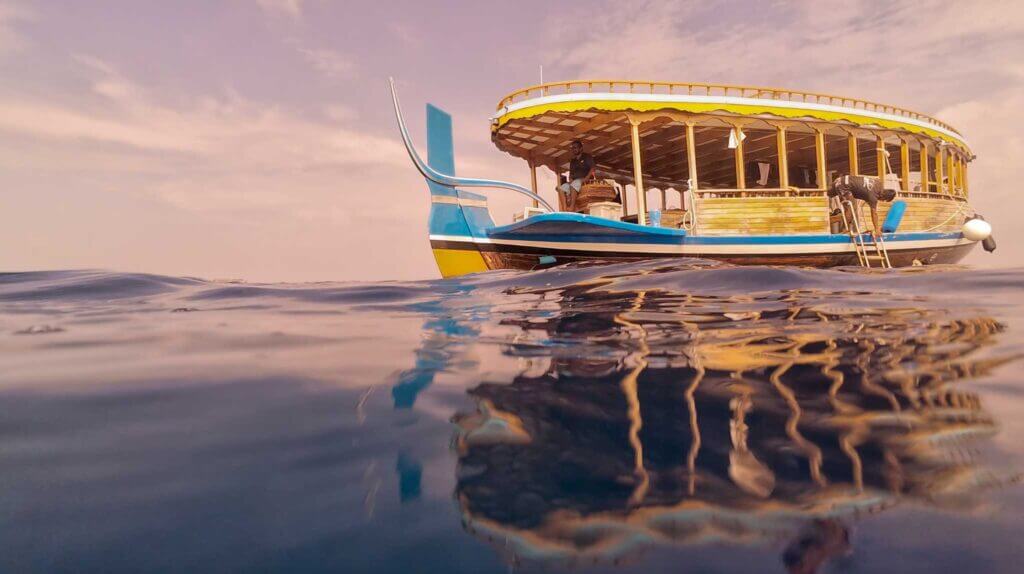
For us, the speedboat was the best value: comfortable, efficient, and with the bonus of dolphin spotting along the way.
Tip: We never travel without our DJI Mini 3 PRO drone anymore — it’s totally worth having to capture places from a whole new perspective.
Maldives tips: Cost
When people think of the Maldives, they often picture luxurious overwater villas on private islands. But that’s not the only way to experience this paradise. In fact, the Maldives also offers public islands, which are a lot more budget-friendly—and still absolutely stunning.
During our trip, we chose to visit two public islands: Maafushi and Dhigurah. These local islands allowed us to keep our total 6-day budget around $1,320 USD, which included accommodation, food, and excursions—roughly $264 USD per day for two people.
To give you some perspective, staying on a private island would have cost us around:
- $850 USD per night for half board
- $950 USD per night for full board
- $1,100 USD per night for all-inclusive
Of course, there are ways to reduce your expenses even further—but you’ll likely have to cut down on activities or compromise on comfort. For us, this balance of adventure, value, and authenticity made the public islands the best choice for a budget-friendly Maldives itinerary.

Read: Cost to Travel in the Maldives, Our 2024 Budget breakdown
Maldives tips: Food & Supermarkets
We mostly follow a plant-based diet, but when we travel, we tend to eat more vegetarian and stay open to new experiences.
During our time in the Maldives, especially on local islands, we never had any issues finding food options that suited us. While the country is known for its fresh fish and seafood, there are definitely alternatives if you’re looking for meat-free meals.
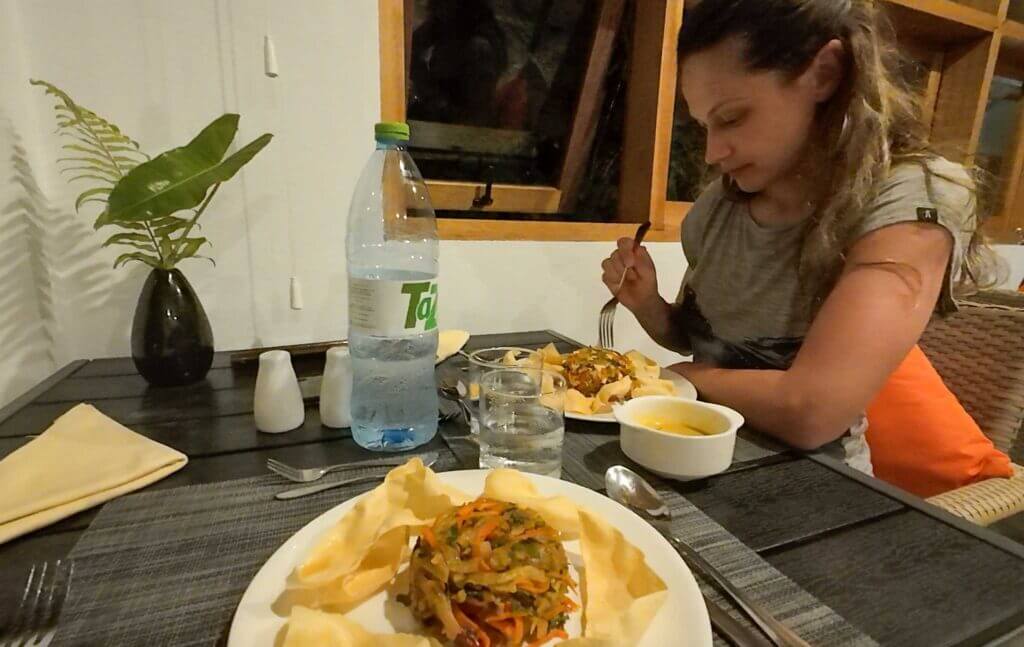
Vegetable noodles, vegetable curry, and vegetable kottu were some of our go-to dishes—they were tasty, filling, and widely available.
That said, we still recommend trying Mas Huni, a traditional Maldivian breakfast made with shredded smoked tuna and coconut. If you’re not eating fish, there’s often a vegan version made with pumpkin—and honestly, it was one of our favorite things we ate during the whole trip!
Maldives tips: The essentials
There are three essentials you’ll absolutely need in the Maldives:
- a high SPF sunscreen for both your body and face,
- an SPF lip balm to protect your lips from the strong tropical sun,
- and a good mosquito repellent.
Even though the Maldives feels like paradise, the sun is intense, and the UV rays can be harsh, especially when you’re spending long hours swimming or snorkeling. As for mosquitoes, they’re not a big issue everywhere, but on local islands like Dhigurah or Maafushi, they can definitely make an appearance—especially in the early morning and late evening. So, pack smart and stay protected!

Tip: We use the DJI Action 4 to film our vlogs — compact, durable, and perfect for capturing every adventure.
Maldives tips: Drink & Fruits
Another thing you absolutely must try while traveling in the Maldives is the fruit—they’re so fresh and delicious! Whether raw, in juices, or smoothies, tropical fruits here are bursting with flavor and the perfect way to cool down after a hot day under the sun.
Now, regarding alcohol: the Maldives is a Muslim country, so alcohol is strictly prohibited on public and local islands. You’ll only find alcoholic drinks available on resort islands and safari cruise boats. That said, many restaurants and supermarkets on local islands do offer alcohol-free beer, which can be a refreshing alternative.
And if you’re ever in need of a snack, don’t worry—local supermarkets have you covered with everything from packaged treats to fresh produce.

Here are all your accommodation options in Dhigurah
Maldives tips: Accommodation in The Maldives
Where to stay in Maafushi: Triton Prestige Seaview: If you’re looking for comfort, convenience, and a great location right by the beach, Triton Prestige Seaview & Spa is one of the best options in Maafushi. With spacious rooms, friendly staff, and easy access to tours and restaurants, it’s a solid choice for your stay on this lively island.
Where to stay in Dhigurah: Seaside Dhigurah: For a more peaceful and boutique experience, Seaside Dhigurah is a lovely hotel nestled near the beach and surrounded by tropical greenery. This place has a cozy vibe, free bikes, and a rooftop dining area that’s perfect for enjoying your evenings. It truly feels like a little slice of paradise.
Read: The perfect 6-day Maldives Itinerary on a budget
About the authors
We are Alex and Tina, a French-Serbian couple who met in China back in 2014. We spent three incredible years there before making France our home. Our shared passion for travel has been the heartbeat of our relationship for over 12 years, taking us across 44 countries and counting.
We launched TheDailyPackers in 2019 as a way to document our adventures. In 2026, we reached a major milestone by officially turning our blog into our full-time job. While we are still growing toward financial independence through this platform, every article we write is fueled by our mission to make your voyages easier through in-depth guides, honest advice, and the lessons we’ve learned from our own mistakes.
Our journey has not been without its storms. In 2023, our world changed forever when our first son, Poppy, was stillborn on November 25th. It was, and remains, the hardest chapter of our lives. In 2025, we were blessed with our second little boy, Milo. He has since joined our traveling tribe, and you’ll be seeing him—and the reality of traveling with a little one-on the blog more and more.
We hope to inspire you to explore the world with curiosity and resilience. Thank you for being part of our story.
You may also like those related posts
15 best things to do in Ljubljana, Slovenia, in 1 to 3 days
6 Best Places to Visit in September
11 Best things to do in Cap Corse, Corsica, France
Lorient La Base:The Complete Submarine Guide
Lake Lucerne Road Trip: The Ultimate 1-day Guide
27 Best Things to do on Easter Island, Chile, in 4 to 5 days
8 Best things to do in Koh Pha Ngan, Thailand, in 3 days
Lavezzi islands: Corsica’s best secluded island in 2025
Pssst, did you know that…
If you purchase something through our links, we earn a small fee. However, you still pay the same. Win-win! And one day we may get to be full-time travel bloggers =)
Find Hotels with Booking.com
Do Yoga with KVY
Buy us a Coffee
Rent a car with DiscoverCars
Find Attractions with GetYourGuide
Find Flights with Expedia
Buy an eSIM with Airalo
Get insured with World Nomads
Get ready with Amazon.com