
Introduction
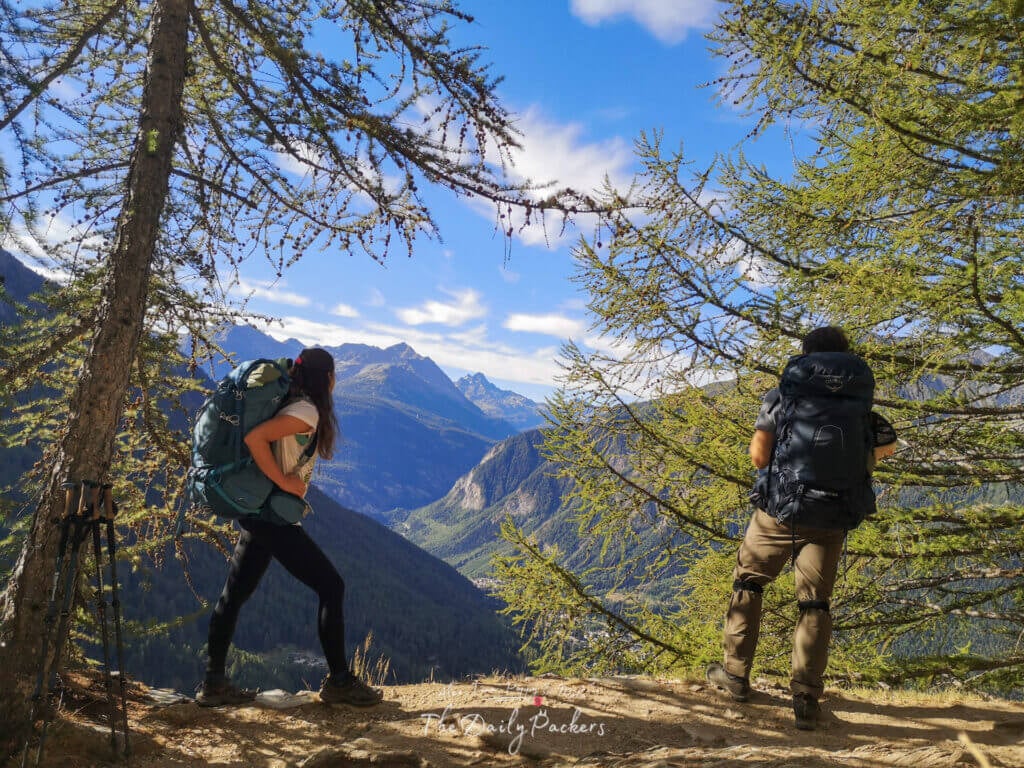
When it comes to long-distance hiking, pack weight can make or break your adventure. For us, the Tour du Mont Blanc (TMB) was the perfect lesson in that. We tackled the 11-day trail in sections because of knee issues and—let’s be honest—overloaded backpacks.
The first time, we brought way too much gear and “just-in-case” stuff. Once home, we weighed everything and realized our mistake. My backpack came in at 17.5 kg, and Tina’s was 13.9 kg—well above the recommended 13 kg limit for this kind of hike. Let’s just say it wasn’t exactly enjoyable.
The second time, we learned our lesson. We carefully reviewed every item, kept only the essentials, and dropped the weight to 12 kg for me and 9 kg for Tina. The difference was incredible — suddenly, hiking felt effortless again.
In this guide, we’ll show you exactly how to reduce the weight of your backpack and keep it light without sacrificing comfort or safety.
How to Reduce Your Backpack Weight for Hiking
Reduce Your Backpack Weight by Lightening Up Your Miscellaneous Gear
The first time I packed for the Tour du Mont Blanc, I completely overdid it with all the “just in case” items:
- iPhone charger
- Mobile Phone charger
- Micro-USB cable
- Sewing kit
- Tent & sleeping mattress repair kit
- Osprey 1 L pouch
- Glasses and case
- Wallets
- House & car keys
- Passport covers (for both of us)
- Two passports
All that tiny stuff added up to 0.853 kg — almost a full kilo of dead weight.
Here’s how I managed to cut it down to just 0.314 kg:
- Shared one phone charger with Tina
- Removed the Micro-USB cable and sewing kit
- Left the vision glasses at home
- Ditched the bulky wallet — just took a card and cash
- Removed the house keys (you don’t need them on the trail!)
- Swapped the heavy pouch for a simple plastic bag
- Removed the passport covers
By doing this, I dropped the weight to 0.314kg.
Tina’s pack was lighter to begin with — 0 kg the first time and 0.047 kg later (just one phone charger).
If you want to go even lighter: Skip the tent and sleeping-mat repair kit if you’re staying in refuges, and leave the Osprey 1 L pouch behind. That brings your total to about 0.27 kg — almost half a kilo saved just on small items.
Reduce Your Backpack Weight by Lightening Your Sleeping Gear
Sleeping gear is one of those categories where weight can add up fast — and it’s easy to overpack, especially for long treks like the Tour du Mont Blanc.
Here’s what I packed the first time:
- Sleeping bag (1°C) + compression bag + storage net
- Sleeping liner + case
- Head torch
- Microfiber towel + case
All together, that came to 1.518 kg. The only change I made the second time was skipping the storage net (which I had left inside the sleeping bag anyway). That small change brought it down to 1.468 kg.
Tina’s first setup:
- Sleeping bag (-5°C) + compression bag
- Sleeping liner + case
- Head torch
- Microfiber towel + case
Her sleeping setup weighed 1.804 kg, but she managed to drop it to 1.719 kg by removing her head torch — one between the two of us was plenty for a summer hike.
If you want to reduce your backpack weight even more, Tina could have swapped her -5°C sleeping bag for a lighter 1°C version like mine, bringing her total down to about 1.23 kg. That’s nearly half a kilo saved just by matching the sleeping bag to the actual conditions of the trek.
Reduce Your Backpack Weight by Packing Only the Snacks You’ll Actually Eat
Snacks are one of the easiest ways to accidentally overload your backpack. The first time we hiked the Tour du Mont Blanc, I didn’t pack any snacks at all — so my weight here was 0 kg. The second time, I carried a few that Tina shared with me, which added 0.347 kg.
Tina, on the other hand, went all in the first time with 2.137 kg of snacks. By our next trip, she had learned her lesson and brought just 0.395 kg — a huge difference!
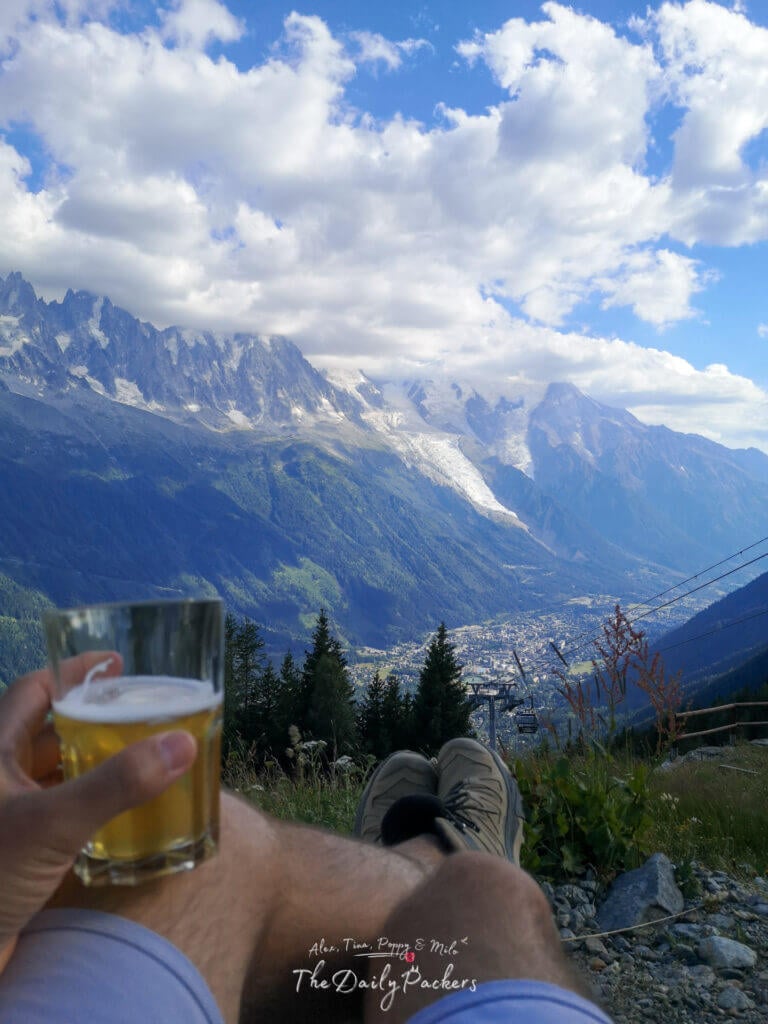

Tip: On the TMB, you pass through towns almost every day, and most refuges and villages have small shops or cafés. There’s no need to carry days’ worth of food. Bring a few light, high-energy snacks (like nuts or dried fruits), and restock as you go. It saves weight and keeps things fresh.
Reduce Your Backpack Weight by Simplifying Your Beauty Kit
It’s so easy to overpack toiletries and small hygiene items — they seem light, but together they add up quickly. On our first Tour du Mont Blanc hike, I carried:
- Nail cutter
- Wet wipes
- Two travel shampoos
- Two travel soaps
- Toothbrush
- Toothpaste
- Toilet paper
- Sun cream
Altogether, that weighed 0.679 kg.
The second time, I seriously pared it down — only half a pack of wet wipes, no shampoo or soap, Tina carried the toothpaste, and I skipped the sunscreen. My new total? Just 0.176 kg.
If you want to reduce your backpack weight even more, skip the nail cutter and wet wipes entirely. That would bring it down to about 0.092 kg — basically nothing.
As for Tina, her first kit included:
- Travel shampoo
- Travel soap
- Toothbrush
- Toilet paper
- Sun cream
For the second trek, she switched to solid shampoo and soap bars, left out the toilet paper, and added the toothpaste — bringing her total from 0.222 kg to 0.212 kg.

Tip: Solid shampoo and soap are perfect for long-distance hiking. They last longer, don’t leak, and eliminate plastic waste — while keeping your toiletry bag light and simple.
Reduce Your Backpack Weight by Minimizing Medicine
The first time we hiked the Tour du Mont Blanc, I brought along a small pouch with basic medicine — painkillers, antiseptic, and a few extras — which weighed 0.087 kg.
By the second trip, I realized we didn’t need most of it. You pass through towns almost every day on the TMB, and every refuge or village has access to basic medical supplies if needed. So this time, I decided to skip it completely — and I didn’t miss it once.

Tip: For long-distance hikes like the TMB, bring only a few essentials: a couple of plasters, basic painkillers, and maybe something for blisters. Anything else, you can easily buy on the way.
Reduce Your Backpack Weight by Lightening Up Your Headgear
When it comes to headgear, it’s easy to overpack “just in case.” On our first Tour du Mont Blanc, I carried a cap, a hat, and sunglasses with their pouch, for a total of 0.227 kg.
On our second trek, I realized I didn’t need both the hat and the cap. I kept just the cap — which I used for both sun and wind protection — and dropped the total down to 0.181 kg.
Tina did exactly the same. Sometimes it’s those small, simple choices that make a real difference over the course of a long hike.
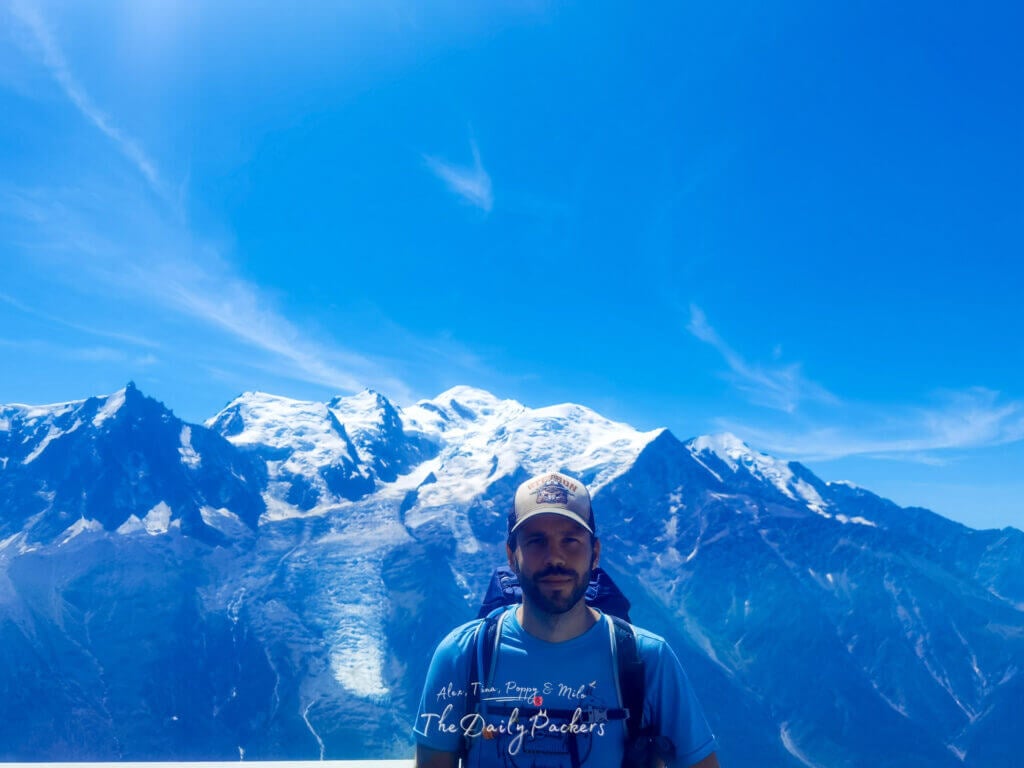
Tip: Pick one versatile hat or cap that gives sun protection, fits comfortably under a hood, and dries fast. You’ll never need more than one.
Reduce Your Backpack Weight by Streamlining Your Chest Gear
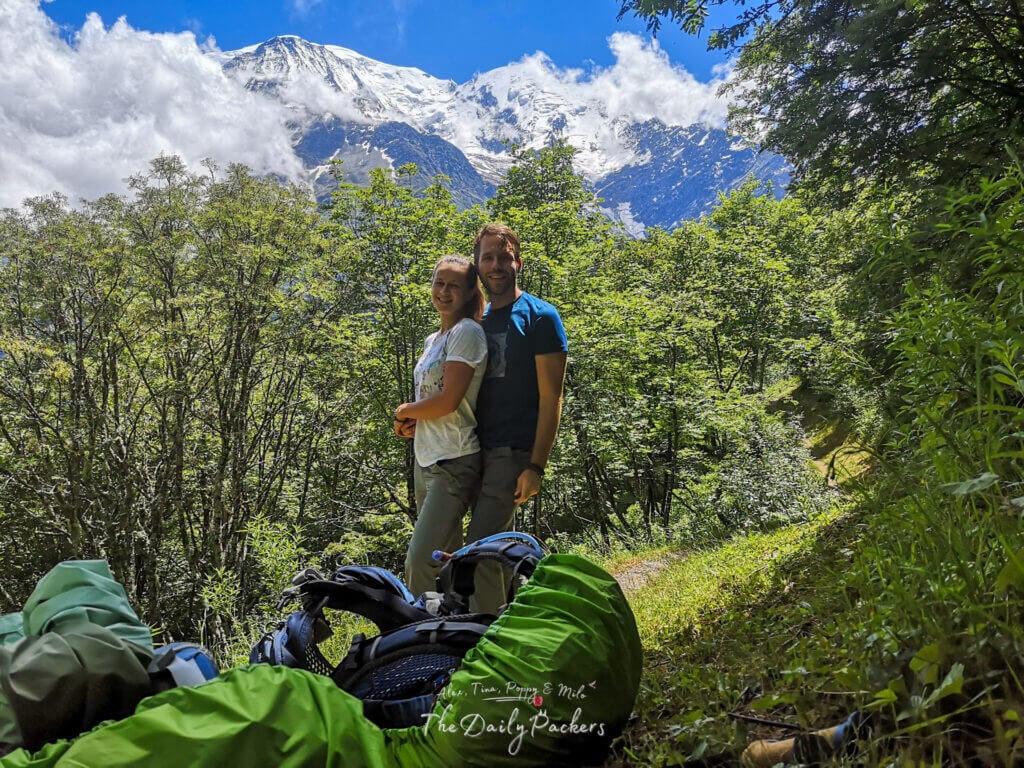
Chest layers are one of those areas where preferences really vary between hikers. Some people can wear the same shirt for five days straight, while others (like us!) prefer to change every two or three days. When the weather’s good, we wash our clothes at night so they’re dry by morning — it’s simple and saves carrying extra weight.
On our first Tour du Mont Blanc, my pack included:
- 5 merino t-shirts
- 1 down jacket
- 1 rain hard-shell jacket
- 1 rain soft-shell jacket
- Total: 1.711 kg
The second time around, I made two small but effective changes:
- Removed 1 merino t-shirt
- Removed the soft-shell rain jacket
- New total: 1.387 kg
Want to go even lighter? Drop one more merino t-shirt, and you’ll reach about 1.254 kg — still plenty of layers for warmth and rotation.
As for Tina, here’s what she had on our first trip:
- 3 merino t-shirts
- 2 regular t-shirts
- 1 down jacket
- 1 shirt
- 3 bras
- 1 hard-shell rain jacket
- 1 soft-shell rain jacket
- 1 pyjama set
- Total: 1.622 kg
For the second hike, she fine-tuned her pack:
- Removed 1 t-shirt and 1 shirt
- Reduced from 3 bras to 2 bracers
- Removed the soft-shell rain jacket
- Skipped the pyjamas
That brought her total down to 1.007 kg. If she’d dropped the extra t-shirt too, she could have hit 0.898 kg — a huge improvement while still staying comfortable and covered.

Tip: Merino wool is your best friend. It’s light, dries fast, and doesn’t smell even after several days — making it perfect for long-distance hikes like the TMB.
Reduce Your Backpack Weight by Lightening Your Leg Gear
Lower body gear is another area where we can easily overpack. Pants, shorts, rain gear — they all add up fast. On our first Tour du Mont Blanc, I carried:
- 1 hiking pant
- 1 hybrid hiking short pant
- 1 swim short
- 8 underwear
- 1 belt
- 1 pair of rain over-pants
- Total: 1.877 kg
For the second hike, I made a few smart cuts:
- Removed the swim short (the hybrid pant already did the job)
- Skipped the rain over-pants
- Reduced to 5 underwear
New total: 0.721 kg — almost 1.2 kg lighter! If I’d brought just one pair of hiking pants, I could have gone down to 0.641 kg without losing comfort or practicality.
As for Tina, her first setup was:
- 1 hiking pant
- 1 legging
- 1 three-quarter pant
- 8 underwear
- 1 rain poncho
- Total: 1.068 kg
She simplified it to:
- Removed the ¾ pant
- Reduced to 5 underwear
- Removed the rain poncho
- New total: 0.571 kg
She could have dropped even further to 0.393 kg by skipping the leggings altogether.

Tip: Two bottom layers are enough — one light pant or short, and one warmer or waterproof option. Anything beyond that usually stays unused.
Reduce Your Backpack Weight by Simplifying Your Foot Gear
Footwear is a big one — it’s heavy, bulky, and crucial for comfort. On our first TMB, my pack included:
- 1 pair of hiking boots
- 1 pair of hiking sandals
- 1 pair of merino socks
- 4 pairs of regular socks
- Total: 2.175 kg
The second time, I made some easy swaps:
- Switched to 3 merino socks only
- Removed all regular socks
- Replaced hiking sandals with flip-flops (lighter and perfect for evenings)
- New total: 1.809 kg.
If I’d gone with just 2 merino socks, I could’ve brought it down to 1.746 kg.
Tina’s first pack was:
- 2 pairs of merino socks
- 2 pairs of regular socks
- 1 pair of hiking shoes
- 1 pair of hiking sandals
- Total: 1.402 kg
The second time, she also switched sandals for flip-flops and removed the extra socks, dropping her total to 1.008 kg, and potentially 0.941 kg with only merino socks.
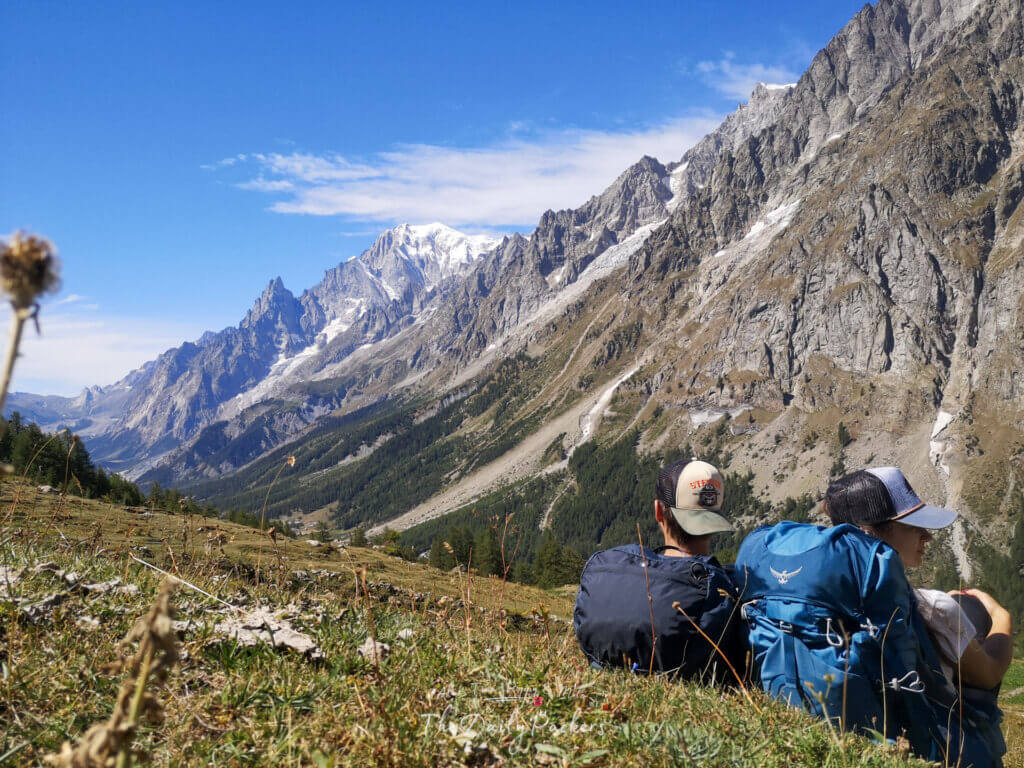
Tip: Merino socks are worth the investment — they dry fast, resist odor, and stay comfortable even after days of hiking. And trust us, you’ll never need more than two pairs!
Reduce Your Backpack Weight by removing Other Essentials
Even after trimming the main gear, there are always a few “extra essentials” that sneak into your backpack — the kind of items that feel necessary until you realize how much they weigh together.
On our first Tour du Mont Blanc, I carried:
- 1 battery bank
- 1 tripod
- 1 Swiss Army knife
- 1 Leatherman multi-tool
- 2 hiking poles
- 1 water pouch (3 L)
- 1 water bottle
- 1 energy gel
- 1 TMB guidebook
- 1 map
- Total: 5.047 kg
On our second hike, I managed to cut that weight almost in half:
- Removed the Leatherman multi-tool (the Swiss Army knife was enough)
- Carried only 1–1.5 L of water instead of filling the full 3 L pouch
- Gave the water bottle to Tina
- Removed the gel and the bulky guidebook
New total: 2.941 kg. If I’d gone even lighter by removing the battery bank and the paper map (by using an online map like this one), I could have reached 2.477 kg.
Tina, on her side, started with:
- 1 battery bank
- 1 yoga mat
- 1 pair of earphones
- 1 essential oils pouch and cream
- 2 hiking poles
- 1 water bottle
- Total: 2.959 kg
For the second hike, she simplified her setup too:
- Removed the battery bank (we shared mine)
- Skipped the yoga mat
- New total: 1.442 kg
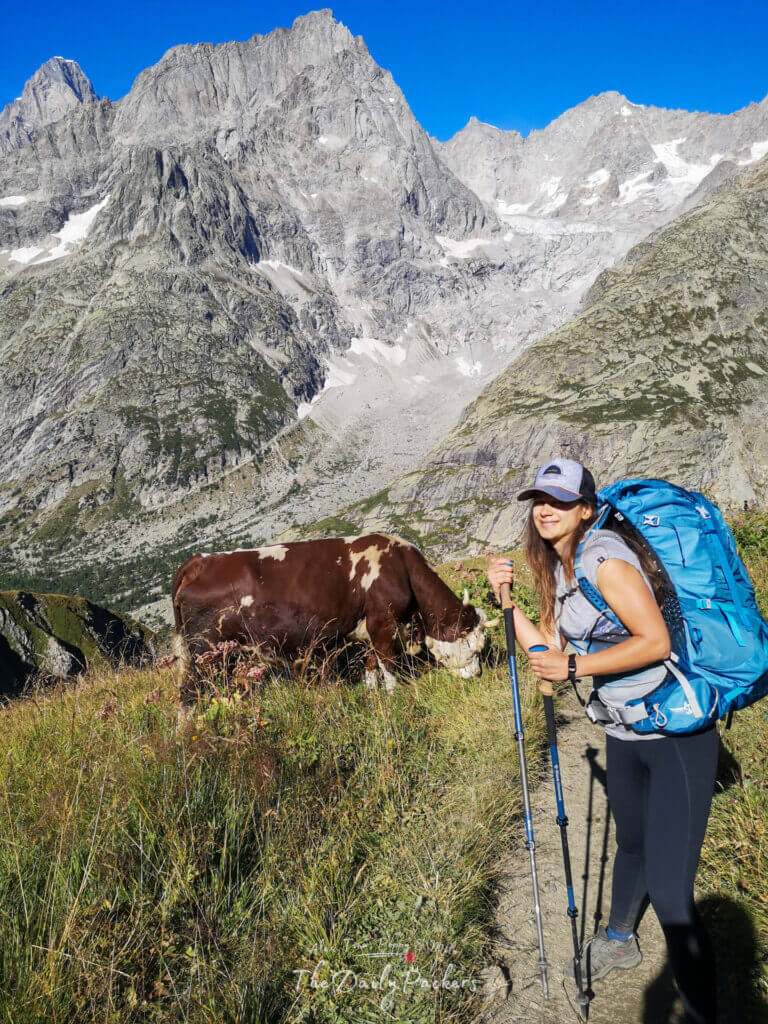
Tip: If you hike as a couple or group, share gear whenever possible — like power banks, maps, or repair kits. And remember, every extra kilo feels like ten after the first 1,000 meters of elevation!
Reduce Your Backpack Weight by Optimising Your Backpacks & Pouches
How you organize your gear makes a big difference — not only in comfort but also in overall weight. Pouches and compression bags are incredibly useful, but it’s easy to overdo it.
On my first Tour du Mont Blanc, I carried:
- 1 backpack (65 L)
- 1 backpack upper hood
- 1 rain cover
- 1 large compression bag (clothes)
- 1 large compression bag (sandals)
- 1 medium compression bag (underwear)
- 1 medium compression bag (others)
- Total: 2.590 kg
For the second hike, I simplified a bit:
- Removed one of the pouches I barely used
- Use a 40L backpack
- New total: 2.534 kg
Want to go lighter? If you leave the upper hood of your backpack at home (it’s often unnecessary for shorter hikes or when the pack isn’t full), you can drop down to 2.299 kg.
As for Tina, her original setup was:
- 1 backpack (65 L)
- 1 backpack upper hood
- 1 rain cover
- 1 compression bag (12 L for cooking gear)
- 1 large compression bag (clothes)
- 2 shoe bags
- 2 small compression bags (others)
- Total: 2.949 kg
For our second hike, she optimized her organization and saved a lot of weight:
- Removed the shoe bags
- Removed 1 small compression bag
- Use a 40L backpack
- New total: 2.213 kg

Tip: Keep your packing system simple — a few compression bags are great for organization, but every extra pouch adds up. If your backpack isn’t packed to the brim, you probably don’t need that top hood either.
Reduce Your Backpack Weight by Improving Your Camping
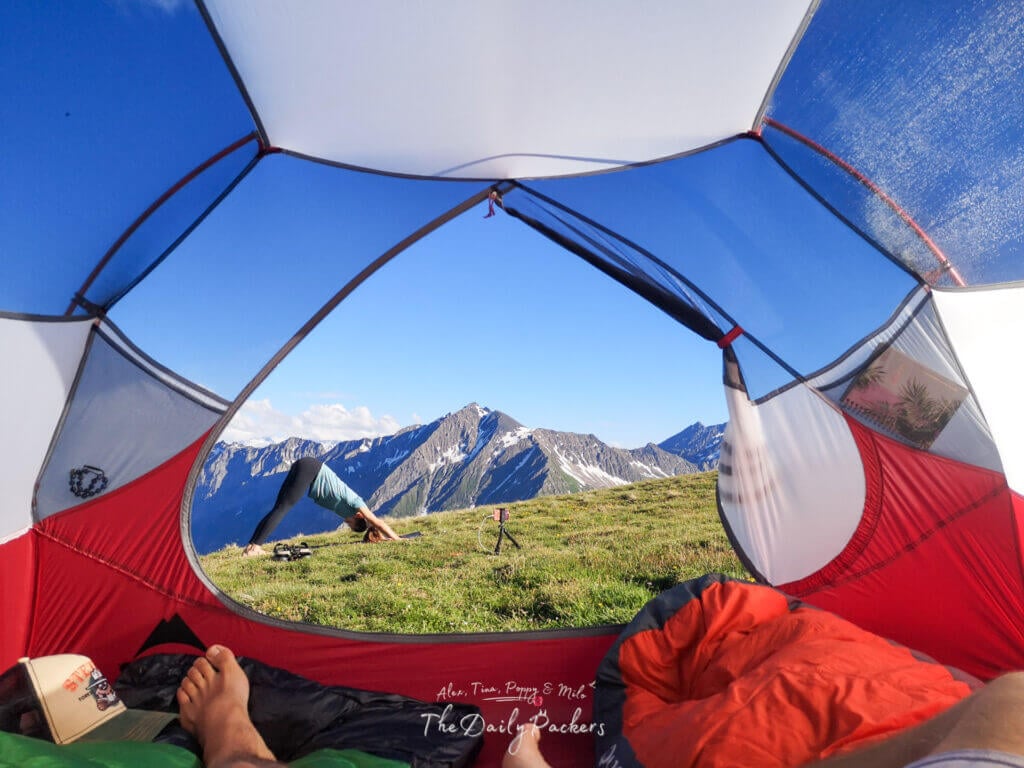
If, like us, you plan to camp along the trail, you’ll need to carry extra gear — and that means extra weight. But with some smart distribution, you can still keep your pack light and balanced.
On our first Tour du Mont Blanc, my camping setup included:
- 1 pillow + case
- 1 sleeping mattress + case
- 1 sitting towel
- 1 tent bag
- 12 tent pegs
- 1 tent
- 1 rain cover
- 1 tent pole structure
- 1 footprint
- Total: 3.201 kg
Before the second hike, I made a few simple adjustments:
- Removed the sitting towel (a jacket works just as well)
- Gave the 12 tent pegs to Tina
- Gave the tent pole structure to Tina
- Gave the footprint to Tina
- New total: 2.001 kg
Meanwhile, Tina’s original setup was lighter:
- 1 pillow + case
- 1 sleeping mattress + case
- Total: 0.587 kg
For the second round, she took on a bit more shared gear — the tent poles, pegs, and footprint — to balance our load between both backpacks.
New total: 1.624 kg
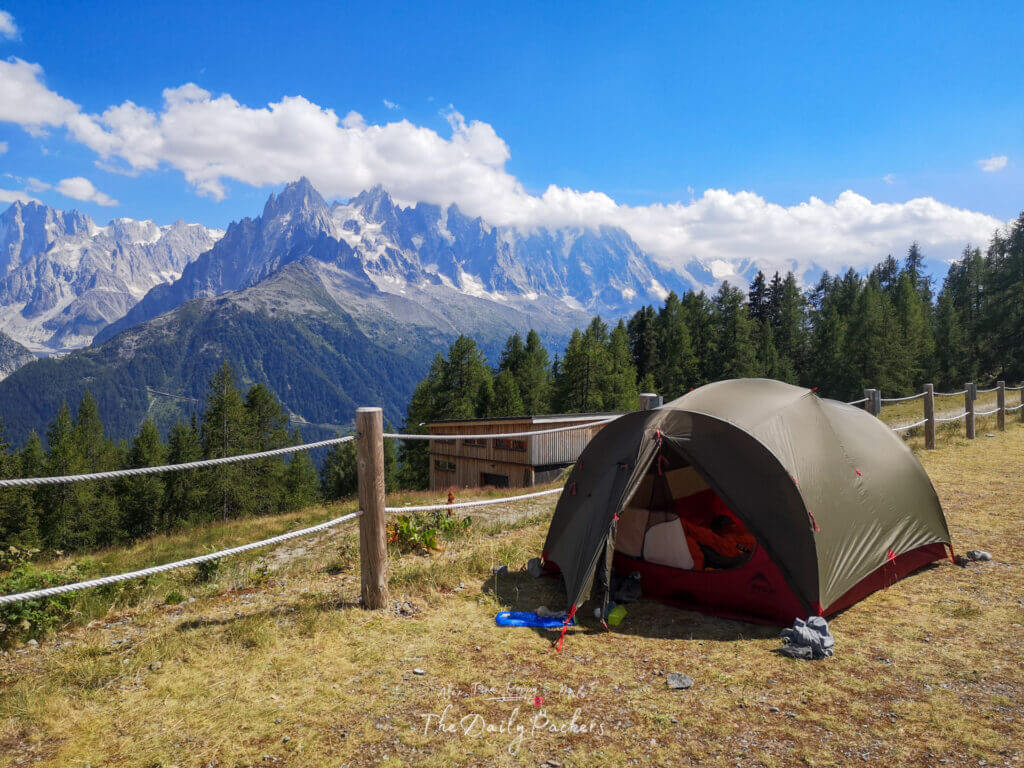
Tip: When hiking as a couple, share the load strategically. Splitting the tent, poles, and other common gear keeps both packs manageable and makes the hike far more enjoyable.
Reduce Your Backpack Weight by reducing your Cooking Gears
If you plan to cook along the trail, be prepared to carry a few extra items. Even lightweight gear adds up quickly once you include all the essentials.
Here’s what we carried for two people:
- 1 gas bottle
- 1 camping gas heater + lighter
- 2 cutlery sets
- 1 bowl, pan, and cup set
- 1 small kitchen cloth
- Total: 1.074 kg (plus the weight of any food you bring)
Tip: If you want to reduce the weight of your backpack even more, consider:
- Sharing one bowl or cup between two people
- Using a single spork instead of full cutlery sets
- Replacing a traditional gas stove with an ultralight burner
- Buying food that can be eaten cold or cooked quickly to save fuel
Cooking on the trail adds comfort and freedom — but every extra item counts. Keep your setup minimal, and you’ll enjoy both your meals and your lighter pack.
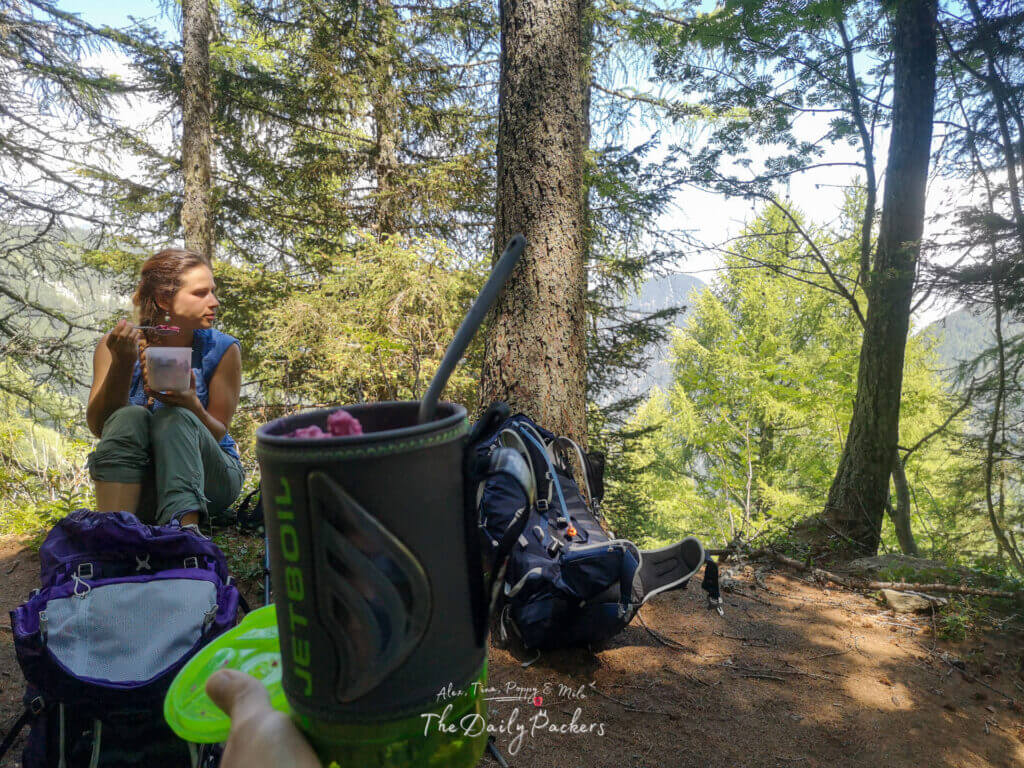
How to Reduce Your Backpack Weight Even More
If you want to go ultra-light, there are still a few clever ways to save even more weight without sacrificing too much comfort.
One of the biggest changes would be switching from a 65 L backpack to a 40–50 L one. This alone can easily save around 1 kg per pack — and since smaller packs also limit what you can bring, they naturally help you pack lighter.
You could also switch to lighter shoes or trail runners instead of classic hiking boots. While they’re not part of your backpack weight, every gram on your feet counts. As the saying goes, “a kilogram on your feet equals five on your back.”
Of course, that depends on your preferences and terrain — some hikers prefer the ankle support of heavier boots, especially on rocky trails.

Summary: Reduce Your Backpack Weight
Here’s a full overview of how to Reduce Your Backpack Weight — based on real numbers from our hikes:
What we carried with us:
- Alex: 2.462 kg (Merino T-shirt x1, hiking pants x1, belt x1, underwear x1, socks x1, hiking boots x1, Swiss Army knife, hiking poles x2)
- • Tina: 1.684 kg (Merino T-shirt x1, bra x1, hiking pants x1, regular socks x2, underwear x1, hiking shoes x1, hiking poles x2)
Totak Hiking Gear Weight:
- First time: 14.302 kg + 12.252 kg
- Second time: 9.397 kg + 7.112 kg
- Minimalism setup: 7.315 kg + 5.318 kg
Plus Camping
- First time: 17.503 kg + 12.839 kg
- Second time: 11.398 kg + 8.736 kg
- Minimalism setup: 9.316 kg + 6.942 kg
These numbers are, of course, approximate and based on our gear — yours might differ depending on what you bring. But one thing is sure: cutting down on weight makes the experience so much better.
When your backpack feels like part of you instead of a burden, every step becomes easier — and you can truly enjoy the trail.
About the authors
We are Alex and Tina, a French-Serbian couple who met in China back in 2014. We spent three incredible years there before making France our home. Our shared passion for travel has been the heartbeat of our relationship for over 12 years, taking us across 44 countries and counting.
We launched TheDailyPackers in 2019 as a way to document our adventures. In 2026, we reached a major milestone by officially turning our blog into our full-time job. While we are still growing toward financial independence through this platform, every article we write is fueled by our mission to make your voyages easier through in-depth guides, honest advice, and the lessons we’ve learned from our own mistakes.
Our journey has not been without its storms. In 2023, our world changed forever when our first son, Poppy, was stillborn on November 25th. It was, and remains, the hardest chapter of our lives. In 2025, we were blessed with our second little boy, Milo. He has since joined our traveling tribe, and you’ll be seeing him—and the reality of traveling with a little one-on the blog more and more.
We hope to inspire you to explore the world with curiosity and resilience. Thank you for being part of our story.
You may also like those related posts
11 best things to do in SaPa, Vietnam, in 4 days or less
How to Start Yoga and Why It Changed Travelling
9 best things to do in Xi’an, China, in 3 days or more
How to Get From San Rafael to Bariloche by Bus
4 Best things to do in Imlil, Morocco, in 2 to 3 days
Traveling as a Couple: 5 Real Truths You Should Know
8 Best things to do in Florianópolis, Brazil, in 2 days
Sacred Valley of the Inca: An incredible 1-day adventure, Peru
Pssst, did you know that…
If you purchase something through our links, we earn a small fee. However, you still pay the same. Win-win! And one day we may get to be full-time travel bloggers =)
Find Hotels with Booking.com
Do Yoga with KVY
Buy us a Coffee
Rent a car with DiscoverCars
Find Attractions with GetYourGuide
Find Flights with Expedia
Buy an eSIM with Airalo
Get insured with World Nomads
Get ready with Amazon.com