

Introduction
The Sacred Valley of the Incas is one of those places that quietly steals the show during a trip to Peru. Stretching between Cusco and Machu Picchu, this fertile region—also known as the Urubamba Valley—was once the heart of the Inca Empire. Thanks to its mild climate, rich soil, and strategic location, it became an essential area for agriculture, experimentation, and settlement.
A Sacred Valley trip isn’t just a stop on the way to Machu Picchu. It’s a journey through Inca villages, dramatic landscapes, and some of the most impressive archaeological sites in the country. From the terraces of Moray and the salt ponds of Maras to the cobbled streets of Ollantaytambo, the Sacred Valley of the Incas offers a perfect mix of history, culture, and scenery.
If you’re short on time, this can easily be done as a one-day adventure from Cusco. It’s also the most logical route when traveling onward to Machu Picchu. In this guide, you’ll discover how to explore the Sacred Valley efficiently, what stops are worth your time, and how to turn one day in the Urubamba Valley into one of the highlights of your Peru itinerary.

Getting there
The Sacred Valley is easy to reach from Cusco and fits perfectly into a one-day adventure. The most straightforward option is to join a Sacred Valley trip from Cusco, which takes care of transport, timing, and key stops. Tours usually leave early in the morning and follow a logical route through the Urubamba Valley, ending in Ollantaytambo or back in Cusco, depending on your plans.
If you prefer more freedom, you can hire a private taxi or driver for the day. This option works well if you want to move at your own pace, spend more time at places like Maras & Moray, or align the day with a pre-booked train to Aguas Calientes. Expect the drive from Cusco into the Sacred Valley to take around 1 to 1.5 hours, depending on your first stop.
Public transport is possible but less convenient for a single day. Minivans (colectivos) run between Cusco, Urubamba, and Ollantaytambo, but reaching sites like Moray or the salt mines requires additional taxis and extra time. If you only have one day, a tour or private driver is by far the easiest way to experience the Sacred Valley of the Incas without stress.
Moving Around the Sacred Valley
Getting around the Sacred Valley in one day is all about choosing the right transport. If you want flexibility and peace of mind, hiring a private taxi or driver is one of the best options. This is what we did the day before heading to Machu Picchu. Our guesthouse in Cusco arranged a taxi to pick us up at 8:30 am, and just like everywhere else in Peru, the driver was already waiting when we came down. No rushing, no stress.
We chose this option mainly because it allowed us to move at our own pace and, most importantly, to reach Ollantaytambo in time for a train we had booked months in advance. Missing that train to Aguas Calientes was not an option. The full-day taxi cost between 75 and 100€, which felt reasonable considering the distance covered and the freedom it gave you throughout the day.
From Cusco, you’ll usually choose between two main routes through the Sacred Valley of the Incas:
- The first option goes through Chinchero, Maras, Moray, Urubamba, and ends in Ollantaytambo.
- The second route passes through Pisac, Urubamba, and Ollantaytambo.
With limited time, you’ll need to pick one. We went for the Chinchero–Maras & Moray route, as it packed in more variety and Pisac was a bit out of the way that day. If you have extra time, Pisac works well as an alternative or even on a return journey.
If you’re not continuing on to Machu Picchu, you can easily return to Cusco from Ollantaytambo by train or road. If you are heading to Machu Picchu, finishing your Sacred Valley trip in Ollantaytambo makes perfect sense, as it’s the main departure point for trains to Aguas Calientes.


When to Visit
The Sacred Valley of the Incas can be visited all year round, but the experience changes quite a bit depending on the season. Thanks to its lower altitude compared to Cusco, the Urubamba Valley enjoys milder temperatures, making it a comfortable stop whether you’re exploring ruins, villages, or traveling onward to Machu Picchu.
- Dry season (May to September): This is the most popular time for a Sacred Valley trip. Days are generally sunny with clear skies, perfect for visiting sites like Moray, Maras, and Ollantaytambo. Daytime temperatures usually range between 18–22°C (64–72°F), while mornings and evenings can be cold, especially early on. July and August are peak months, so expect more visitors, particularly at major stops.
- Shoulder seasons (April and October): These months are often the sweet spot. You still get mostly good weather, fewer crowds, and greener landscapes than in the heart of the dry season. Temperatures are similar to the dry months, around 17–21°C (63–70°F), and rain is usually light and short-lived.
- Rainy season (November to March): Rain is more frequent during these months, especially in January and February. Days are warmer, with temperatures around 20–24°C (68–75°F), and the valley turns lush and green. While some trails can get muddy, archaeological sites remain open, and the crowds are noticeably thinner. If you don’t mind occasional rain, this can still be a rewarding time to visit.
Tip: If you’re planning to combine the Sacred Valley with Machu Picchu, aim for April, May, September, or October. You’ll get a good balance of weather, scenery, and manageable crowds, making the entire journey much more enjoyable.


Tip: We use the DJI Action 4 to film our vlogs — compact, durable, and perfect for capturing every adventure.
Where to Stay
If you’re visiting the Sacred Valley as a day trip, staying in Cusco is often the easiest and most practical choice. It allows you to keep one base, avoid changing accommodation, and still explore the Sacred Valley of the Incas comfortably in one full day. Many Sacred Valley trips start early from Cusco and either return in the evening or drop you off in Ollantaytambo if you’re continuing on to Machu Picchu.
Here are some of our top picks in Cusco:
- Amaru Colonial: If you want something affordable and full of character, this is a lovely pick. Set inside a traditional Andean home with leafy courtyards and mountain views, it feels peaceful yet remains close to Plaza de Armas. Rooms are simple but comfortable, breakfasts are generous, and the atmosphere is friendly in that old-Cusco way that makes you want to stay longer.
- Antigua Casona San Blas: A beautiful boutique hotel right in the heart of San Blas. It blends rustic stone walls, cozy rooms, and small courtyards with thoughtful touches like heated floors and a surprisingly good onsite restaurant. You step outside and you’re already in the middle of Cusco’s artisan shops and cafés, which makes it perfect for slow mornings and evening strolls.
- JW Marriott El Convento Cusco: For a luxury stay, this restored 16th-century convent is something special. The mix of Inca stonework and modern comfort feels unique to Cusco, and the service is excellent. Rooms are elegant, the courtyards are beautiful, and they even offer oxygen-enriched rooms if you struggle with the altitude.
That said, if you want to slow things down or experience the Urubamba Valley differently, spending a night in the Sacred Valley can be a great option. Staying there means quieter evenings, mountain views, and waking up closer to the archaeological sites.
For something truly unique, consider the Skylodge Adventure Suites built into the mountainside. These glass pods are suspended above the valley and offer incredible views over the Sacred Valley and surrounding peaks. It’s not the most budget-friendly option, but it’s a memorable experience if you’re looking for something out of the ordinary and don’t mind a bit of adventure getting there.
In short, stay in Cusco for convenience and efficiency, or choose the Sacred Valley itself if you want a slower pace or a once-in-a-lifetime stay with a view.


Here are all your accommodation options in Cusco
What to Eat
Food in the Sacred Valley is simple, hearty, and deeply connected to the land. Many dishes are based on ingredients that have been grown here since Inca times, thanks to the fertile soil of the Urubamba Valley. Whether you stop at a small local restaurant or eat during a Sacred Valley tour, you’ll come across a mix of traditional Andean flavors and comforting classics.
One dish you’re almost guaranteed to see is trucha, fresh river trout, usually grilled or lightly fried and served with potatoes and rice. It’s a staple in the Sacred Valley and one of the safest and tastiest options for lunch during a busy sightseeing day.
Another local favorite is ají de verduras or ají de quinua, a creamy dish made with vegetables or quinoa and a mild yellow chili sauce. It’s filling without being too heavy, which is ideal if you’re still adjusting to the altitude.
Potatoes deserve a special mention here. The Sacred Valley is home to hundreds of varieties, and you’ll often see them boiled, roasted, or served as papas nativas alongside most meals. You may also come across choclo con queso, large-kernel corn served with fresh local cheese, perfect as a quick snack.
If your Sacred Valley trip includes a stop in Urubamba or Ollantaytambo, look out for menu del día lunch spots. These fixed-price meals usually include soup, a main dish, and a drink, and are a great way to eat local food without spending much.
Tip: Eat a light lunch if you’re continuing on to Machu Picchu the same day. Simple dishes with quinoa, vegetables, or trout sit better than heavy or fried foods when you’re on the move.

Sacred Valley Tour: What to Expect in One Day
Chinchero – Discover Traditional Wool Weaving
Your Sacred Valley trip usually starts in Chinchero, and the first stop is often a small wool workshop run by local families. This is where you’ll learn how alpaca and sheep wool are cleaned, spun, dyed, and woven using natural ingredients like plants, minerals, and even insects.

Even if no long explanations are given in English, the process is easy to understand just by watching. You’ll see the raw wool, the natural dyes, and the final textiles side by side. There’s no entrance fee, but the expectation is that you’ll browse the shop at the end. Buying something isn’t mandatory, but it’s a direct way to support the local community.


Chinchero – Explore the Village and Inca Ruins
A few minutes away from the workshop, you’ll reach Chinchero village itself. Built on Inca foundations, the town sits high above the Sacred Valley and offers wide views over the surrounding mountains.

The main square is home to a colonial church, and just behind it you’ll find Inca terraces and stone walls that blend seamlessly into the village. Walking through Chinchero feels calm and local, far from the crowds of larger sites. If you’re lucky, you may even witness a local event or ceremony, which gives a glimpse into everyday life in the Andes.

Access to the ruins requires the partial tourist ticket, which also covers several other Sacred Valley sites visited the same day.
Mara & Moray – Step into Inca Agricultural Innovation
After Chinchero, the road leads toward Moray, passing through the small village of Maras without stopping for long. Moray is one of the most fascinating sites in the Sacred Valley of the Incas.

Here, you’ll find massive circular terraces carved into the ground. These weren’t ceremonial structures but an Inca agricultural laboratory. Each level has a slightly different climate, allowing the Incas to test which crops would grow best under specific conditions. Walking around the terraces, you really feel how advanced their understanding of agriculture and environment was.
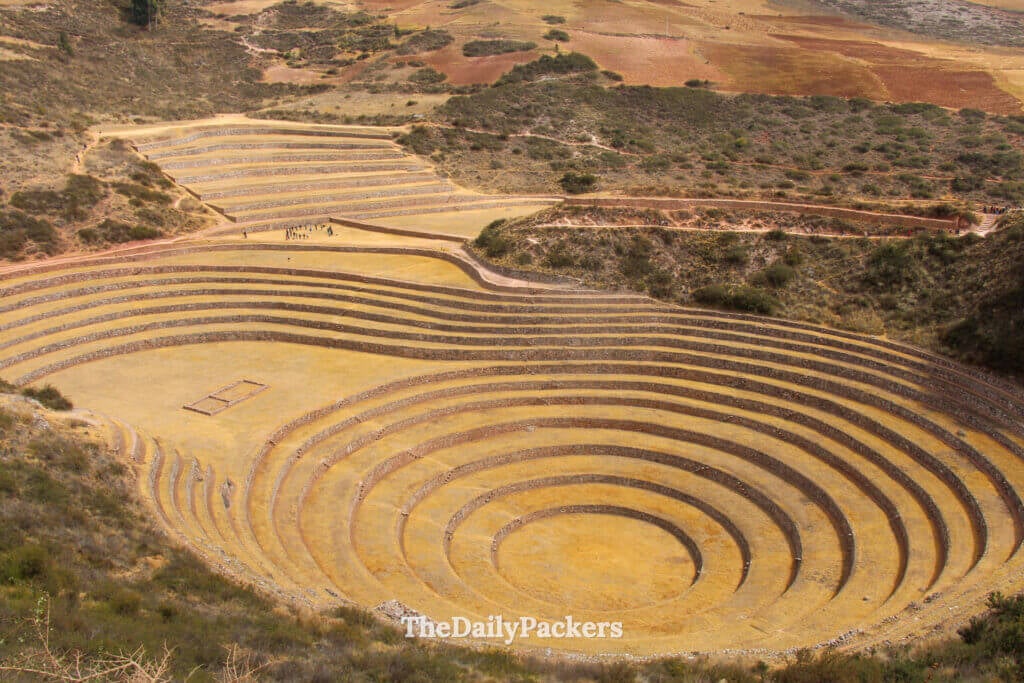
There are several walking paths around Moray. If time is limited, the short loop is more than enough to appreciate the site and its scale.

Here are all your accommodation options in Cusco
Maras Salt Mines – Walk Through Thousands of Salt Pools
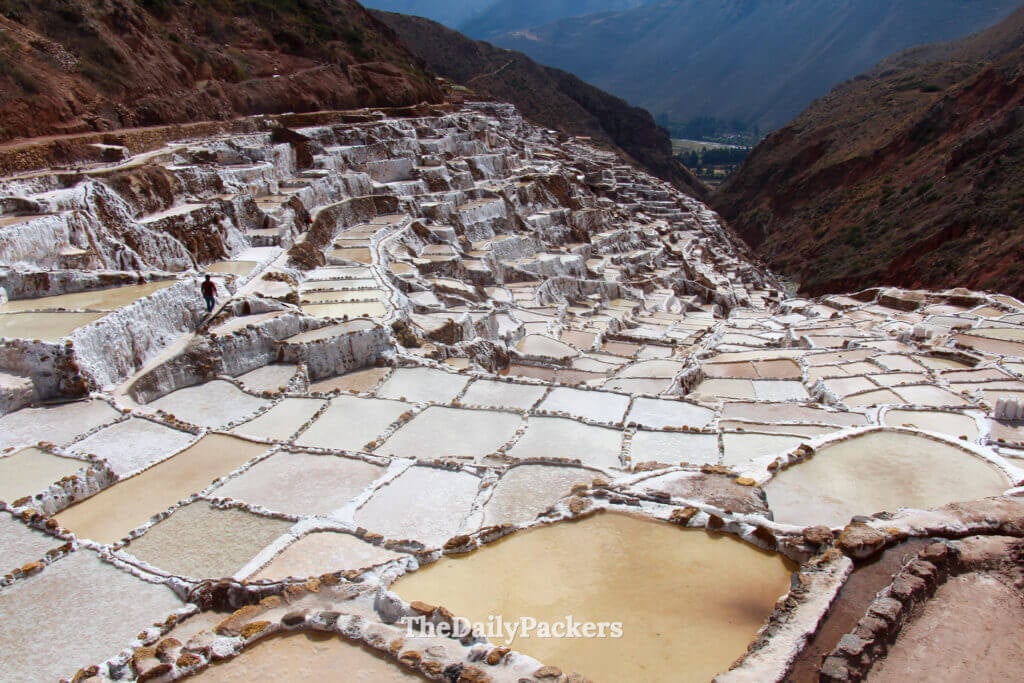
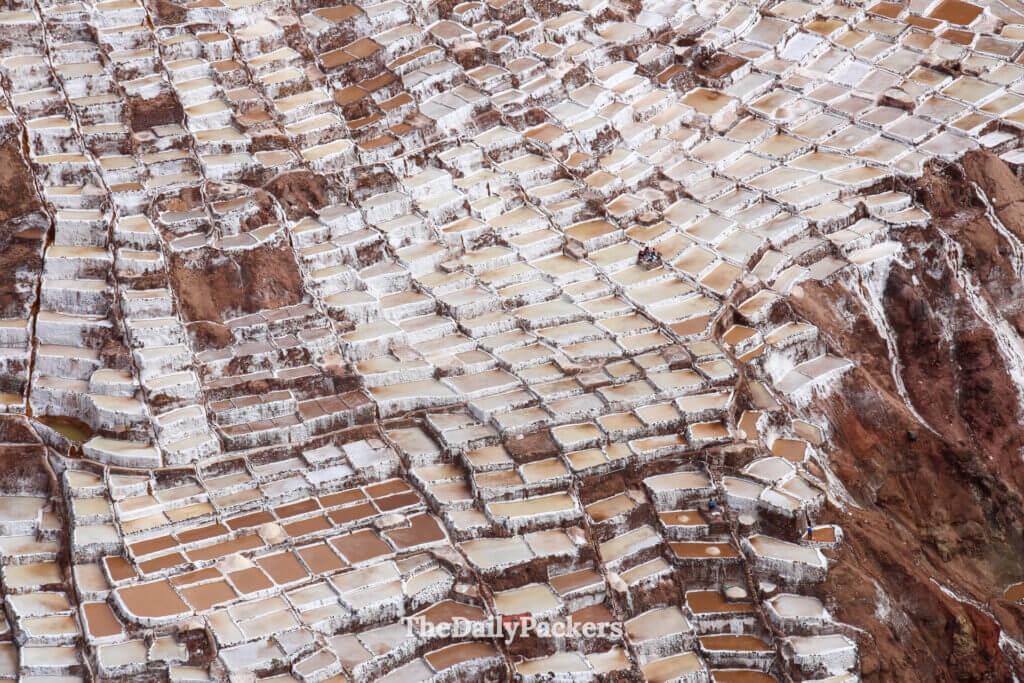
From Moray, a short detour brings you to the Maras salt mines, one of the most visually striking places in the Sacred Valley. Thousands of small salt ponds cascade down the mountainside, all fed by a natural underground saltwater stream.

Salt has been harvested here since pre-Inca times, and many families still own and maintain individual pools. Watching the contrast between the white salt, red earth, and green mountains is impressive, especially if you’ve never seen salt extraction done this way.

There’s a small entrance fee, and while explanations on-site are limited, the process becomes clear as you walk along the paths overlooking the pools.
Tip: We use the DJI Action 4 to film our vlogs — compact, durable, and perfect for capturing every adventure.
Urubamba – Pause in the Heart of the Sacred Valley
Next, you’ll pass through Urubamba, the geographic and agricultural center of the Sacred Valley. While it doesn’t have major archaeological sites, it’s often where lunch stops are made.

Urubamba gives you a more everyday look at life in the valley. You may pass local markets, street stalls, and small shops, and it’s a good moment to slow down before the final stop of the day. Even a short walk through town helps you understand why this area was so important to the Incas.
Ollantaytambo – End the Day in a Living Inca Town
The final stop is Ollantaytambo, one of the most impressive and atmospheric places in the Sacred Valley. Unlike other ruins, this is still a living town, with original Inca streets, water channels, and stone houses.

Above the village rises the Ollantaytambo fortress, a massive complex of terraces, temples, and storehouses built into the mountainside. Climbing up the ruins gives you incredible views over the town and valley, but be prepared for some steep steps.

Many Sacred Valley trips end here, especially if you’re continuing on to Machu Picchu, as Ollantaytambo is the main train departure point to Aguas Calientes. Even if you’re returning to Cusco, it’s a perfect place to end the day on a high note.

Train to Aguas Calientes
After finishing your Sacred Valley trip in Ollantaytambo, it’s time to continue toward Machu Picchu. The town is the main departure point for trains heading to Aguas Calientes, and everything is within walking distance.
We headed to the train station to catch our 4:36 pm Inca Rail train and arrived about 30 minutes early to collect the boarding passes and settle in. The ride itself was comfortable and scenic, with large windows, snacks, and drinks served on board. It’s a relaxing way to end a long day of exploring the Sacred Valley.
Train tickets can sell out quickly, especially in high season, so booking in advance is highly recommended. We secured ours around three months ahead of time directly through the Inca Rail website, but you can also get them on 12GO, which gave peace of mind when planning the rest of the itinerary.

Arriving in Aguas Calientes
Once you arrive in Aguas Calientes, the gateway town to Machu Picchu, the atmosphere changes instantly. The town is compact, lively, and very touristic, filled with restaurants, cafés, souvenir shops, and hotels.
Our hotel had someone waiting for us at the station, which made the arrival easy after a full day on the road. One of the first things you should do upon arrival is buy your bus ticket to Machu Picchu for the following day. Hotels usually recommend doing this in advance, as lines can get long early in the morning. The return bus ticket costs around 24 USD or 80 soles and is valid for the entire day.
Aguas Calientes is a convenient place to stay for one night before visiting Machu Picchu. It’s lively and practical, but not somewhere you’d want to linger too long. One evening is more than enough before heading up to the ruins early the next morning.

Where to stay in Aguas Calientes
Aguas Calientes is the gateway town to Machu Picchu — small, busy, and full of restaurants, cafés, and shops catering to visitors. It’s the perfect place to rest the night before your early visit to the ruins, but it’s not a place you’ll want to stay longer than necessary. Here are a few great options right in the heart of town:
- Inti Pacha Palace Machupicchu: If you’re looking for comfort and convenience, Inti Pacha Palace delivers. Rooms are spacious, the décor feels warm and inviting, and the service makes it easy to unwind after a long day in the Sacred Valley. It’s just a short walk from the train station and bus stop for Machu Picchu, so you won’t be rushing in the morning. The hotel’s location makes exploring the town’s streets and markets easy as well.
- Hatun Inti Boutique: A lovely mid-range choice with a boutique feel and great attention to detail. The rooms are charming without being overly fancy, and you’ll find yourself lingering in the common areas, enjoying a coffee or planning the next day’s route. It’s a peaceful spot to return to after the buzz of the town, and it keeps you close to restaurants and shops without feeling like you’re right in the busiest streets.
- Casa del Sol Machupicchu: For something cosy and comfortable, Casa del Sol is a great pick. The rooms are well appointed, the beds are comfortable, and the location is excellent — just a few minutes’ walk from the central square. Because Aguas Calientes is compact, being near the main plaza means you’re close to dinner spots, tour pickup points, and the bus to Machu Picchu.
Wherever you stay, make sure you plan enough time in the evening to walk around town, have an early dinner, and get your bus or train tickets sorted for Machu Picchu the next morning. Aguas Calientes fills up quickly in high season, so booking ahead is always a good idea.

Here are all your accommodation options in Aguas Calientes
Sacred Valley Itinerary
- 7:30–8:30 am – Departure from Cusco: Leave Cusco early in the morning and head into the Sacred Valley of the Incas by private driver or organized tour.
- 9:00–10:00 am – Chinchero Wool Workshop & Village: Learn about traditional wool weaving, then explore Chinchero’s village square, colonial church, and Inca terraces.
- 10:45–11:45 am – Moray Terraces: Walk around the circular terraces of Moray and discover how the Incas used this site for agricultural experiments.
- 12:15–1:00 pm – Maras Salt Mines: Stroll along the paths overlooking the salt pools and learn about centuries-old salt harvesting methods.
- 1:45–2:45 pm – Lunch in Urubamba: Stop in Urubamba for a relaxed lunch in the heart of the Urubamba Valley.
- 3:30–4:45 pm – Ollantaytambo Ruins & Town: Explore the Inca fortress, terraces, and original streets of Ollantaytambo.
- 4:30–5:30 pm – Train to Aguas Calientes: Head to the train station and board your train toward Aguas Calientes, depending on your departure time.
This route makes the most of one full day and connects perfectly with a visit to Machu Picchu.
About the authors
We are Alex and Tina, a French-Serbian couple who met in China back in 2014. We spent three incredible years there before making France our home. Our shared passion for travel has been the heartbeat of our relationship for over 12 years, taking us across 44 countries and counting.
We launched TheDailyPackers in 2019 as a way to document our adventures. In 2026, we reached a major milestone by officially turning our blog into our full-time job. While we are still growing toward financial independence through this platform, every article we write is fueled by our mission to make your voyages easier through in-depth guides, honest advice, and the lessons we’ve learned from our own mistakes.
Our journey has not been without its storms. In 2023, our world changed forever when our first son, Poppy, was stillborn on November 25th. It was, and remains, the hardest chapter of our lives. In 2025, we were blessed with our second little boy, Milo. He has since joined our traveling tribe, and you’ll be seeing him—and the reality of traveling with a little one-on the blog more and more.
We hope to inspire you to explore the world with curiosity and resilience. Thank you for being part of our story.
You may also like those related posts
Best eSIM for International Travel in 2025
5 Best things to do in Tønsberg, Norway’s oldest city
Ella train: An Unforgettable Experience from Nuwara Eliya 2025
Merzouga Luxury Desert Camp: 3 Days in the Sahara Dunes
Thuy Tien Lake: Exploring Hue’s Forgotten Abandoned Water Park
Zaanse Schans: The most Iconic Windmills of the Netherlands
25 Best things to do in Salzburg, Austria, in 2 to 6 days
Travel Insurance: is World Nomads the best in 2025?
Pssst, did you know that…
If you purchase something through our links, we earn a small fee. However, you still pay the same. Win-win! And one day we may get to be full-time travel bloggers =)
Find Hotels with Booking.com
Do Yoga with KVY
Buy us a Coffee
Rent a car with DiscoverCars
Find Attractions with GetYourGuide
Find Flights with Expedia
Buy an eSIM with Airalo
Get insured with World Nomads
Get ready with Amazon.com