
Introduction
After leaving Hallstatt behind, our journey brought us to Graz—Austria’s second-largest city and one we honestly didn’t know much about beforehand. Graz turned out to be the perfect stop on our way toward Serbia, offering a colorful old town, impressive architecture, and a surprisingly relaxed vibe for a city of its size.
We only had a bit more than a day to explore, but Graz kept us busy with its mix of historic corners, green parks, and views from the Schlossberg.
And just outside the city, one of the most unexpected highlights awaited us: a visit to the Arnold Schwarzenegger House Museum in Thal, the very village where he was born.
From strolling cobbled streets to standing inside the home of a Hollywood legend, Graz offered more variety than we imagined—and it made for a stop we won’t forget.
So, let’s dive into the best things to do in Graz!


Here are all your accommodation options in Graz
Getting there
Graz sits in southern Austria, making it easy to reach whether you’re coming from Vienna, Salzburg, or even crossing over from neighboring countries.
By Car: We reached the city by car, coming straight from Hallstatt on our way to Serbia. The drive is smooth and well-connected, and parking is available in several underground garages right in the city center. Just be prepared—convenient parking comes at a price, but the location makes exploring on foot much easier.
By Train: Graz is also well connected by train. From Vienna, the trip takes around 2.5 hours, while from Salzburg it’s about 4 hours. Trains arrive at the modern Hauptbahnhof (main station), from where you can hop on a tram or bus into the old town.
By Air: If you’re flying in, Graz Airport (Flughafen Graz) is only about 20 minutes from the city center. It’s a small airport with mainly European connections, but easy to navigate.
By Bus: Budget travelers can also reach Graz by long-distance bus. Services from Vienna and other Austrian cities are frequent, and international routes connect Graz with destinations like Ljubljana or Zagreb.


Check all your transportation options online — from buses to trains and ferries — it makes planning so much easier.
Moving Around
Graz is a city best explored on foot. The old town is compact, filled with colorful buildings, lively squares, and hidden courtyards that are easiest to enjoy at a slow pace. Most of the main attractions—like the Schlossberg, the double staircase, and the Market Square—are all within walking distance of each other.
If you arrive by car, you’ll need to leave it in one of the underground garages around the city center or use a park-and-ride.
We used Parkgarage Kastner & Öhler, which couldn’t be more convenient—it’s right in the middle of town, just steps away from the main streets. The downside? It’s super expensive:
- Monday–Saturday (8:00–19:00): €1.60 per half hour
- Sundays & holidays (8:00–19:00): €1.60 per half hour
- Night tariff (19:00–8:00): €1.60 per half hour, capped at €5.00 for the whole night
If you’re only staying a short while, the location is worth it. But if you plan to spend more time in Graz, you might want to look for cheaper garages further from the center and hop on a tram instead.


We recommend to rent a car through Discover Cars with free cancellation. Book your rental car here.
When to Visit
Graz is a year-round destination, but the experience changes a lot with the seasons.
- Spring (April–May): The city shakes off winter with blooming parks and mild weather, perfect for exploring the old town on foot. Outdoor cafés start filling up, and it’s a lovely time to stroll without the summer crowds.
- Summer (June–August): Expect warm, sunny days and a lively atmosphere. The streets are buzzing, festivals are in full swing, and terraces are packed late into the evening. On the flip side, parking and accommodation can be more expensive, and sightseeing in the midday heat might feel heavy.
- Autumn (September–October): Our favorite time to visit the city. The city feels calmer, the weather is still pleasant, and the trees in the parks turn beautiful shades of orange and red. It’s also harvest season, so food markets are especially tempting.
- Winter (November–March): While Graz doesn’t get the fame of Vienna for its Christmas markets, the holiday season is still magical here. The city lights up with festive decorations, and you’ll find fewer tourists around. Just be prepared for chilly, short days.
Tip: If you can, aim for spring or autumn. The weather is comfortable, prices are more reasonable, and you get to enjoy the city without the big summer crowds.


Where to Stay
While Graz is easy to visit, staying overnight lets you experience the city without rushing—enjoying the old town in the evening once the day-trippers have left, or catching the early morning calm before cafés open. The city offers a mix of budget-friendly options, stylish boutique stays, and historic hotels with plenty of character. Here are three top picks:
(€) B&B Hotel Graz-Hbf – A modern, budget-friendly option close to the main train station. It’s simple, comfortable, and a good choice if you’re just passing through Graz on a longer trip.
(€€) Grand Hôtel Wiesler – Centre of Graz – A stylish hotel right in the heart of the city, blending historic charm with modern design. Its location makes it perfect for exploring the old town on foot.
(€€€) Schlossberghotel – A beautiful boutique hotel at the foot of the Schlossberg. With elegant rooms, an art-filled interior, and a rooftop pool overlooking the city, it’s a great choice if you want to treat yourself.

Here are all your accommodation options in Graz
What to Eat
Graz isn’t just Austria’s second-largest city—it’s also considered the country’s culinary capital. The surrounding region of Styria is rich in fresh produce, wine, and pumpkin seed oil (Kernöl), which finds its way into many local dishes. Here are a few traditional foods to try while you’re here:
- Backhendl – Styrian fried chicken, crispy on the outside and juicy inside, usually served with potato salad.
- Käferbohnensalat – A salad made with Styrian scarlet runner beans, often dressed with pumpkin seed oil.
- Kürbiscremesuppe – Creamy pumpkin soup, a classic in autumn when Styrian pumpkins are in season.
- Apfelstrudel – The Austrian dessert favorite, best enjoyed warm with a sprinkle of powdered sugar.
- Styrian wine – Don’t miss a glass of local white wine from the region, especially Sauvignon Blanc.
Where to Eat in Graz
During our visit, we stumbled upon a cozy vegan spot in a little alley that turned out to be a real gem, and Graz has plenty more to offer if you know where to look. A few great places include:
- Café Greenhouse – A modern café with a focus on fresh, plant-based dishes. Perfect for a light, healthy lunch or coffee break.
- Pierogi – A casual spot serving up Eastern European dumplings with various fillings. Comfort food at its best.
- Landhauskeller – One of the most traditional restaurants in town, where you can sample Styrian classics like Backhendl or hearty seasonal dishes in a rustic setting.

Best things to do in Graz
Explore the Old Town of Graz
The Old Town of Graz is compact, colorful, and perfect for wandering on foot. Even though Graz is Austria’s second-largest city, its historic center feels cozy and welcoming. Walking through the narrow streets, you’ll notice beautifully painted facades, Baroque details, and Renaissance-style courtyards hidden behind unassuming entrances.

From there, you can wander into nearby parks or just keep strolling through the winding lanes. The Old Town is full of small cafés, shops, and quiet corners that invite you to slow down and take in the atmosphere.


Tip: Now, that we travel with baby Milo, we always bring this Babybjorn baby carrier with us.
Visit the city’s main square
At the very heart of Graz lies Hauptplatz, the city’s main square and one of the most vibrant spots in town. Surrounded by elegant Baroque and Renaissance buildings, this square has been the center of city life since medieval times. Today, it’s still buzzing with activity—trams passing through, locals meeting for coffee, and street performers adding a lively atmosphere.

The standout landmark here is the Town Hall (Rathaus) with its impressive façade, but don’t miss the charming details all around, like colorful old merchant houses and little alleyways leading deeper into the old town. The square also hosts markets and events throughout the year, so you might stumble upon a food market, Christmas stalls, or cultural performances depending on the season.

Here are all your accommodation options in Graz
Visit the Grazer Landhaus
Right in the heart of the Old Town, the Grazer Landhaus is one of the city’s most striking Renaissance buildings. Built in the 16th century, it once served as the seat of the Styrian government and remains an impressive landmark today.

The highlight here is its arcaded courtyard, a peaceful spot with elegant arches and columns that almost feels Italian. It’s free to enter, so you can step inside, admire the architecture, and imagine how grand events must have looked here centuries ago.
If you happen to visit in December, the courtyard also hosts a Christmas market, adding even more charm to this historic site.

Tip: This is the stroller we recommend for traveling — it’s super lightweight and compact enough to fit in airplane cabins.
Pass by the Gockenspiel
One of the most charming stops in the old town is the Glockenspiel, tucked away in a colorful square in the old town. At first, the building looks like any other traditional house, but three times a day (11:00, 15:00, and 18:00) the magic happens. A small window opens, the bells start chiming, and two wooden figurines – a boy and a girl in traditional Styrian outfits – come out to dance while the carillon plays.

It’s a short performance, just a couple of minutes, but it’s one of those little moments that makes Graz feel extra special. Locals and visitors often gather in the square, enjoying the show from one of the surrounding cafés. It’s definitely worth timing your visit to catch the Glockenspiel.


Tip: We use the DJI Action 4 to film our vlogs — compact, durable, and perfect for capturing every adventure.
Step Inside Graz Cathedral
The Graz Cathedral (Domkirche St. Ägidius) is one of the city’s most important landmarks. Built in the 15th century during the reign of Emperor Frederick III, it blends late Gothic design with Baroque touches added later on. From the outside, it looks rather simple, but step inside and you’ll find a richly decorated interior with gilded altars, frescoes, and an ornate pulpit.

One unique feature is the painted plague picture on the cathedral’s southern wall, dating back to the 1480s. It depicts Graz under threat from war, pestilence, and locusts, serving as a reminder of the hardships people faced in medieval times.

The cathedral isn’t huge, but it’s full of details and atmosphere that make it well worth a visit while exploring the Old Town.

Discover the Mausoleum of Emperor Ferdinand II
Right next to Graz Cathedral, you’ll find the Mausoleum of Emperor Ferdinand II, one of the city’s most remarkable Baroque monuments. Built in the 17th century, it was designed as both a mausoleum and a church, making it a unique architectural landmark.

The exterior is striking, with its turquoise dome and twin towers, while the interior is richly decorated with stucco, marble, and frescoes. The mausoleum houses the tomb of Emperor Ferdinand II, who played a major role in the Counter-Reformation, as well as other members of the Habsburg family.

Climb the Doppelwendeltreppe at Grazer Burg
One of the quirkiest sights in Graz is tucked inside the Grazer Burg, the former ducal palace.

Here you’ll find the Doppelwendeltreppe, or double spiral staircase, dating back to 1499. At first glance it looks like a regular Gothic staircase, but halfway up it splits into two spirals that wind in opposite directions before meeting again on each floor.

Locals like to call it the “staircase of reconciliation,” because no matter which path you take, you’ll eventually meet again. It’s a fun little architectural curiosity, free to visit, and one of those unique details that makes Graz so memorable.

Tip: Now, that we travel with baby Milo, we always bring this Babybjorn baby carrier with us.
Relax in the Burggarten
Right next to the Grazer Burg, you’ll find the Burggarten, a quiet green space that feels like a little escape from the city. Once part of the palace gardens, it’s now open to the public and offers a calm spot for a stroll or a short break.

The garden is dotted with sculptures and shady trees, and in summer you’ll often find locals relaxing on the lawns or reading on benches. From certain corners, you also get nice views of the surrounding historic buildings.

Stroll Through Stadtpark Graz
If you need a break from sightseeing, head to the Stadtpark, the largest and most popular park in Graz. Stretching along the eastern edge of the Old Town, it’s a green oasis filled with walking paths, wide lawns, fountains, and plenty of benches where you can sit and people-watch.

The park is also dotted with statues of notable Austrians, giving it a touch of history amid the greenery. In summer, locals flock here for picnics, outdoor concerts, or just to enjoy the sunshine, while in autumn the colorful foliage makes it especially beautiful.
Stadtpark is the kind of place where you can slow down, grab a coffee to go, and experience Graz at a more relaxed pace.

Tip: This is the stroller we recommend for traveling — it’s super lightweight and compact enough to fit in airplane cabins.
Ride the Schlossberglift
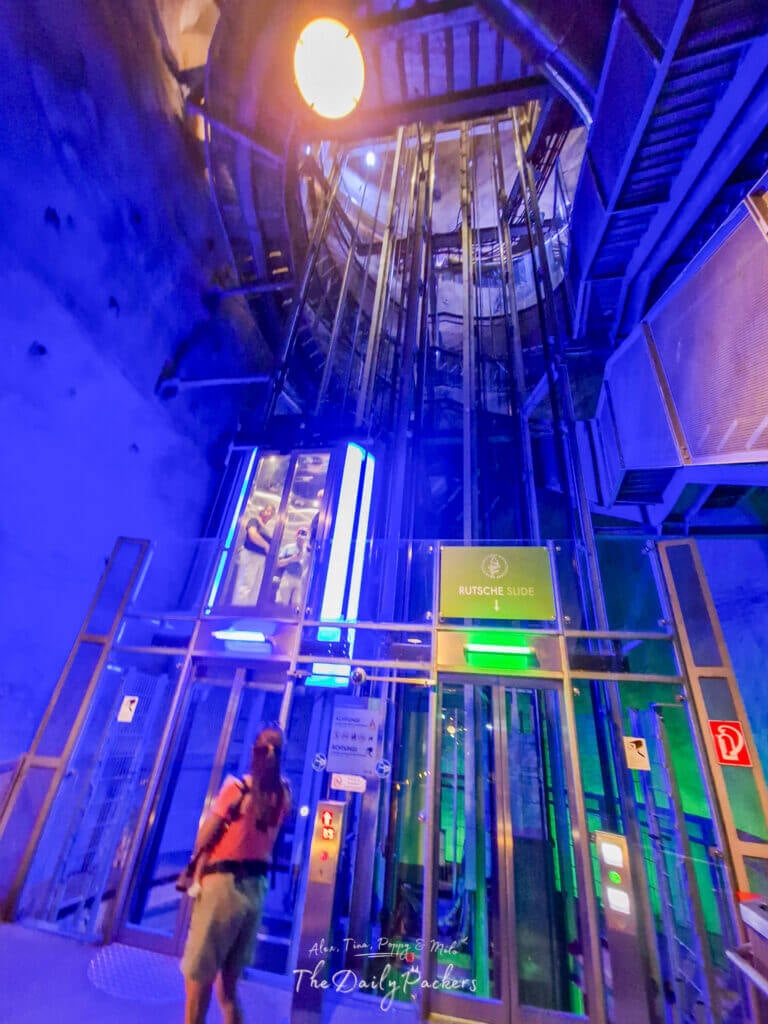
To reach the top of the Schlossberg, you don’t necessarily have to hike up. The Schlossberglift, a modern glass elevator built into the rock, whisks you up 60 meters in just a few seconds. It’s a fun and futuristic way to reach the famous Clock Tower and enjoy the views without breaking a sweat.

The lift departs from inside the Schlossberg tunnel system, which in itself is worth seeing. Originally built during World War II as air-raid shelters, the tunnels now house art exhibitions and events, making the journey part of the experience.
If you’d rather mix it up, you can always ride the lift one way and take the stairs or the funicular the other — that way, you’ll see the mountain from different perspectives.
If you are with kids, there is a little train and a long slide inside the complex.
Here are all your accommodation options in Graz
Explore the Schlossberg
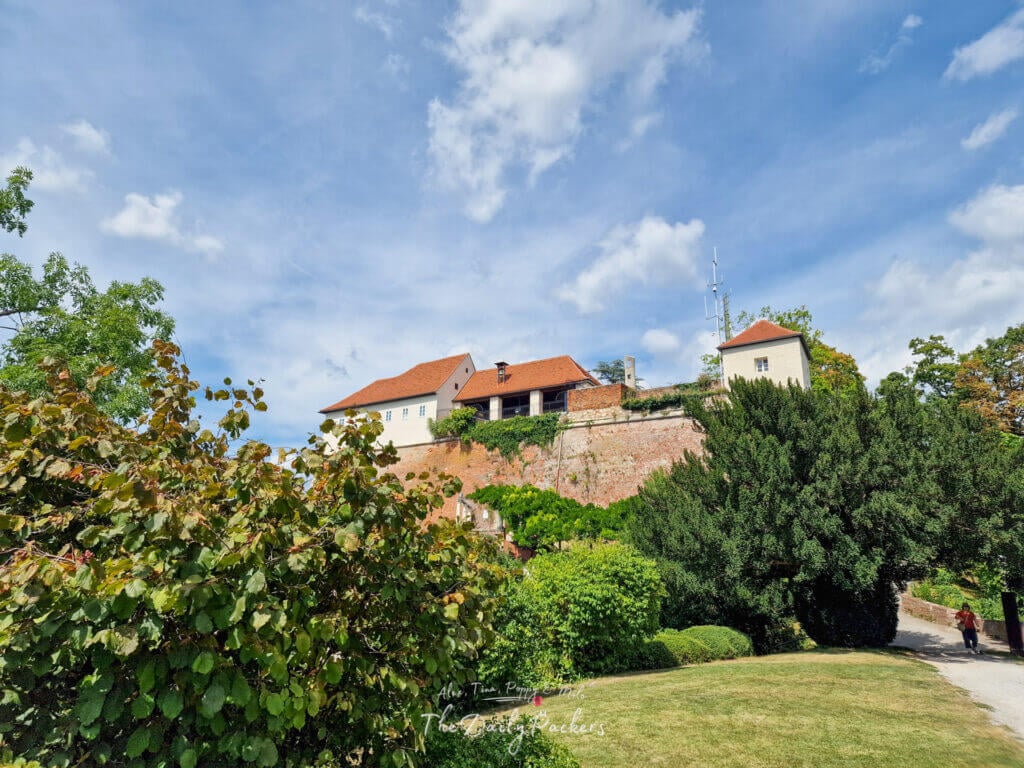
The Schlossberg is the heart of Graz and one of its absolute highlights. Rising right above the Old Town, this green hill was once home to a mighty fortress. Today, it’s a mix of historic ruins, walking trails, viewpoints, and lively spots to sit with a drink while enjoying the view.

The climb up can be done by stairs, the funicular, or the glass Schlossberglift — each offering a different way to experience the hill. Once on top, you’ll find leafy paths leading to gardens, old bastions, and panoramic terraces overlooking the red rooftops of Graz. It’s the perfect place for a relaxed walk, and no matter which direction you look, the views are spectacular.
The Schlossberg is also home to the Clock Tower, the symbol of Graz, which we’ll cover separately because it deserves its own spotlight.
Tip: We use the DJI Action 4 to film our vlogs — compact, durable, and perfect for capturing every adventure.
Visit the Uhrturm (Clock Tower)
The Uhrturm is the iconic symbol of Graz and one of the city’s most photographed landmarks. Sitting proudly on top of the Schlossberg, it dates back to the 13th century and has been watching over the city for centuries.
What makes the tower special is its unique clock face — the hands are reversed compared to most clocks. The large hand shows the hours, while the small one marks the minutes. This design comes from a time when precise minutes didn’t matter, but knowing the hour did.
Around the tower, you’ll find one of the best viewpoints in Graz. The panorama stretches across the Old Town rooftops, the Mur River, and all the way to the surrounding hills. It’s especially magical at sunset when the city glows in golden light.
The Uhrturm isn’t just a clock — it’s the soul of Graz, and no visit to the city would be complete without walking up to it.

Ride the Schlossbergbahn
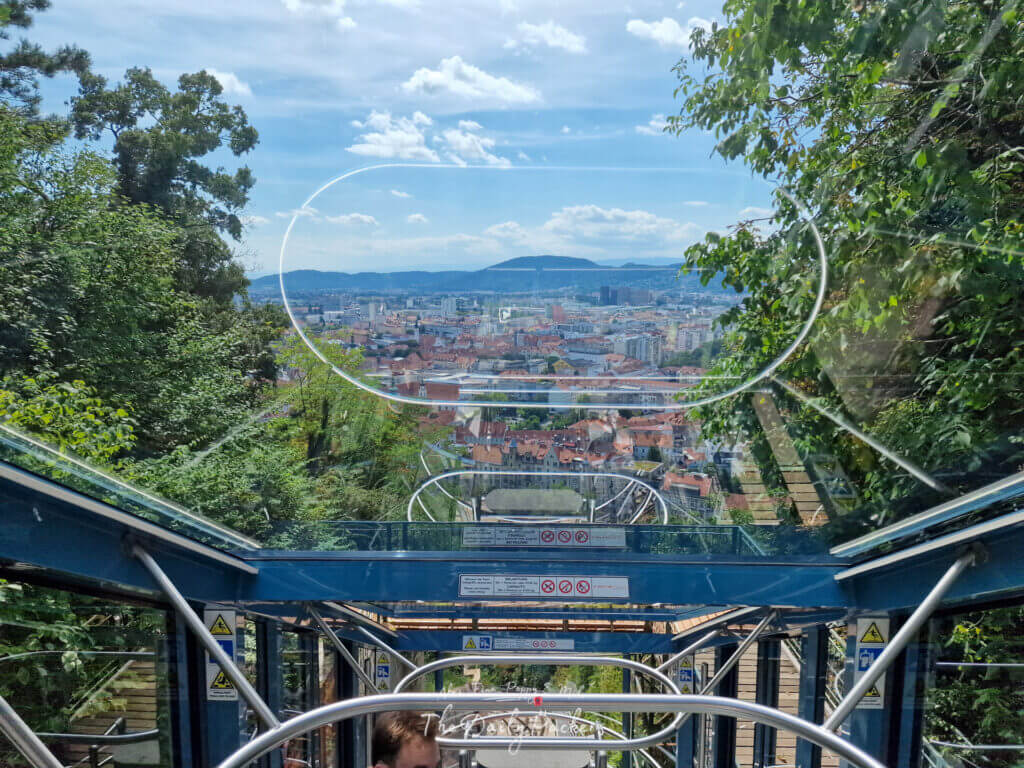
If you don’t feel like climbing the many steps up to the Schlossberg, the Schlossbergbahn funicular is the easiest and most scenic way to reach the top. Opened in 1894 and later modernized, it’s one of the oldest funiculars in Austria.

The ride takes just a few minutes, but it’s a fun experience in itself. The glass-roofed carriages give you wide views as you slowly climb the steep hillside, with Graz’s red rooftops and the Mur River spreading out below.
Explore Murinsel
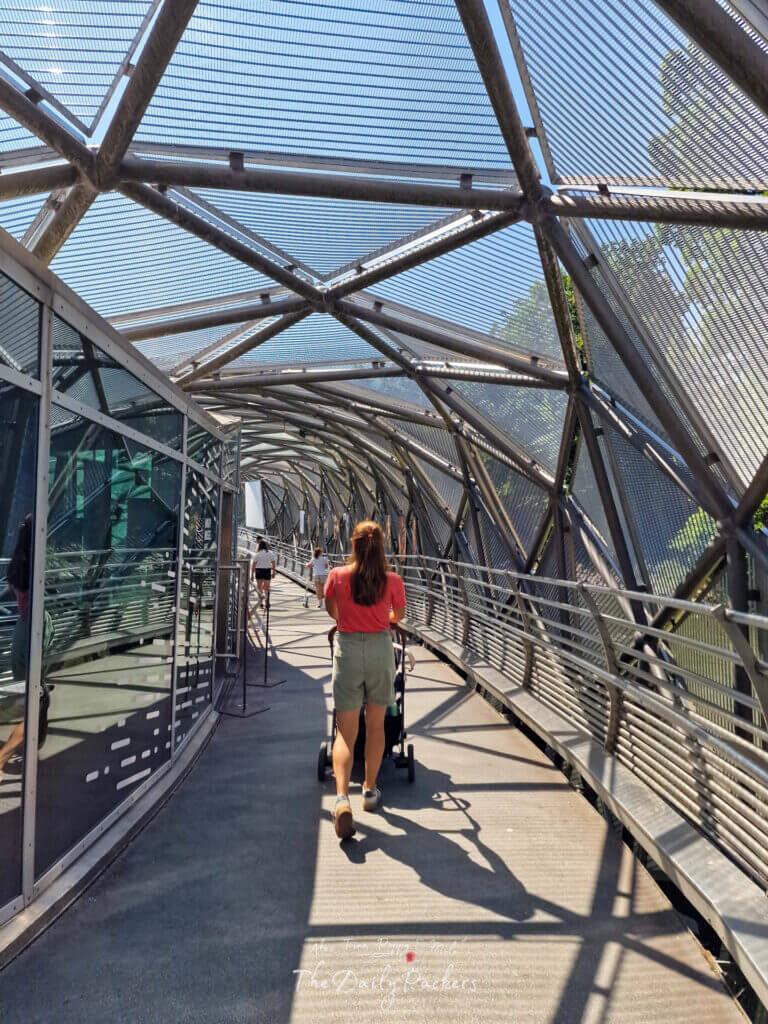
One of the most unique landmarks in Graz is the Murinsel, or “Island in the Mur.” Originally built in 2003 when Graz was named the European Capital of Culture, this floating structure sits in the middle of the Mur River and is shaped like a giant seashell.
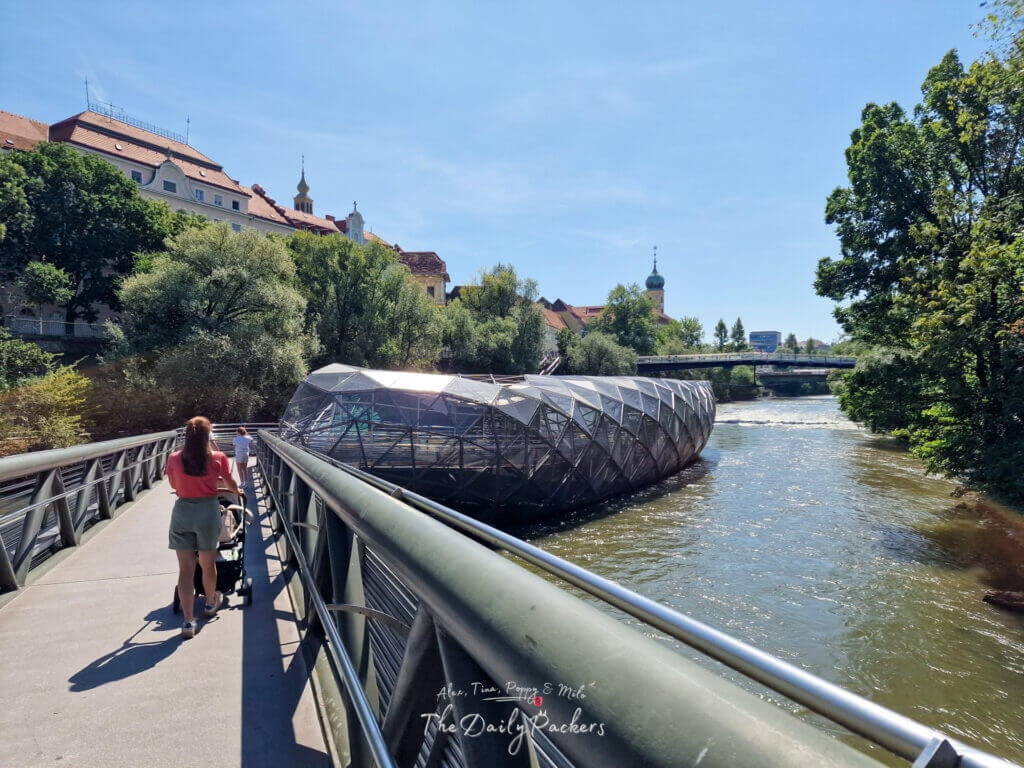
Half bridge, half artificial island, Murinsel connects both banks of the river while also serving as a cultural space. Inside, you’ll find a small café, a playground, and an amphitheater where events are sometimes held. Even if you don’t stop for a drink, it’s worth crossing just for the futuristic design and the views of the city framed by the river.
At night, the island is beautifully lit up, making it a great spot for an evening stroll. It’s not every day you get to walk on an architectural landmark floating in the middle of a river!
Tip: Now, that we travel with baby Milo, we always bring this Babybjorn baby carrier with us.
Visit Schloss Eggenberg
If there’s one place in Graz that feels like stepping back in time, it’s Schloss Eggenberg. Built in the 17th century for Prince Hans Ulrich von Eggenberg, this Baroque palace is the most important and largest in Styria. Today, it’s a UNESCO World Heritage Site and part of the Universalmuseum Joanneum.

The palace is surrounded by a beautiful park filled with peacocks that wander freely—already a good enough reason to visit! Inside, the State Rooms are the real highlight. They’re richly decorated with frescoes, paintings, and ornate details, all designed to represent the harmony of the cosmos (the palace itself was built with symbolic references to time, planets, and the calendar).
If you’re into art and history, don’t miss the Alte Galerie, numismatic collection, and archaeology museum also located within the complex. Even if museums aren’t your thing, the palace gardens are perfect for a peaceful walk away from the busy city center.
Schloss Eggenberg sits about 4 km from the old town, and you can easily reach it by tram in less than 20 minutes.

Tip: This is the stroller we recommend for traveling — it’s super lightweight and compact enough to fit in airplane cabins.
Explore the Arnold Schwarzenegger Museum
Just outside Graz, in the small village of Thal, you’ll find the Arnold Schwarzenegger Museum—the only official museum in the world dedicated to the life of the Hollywood star and former Governor of California. What makes it extra special is that it’s set inside the actual house where Arnold was born and grew up.
The museum takes you through every stage of his incredible journey: from his early days in Austria, to becoming Mr. Olympia, his legendary Hollywood career with classics like Terminator and Predator, and his time in American politics. Each room is dedicated to a chapter of his life, featuring personal items, training equipment, movie props, and even some of his original furniture.
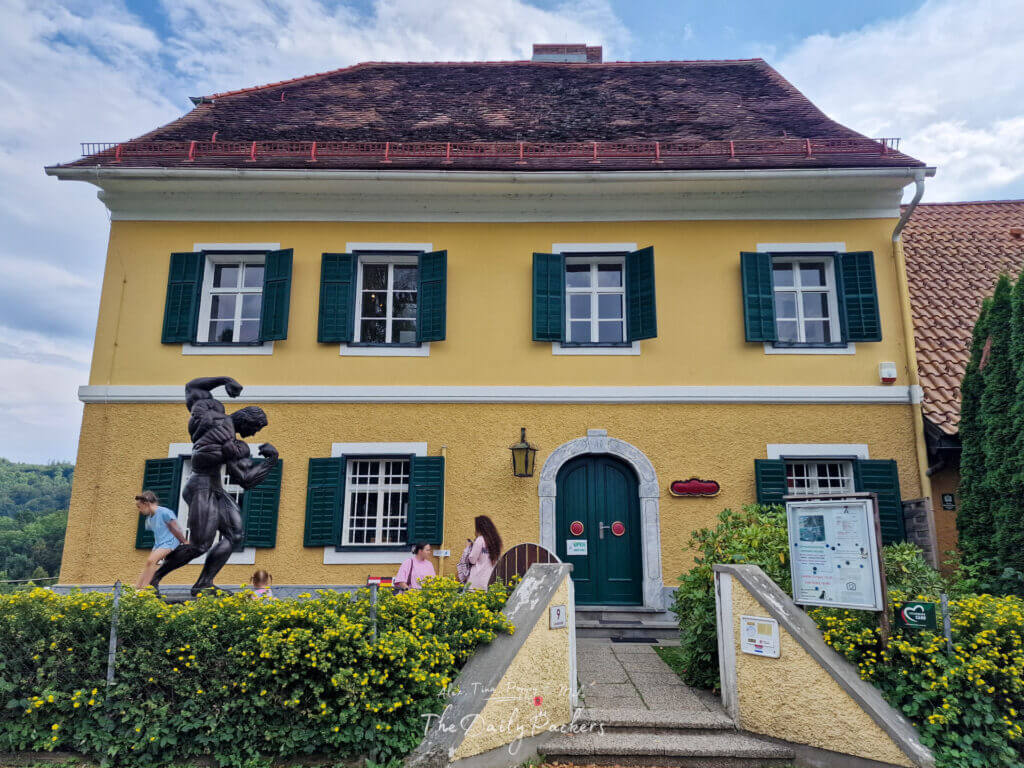
Outside, you’ll also spot a huge bronze statue of Schwarzenegger, which has become a popular photo stop for fans.
The museum is only about a 15-minute drive from Graz, making it a perfect side trip if you’re a fan of “Arnie” or just curious to learn more about the most famous Austrian in the world.
The place is more about the man himself and where it comes from rather than a massive museum.

We recommend to rent a car through Discover Cars with free cancellation. Book your rental car here.
Relax at Thaler See
If you’re looking for a peaceful escape just outside Graz, head to Thaler See, a small lake surrounded by forests and gentle hills. It’s a favorite local spot for walking, jogging, or simply relaxing by the water.

In summer, you can rent paddleboats or go for a refreshing swim, while in autumn the area turns into a colorful, scenic spot for a quiet stroll. There’s also a lakeside café where you can grab a drink or snack and enjoy the view.
Thaler See is only about a 15-minute drive from Graz and pairs perfectly with a visit to the Arnold Schwarzenegger Museum, since both are located in Thal. It’s an easy way to mix sightseeing with some downtime in nature.

Explore Graz’s Museums
If you enjoy art, history, or unique architecture, Graz has plenty of museums to dive into.
- Styrian Armory (Landeszeughaus) – Home to the world’s largest historical armory, with over 30,000 weapons, suits of armor, and military equipment from the 15th to 18th centuries. Walking through its halls feels like stepping back into medieval times.
- New Gallery Graz – Part of the Universalmuseum Joanneum, this gallery focuses on modern and contemporary art. It features Austrian artists alongside international names, covering everything from classical modernism to the present day.
- Kunsthaus Graz – Nicknamed the “Friendly Alien” for its futuristic design, this contemporary art museum is one of Graz’s most recognizable landmarks. It hosts rotating exhibitions of international contemporary art and offers a completely different vibe from the city’s historic old town.

Graz Itinerary
Day 1 – Old Town & Schlossberg
- Start your day in the Old Town, strolling through cobbled streets, colorful courtyards, and Renaissance buildings.
- Visit the Grazer Landhaus, with its beautiful Renaissance arcaded courtyard.
- Stop by Graz Cathedral and the Mausoleum of Emperor Ferdinand II. right next door.
- Walk over to the Doppelwendeltreppe (Double Spiral Staircase) inside the Grazer Burg – one of Graz’s quirkiest sights.
- Take a breather at the Burggarten or Stadtpark Graz, both calm green spaces close to the center.
- Ride the Schlossberglift (glass elevator through the mountain) up to the Schlossberg. Explore the fortress ruins and enjoy the views.
- Visit the Uhrturm, Graz’s iconic Clock Tower, and if you like, ride the Schlossbergbahn funicular down.
- Cross over to the Murinsel Graz, a futuristic floating island on the Mur River, especially stunning when lit up at night.
Day 2 – Palaces, Museums & Nature
- Head to Schloss Eggenberg, Graz’s most beautiful palace and a UNESCO site. Stroll through the lavish staterooms and expansive gardens.
- Head instead to the Arnold Schwarzenegger Museum, located in his childhood home in Thal.
- Relax at Thaler See, a local lake just outside Graz, perfect for a calm walk or a peaceful sunset.
Here are all your accommodation options in Graz
About the authors
We are Alex and Tina, a French-Serbian couple who met in China back in 2014. We spent three incredible years there before making France our home. Our shared passion for travel has been the heartbeat of our relationship for over 12 years, taking us across 44 countries and counting.
We launched TheDailyPackers in 2019 as a way to document our adventures. In 2026, we reached a major milestone by officially turning our blog into our full-time job. While we are still growing toward financial independence through this platform, every article we write is fueled by our mission to make your voyages easier through in-depth guides, honest advice, and the lessons we’ve learned from our own mistakes.
Our journey has not been without its storms. In 2023, our world changed forever when our first son, Poppy, was stillborn on November 25th. It was, and remains, the hardest chapter of our lives. In 2025, we were blessed with our second little boy, Milo. He has since joined our traveling tribe, and you’ll be seeing him—and the reality of traveling with a little one-on the blog more and more.
We hope to inspire you to explore the world with curiosity and resilience. Thank you for being part of our story.
You may also like those related posts
How to Get from Villa General Belgrano to Mendoza by Bus
10 Best places in Argentina You Shouldn’t Miss on Your Next Trip
8 Best Hikes in Argentina You Shouldn’t Miss on Your Next Trip
11 Best things to do in Maafushi, Maldives, in 3 days
Visit the Palace of Versailles: France’s Best Castle in 2025
Merzouga Luxury Desert Camp: 3 Days in the Sahara Dunes
12 Best things to do in Saint Malo, France, in 2 days or more
The Best Tour du Mont Blanc Packing list 2025
Pssst, did you know that…
If you purchase something through our links, we earn a small fee. However, you still pay the same. Win-win! And one day we may get to be full-time travel bloggers =)
Find Hotels with Booking.com
Do Yoga with KVY
Buy us a Coffee
Rent a car with DiscoverCars
Find Attractions with GetYourGuide
Find Flights with Expedia
Buy an eSIM with Airalo
Get insured with World Nomads
Get ready with Amazon.com