
Introduction
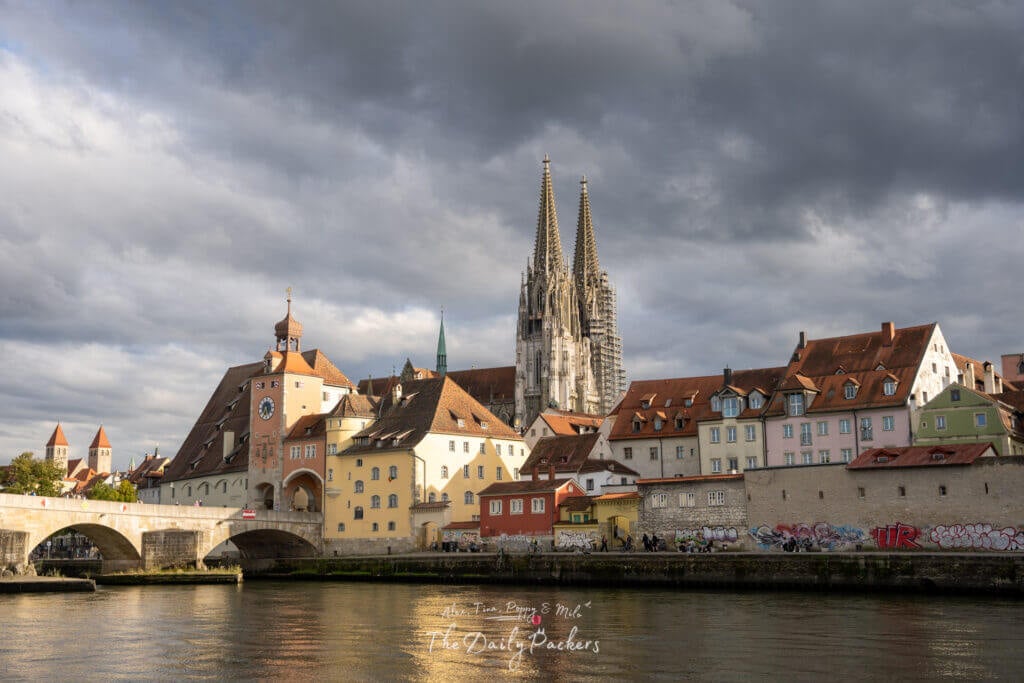
Regensburg is one of Bavaria’s most beautiful cities and a UNESCO World Heritage Site, known for its perfectly preserved medieval old town. Walking through its narrow cobblestone streets feels so amazing and relaxing, with pastel-colored houses, Gothic spires, and Roman remains all blending.
We didn’t really expect much of the city and opted to stop there because it was conveniently located between Bratislava in Slovakia and our home in Strasbourg, France.
What struck us most was how alive the city feels, and we fell in love with it at first sight. It’s not just a museum of the past but a place full of cozy cafés, buzzing beer gardens, and riverside walks where locals and visitors mix.
Whether you’re admiring the impressive Regensburg Cathedral, exploring hidden courtyards, or stopping for a slice of cake, the city has a welcoming charm that’s easy to fall for.
Being right on the Danube, Regensburg is also the perfect base for a scenic cruise, especially the one to Valhalla, a striking 19th-century monument set above the river. Between historical landmarks, laid-back afternoons, and great food, Regensburg has just the right balance of culture and relaxation to keep you exploring at your own pace.
And the hidden part is that the city also has one of the most beautiful Christmas markets in Germany. Meaning that we will have to go back there to experience it.
Getting there
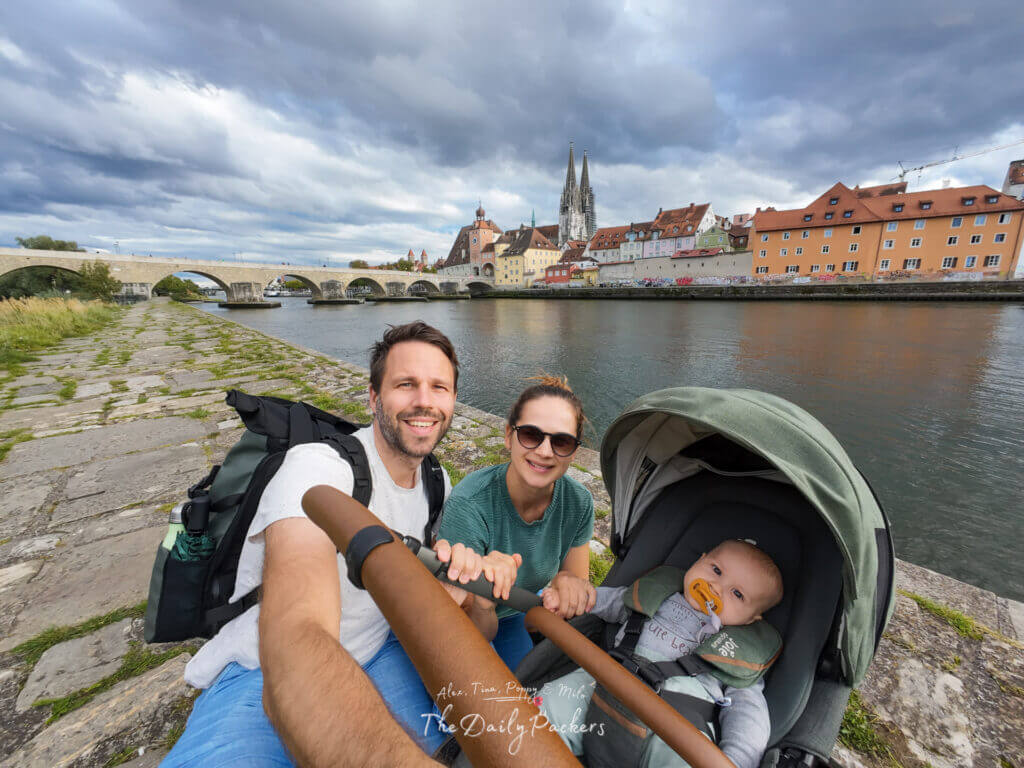
Regensburg is located in Bavaria, about 120 kilometers north of Munich, which makes it easy to reach, whether you’re traveling by train, car, or even on a river cruise.
The fastest and most convenient way is by train. From Munich, direct regional and high-speed trains run regularly and take around 1.5 hours. Nuremberg is also well connected, with direct trains taking just over an hour. If you’re coming from further away, Munich Airport is the closest international hub, and from there you can hop on a train via Munich main station straight to Regensburg.
Driving is another good option if you’re planning a road trip through Bavaria. The city is linked by the A3 and A93 highways, and parking is available in several garages around the old town. We personally used the Parkhaus Petersweg which was really great (2min from our accommodation and cost daily 12 to 15€)
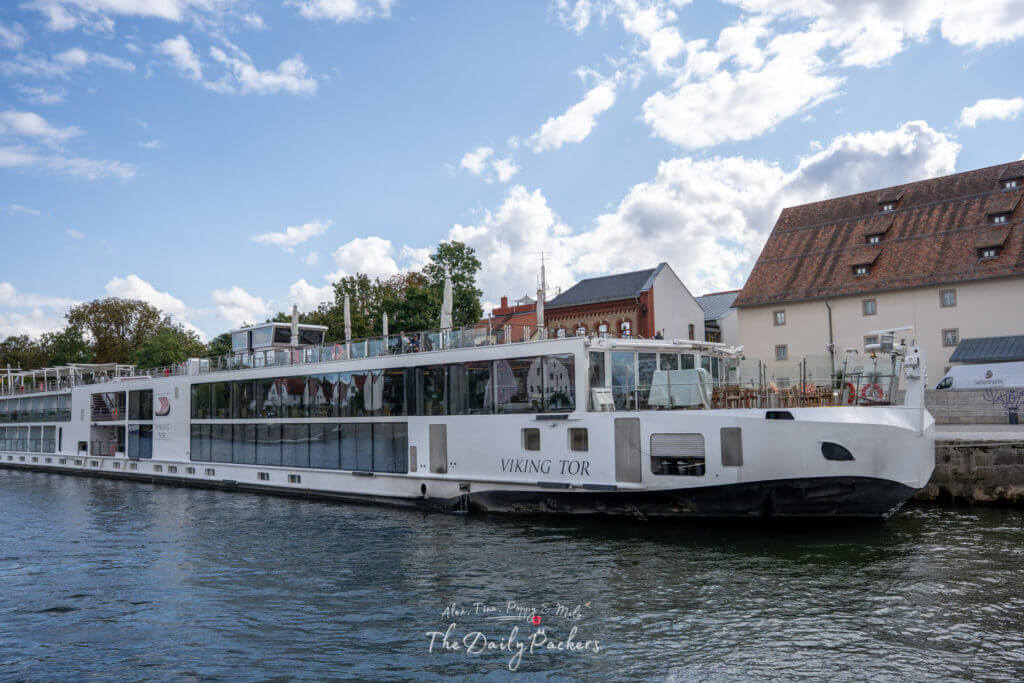
For a slower approach, Regensburg is also a stop for some Danube river cruises, which makes for a very unique way to arrive right in the heart of the city.

Check all your transportation options online — from buses to trains and ferries — it makes planning so much easier.
Moving Around
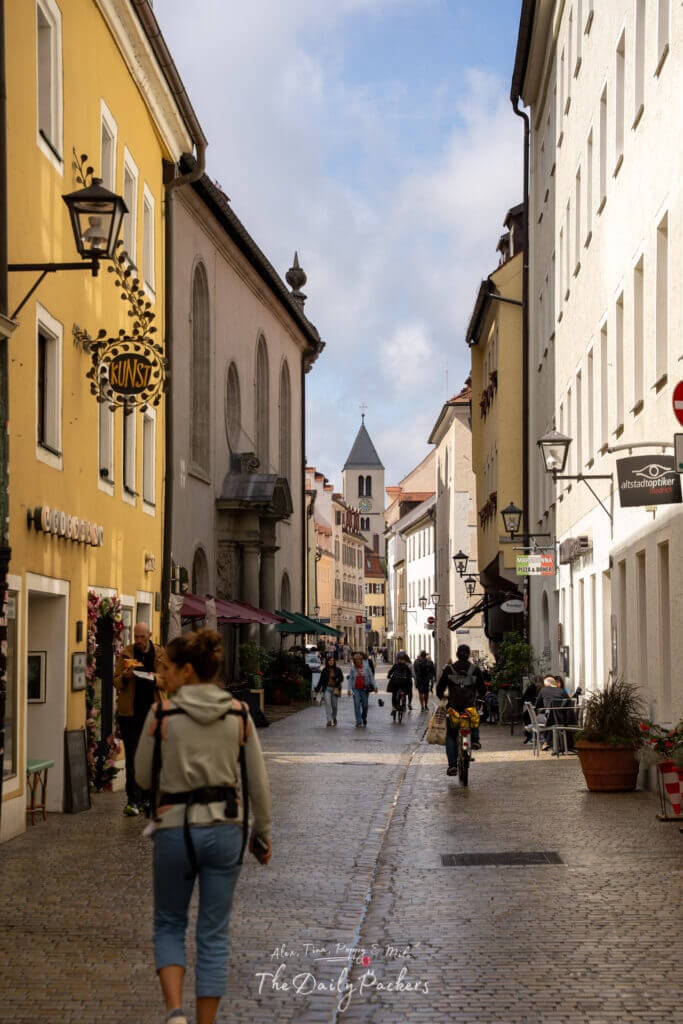
The old town of Regensburg is compact and pedestrian-friendly, so the best way to explore is simply on foot. Every corner hides another church, square, or pastel-colored building, and you’ll enjoy the atmosphere much more at a slow pace.
If you want to venture further, local buses cover the wider city, and bike rentals are also a fun option, especially for following the Danube. But honestly, most of your time here will be spent wandering the charming streets, stopping for coffee or a beer, and enjoying the view from the riverbanks.
And to visit the Valhalla monument, we would recommend the river cruise, which we loved.

We recommend to rent a car through Discover Cars with free cancellation. Book your rental car here.
When to Visit
Regensburg can be enjoyed year-round, but the experience changes a lot with the seasons. Here’s what to expect:
- Spring (March to May): Spring is a beautiful time to visit as the city wakes up after winter. Temperatures range from 10–18°C (50–64°F), perfect for strolling the old town without the heavy summer crowds. The cafés begin to spill out onto the streets, and the parks along the Danube start turning green.
- Summer (June to August): This is the liveliest season, with long days, outdoor events, and bustling beer gardens. Temperatures usually sit between 20–28°C (68–82°F), though it can occasionally get hotter. Summer is great for a Danube cruise or just enjoying the city’s lively atmosphere, but expect more visitors and higher prices.
- Autumn (September to November): Autumn brings crisp air, colorful leaves along the riverbanks, and a calmer vibe after the busy summer. Temperatures range from 8–18°C (46–64°F). It’s also the season for cozying up in traditional Bavarian restaurants and enjoying local beer festivals on a smaller scale than Munich’s Oktoberfest.
- Winter (December to February): Regensburg is cold in winter, with temperatures between –2–5°C (28–41°F), but it has its charm. The Christmas markets light up the medieval streets, especially the one at Thurn and Taxis Palace, which feels straight out of a fairy tale. Dress warmly, and you’ll love the festive atmosphere.
Tip: If it’s your first time, late spring and early autumn are the most comfortable seasons to enjoy Regensburg without too many crowds, while still having great weather for walking and cruising along the Danube.

Where to Stay
Regensburg is worth at least two or three nights if you want to enjoy its old town at a relaxed pace, take a cruise on the Danube, and have time for a few day trips. The city has plenty of charming stays, from boutique hotels to historic addresses right by the cathedral. Here are some good options:
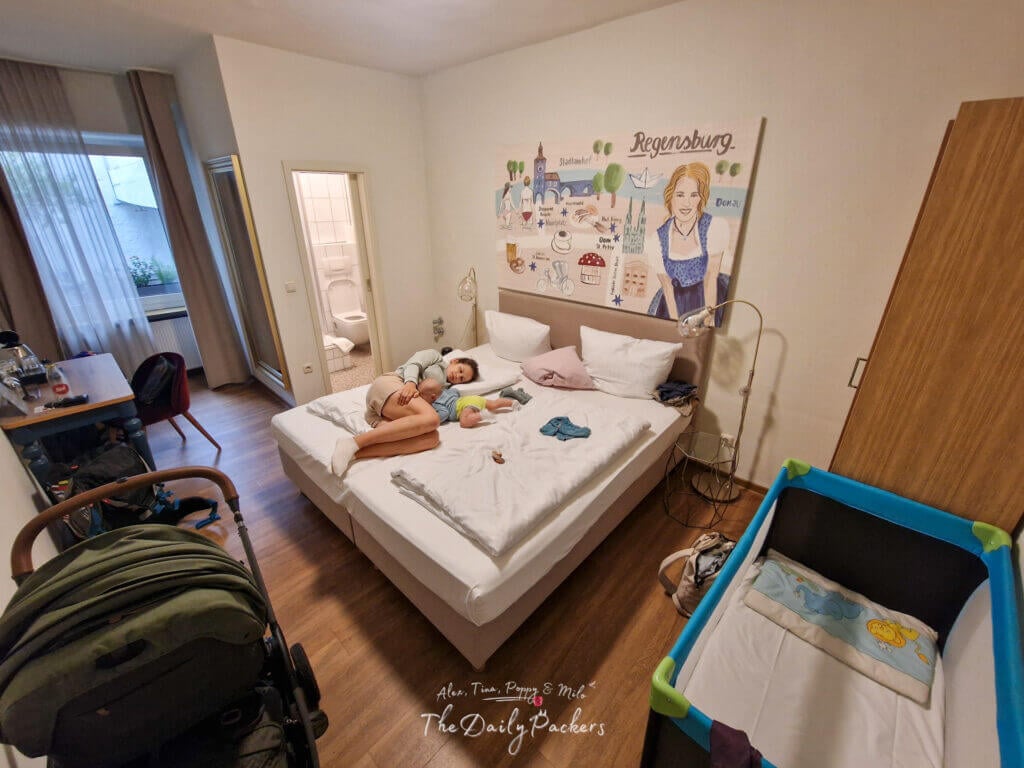
(€) Rosi Boutique Hotel: A cozy boutique hotel with modern design and a playful, colorful touch. It’s a more affordable choice without losing comfort, and the location makes it easy to reach the old town on foot. Great for travelers who want something stylish yet budget-friendly.
(€€) Hotel Bischofshof am Dom: This historic hotel sits right next to Regensburg Cathedral, and staying here feels like being part of the city’s story. The rooms are elegant, with a classic Bavarian style, and the on-site restaurant serves hearty local dishes. The central location means you can step outside and immediately be surrounded by the old town’s charm.
(€€€) Hotel Goliath am Dom: A boutique-style luxury stay just a short walk from the cathedral. Rooms are modern and spacious, with big windows and comfortable beds, perfect for a restful break after exploring all day. The hotel also has a rooftop terrace with views over Regensburg’s rooftops, making it a nice choice if you’re looking for something a little special.

Here are all your accommodation options in Regensburg
What to Eat
Food in Regensburg is a mix of hearty Bavarian classics and modern international spots. You’ll find traditional dishes like sausages, pretzels, and schnitzel everywhere, but the city also has a fun creative side with vegetarian, vegan, and fusion options. Don’t miss trying the famous Regensburger Wurst (grilled sausages served with sauerkraut and mustard) or stopping by one of the beer gardens for a cold Bavarian brew with local specialties. For dessert, apple strudel and cakes are musts in the cafés scattered around the old town.
Where to Eat in Regensburg
Regensburg has no shortage of good food, whether you’re after something traditional or modern. A few places we enjoyed:
- Guacamole – A lively spot with Mexican-inspired food and cocktails. Perfect if you’re craving something different after a few heavy Bavarian meals.
- Cat Temple Regensburg – A cozy vegan café where cats roam freely while you sip your coffee or snack. It’s both relaxing and a bit quirky, especially if you’re an animal lover.
- Malefiz – Café & Bar – Regensburg – A laid-back café and bar with a creative menu, ideal for brunch, coffee, or evening drinks. The vibe is casual and local, making it a nice place to slow down.
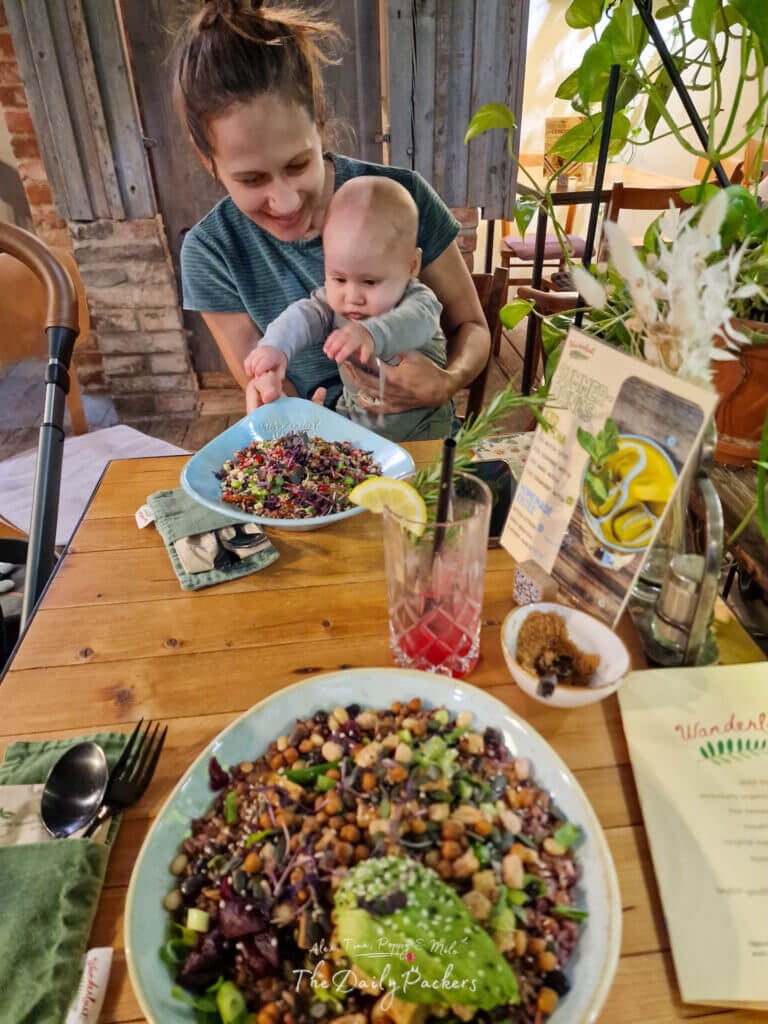
- Wanderlust – A casual eatery with a “make your own poké bowl” concept. Fresh, tasty, and perfect if you want something lighter after a day of walking around the city.
Best things to do in Regensburg
Explore the Old Town
The heart of Regensburg is its UNESCO-listed old town, one of the best-preserved medieval centers in Germany. Wandering here is half the fun—you’ll find cobblestone streets, colorful façades, hidden courtyards, and countless churches that seem to appear around every corner.

What makes the old town special is how lively it feels. It’s not just a historic backdrop; people live, work, and gather here. You’ll pass by small cafés spilling onto the streets, traditional shops, and beer gardens tucked into squares.

We loved just strolling around without an agenda—stopping for coffee, visiting a church, or finding a quiet spot along the Danube. The old town is compact and walkable, which makes it easy to explore at your own pace and soak up the atmosphere.


Tip: Now, that we travel with baby Milo, we always bring this Babybjorn baby carrier with us.
Stop at Neupfarrplatz
Neupfarrplatz is one of those squares you’ll naturally end up crossing a few times while exploring Regensburg. Right in the middle of the old town, it feels like a hub where history and daily life come together. At its center stands the Neupfarrkirche, a small but striking church that gives the square its name.

What we liked about Neupfarrplatz is how it’s always busy with something—market stalls, small events, or just people meeting for a coffee. Around the edges, you’ll find plenty of shops and cafés, making it a good place to pause for a bit before continuing your walk. And if you look closer, you’ll also see traces of history, since this square once stood at the heart of Regensburg’s former Jewish quarter.

During the Christmas season, the square transforms with lights and stalls, creating one of the city’s main festive markets. It’s a place where you feel both the everyday rhythm of Regensburg and the weight of its past, all in one spot.

Here are all your accommodation options in Regensburg
Visit the Basilica of the Nativity of Our Lady
Just a short walk from Neupfarrplatz, the Basilica of the Nativity of Our Lady (Basilika Unserer Lieben Frau zur Alten Kapelle) is one of the most impressive churches in Regensburg. From the outside, it looks rather modest, but once you step inside, it’s a different story—the interior is lavishly decorated with gold, frescoes, and detailed stucco that immediately catch your eye.

This basilica is one of the city’s oldest religious sites, with roots going back to the 9th century. Over the centuries, it has been rebuilt and redesigned, which explains the mix of styles you’ll notice. What stands out most today is the Baroque and Rococo interior, making it one of the most ornate churches in Regensburg.

It’s a peaceful place to step into after walking the busy streets outside, and definitely worth a visit even if you’ve already seen a few other churches in the city. The contrast between the plain exterior and the richly decorated inside makes it one of those memorable surprises in Regensburg’s old town.

Tip: This is the stroller we recommend for traveling — it’s super lightweight and compact enough to fit in airplane cabins.
Admire St. Peter’s Cathedral
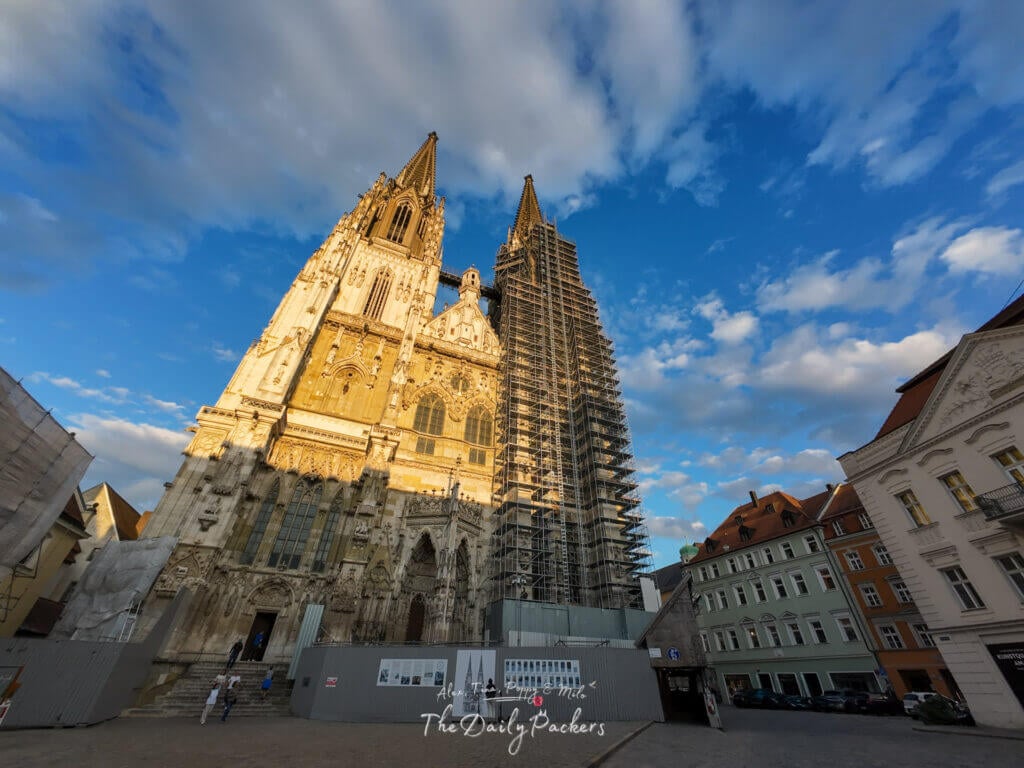
St. Peter’s Cathedral (Dom St. Peter) is the landmark of Regensburg and one of the finest Gothic churches in all of Germany. You can’t miss it—the twin spires rise above the old town and are visible from almost anywhere in the city. Standing in front of it, the sheer scale and detail of the façade are enough to keep you staring for a while.

Inside, the cathedral feels just as impressive. The soaring arches, stained-glass windows, and quiet atmosphere give it a powerful presence. If you’re lucky, you might catch the famous Regensburger Domspatzen boys’ choir performing here, which makes the experience even more special.


Tip: We use the DJI Action 4 to film our vlogs — compact, durable, and perfect for capturing every adventure.
See the Lower Minster Cathedral Parish Church
Tucked just a short distance from St. Peter’s Cathedral, the Lower Minster Cathedral Parish Church (Niedermünster) feels like a hidden gem in Regensburg. From the outside, it’s easy to overlook compared to the grandeur of the main cathedral, but step inside and you’ll discover a quiet, atmospheric space with centuries of history behind it.

The church is built on the remains of an early medieval convent, and today you can visit the archaeological excavations below, which reveal layers of Roman and early Christian history. Walking through these underground passages gives you a completely different perspective on Regensburg’s long past.

Walk Through Porta Praetoria
Porta Praetoria is one of those places where you suddenly realize just how far back Regensburg’s history goes. Built by the Romans in the 2nd century AD, it’s one of the oldest stone structures in the city and once served as a northern gateway to the Roman fortress of Castra Regina.
Today, the remains of the gate are tucked between more modern buildings, and you might almost miss it if you’re not paying attention. Standing in front of its weathered stones, though, you get a sense of the incredible timeline of this city—Roman soldiers once marched through here, long before the medieval streets and Gothic spires we see today.

Cross the Stone Bridge (Steinerne Brücke)
The Stone Bridge is one of Regensburg’s most iconic landmarks and a must when exploring the city. Built in the 12th century, it was once considered a marvel of medieval engineering and played a key role in trade routes across Europe. Today, it still stretches proudly across the Danube, linking the old town with the quieter Stadtamhof district.

Walking across the bridge gives you some of the best views of Regensburg. On one side, you see the cathedral towers rising above the rooftops, while on the other, the wide Danube flows calmly beneath you. It’s especially beautiful at sunset, when the city glows in warm light.

At the foot of the bridge, you’ll also find the historic Wurstkuchl, said to be the world’s oldest sausage kitchen, serving Regensburger sausages for hundreds of years.

Tip: Now, that we travel with baby Milo, we always bring this Babybjorn baby carrier with us.
Wander Through Stadtamhof
Just across the Stone Bridge, you’ll find Stadtamhof, a former independent town that today feels like an extension of Regensburg’s old center. It’s quieter and less crowded than the main squares, with narrow cobblestone streets, colorful houses, and a more relaxed atmosphere.

We enjoyed strolling through Stadtamhof because it feels a bit more local—you’ll find small cafés, bakeries, and restaurants tucked into the old buildings. It’s also a great place to grab a drink or meal with a view back toward Regensburg’s skyline across the Danube.

The area is small, so you won’t need long to explore, but it’s worth crossing the bridge just to experience the change in pace. If you’re visiting in the evening, Stadtamhof is especially charming when the lights of Regensburg reflect on the river and the cathedral towers glow in the distance.

Tip: We use the DJI Action 4 to film our vlogs — compact, durable, and perfect for capturing every adventure.
Visit the Old Town Hall (Altes Rathaus)
Right in the center of the old town, the Altes Rathaus is one of Regensburg’s most important historic buildings. From the outside, it looks like a charming medieval complex with colorful façades and a tall tower, but its history goes far beyond appearances. For centuries, it was the seat of the Imperial Diet of the Holy Roman Empire, making it a place where major political decisions were made.
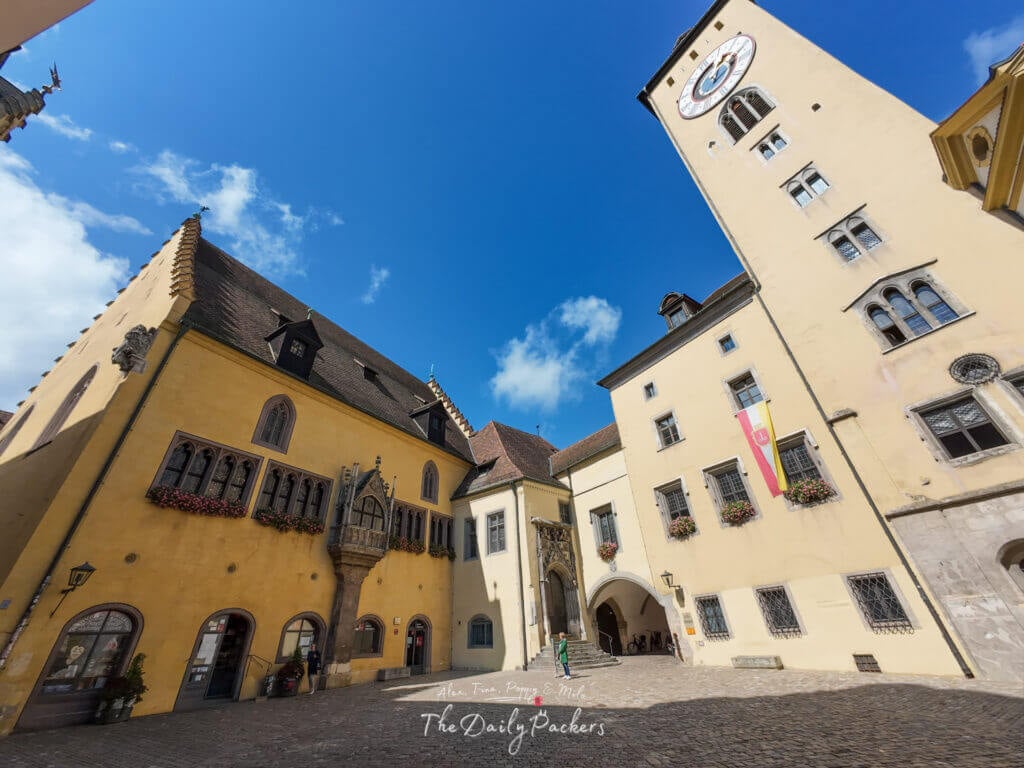
Inside, you can join a guided tour to see the richly decorated Imperial Hall, council chambers, and even the old torture chamber in the cellar. The tour gives a fascinating look into how the city was governed and its role in European politics.

Tip: This is the stroller we recommend for traveling — it’s super lightweight and compact enough to fit in airplane cabins.
Relax at Haidplatz
Haidplatz is one of the most atmospheric squares in Regensburg, and it feels like stepping straight into a medieval postcard. Surrounded by colorful townhouses and historic buildings, the square has long been a gathering place for markets, festivals, and daily life. Today, it’s lined with cafés and restaurants where you can sit outside and watch the city go by.

One of the most striking buildings here is the Golden Cross, a 16th-century house that once hosted emperors and princes. The square itself is lively but not overwhelming, making it a perfect spot to pause with a coffee or beer before continuing your walk through the old town.

Step Inside Trinity Church
Trinity Church (Dreieinigkeitskirche) is a quiet yet fascinating stop in Regensburg. Built in the early 17th century, it was the first Protestant church constructed in the city after the Reformation, which gives it an important place in local history.

The church is quite different from the richly decorated Catholic basilicas you see elsewhere in Regensburg. Its interior is simpler, with white walls, wooden galleries, and clean lines that create a calm, almost understated atmosphere. Standing inside, you can feel the contrast in style and spirit compared to the city’s Gothic and Baroque churches.
But what makes it truly worth visiting is that you can go on a tower tour from Monday to Sunday from 12:00 PM to 6:00 PM

Here are all your accommodation options in Regensburg
Watch a Performance at Theater Regensburg
Theater Regensburg is the cultural heart of the city, and if you have the time, it’s worth checking what’s on during your visit. The theater dates back to the early 19th century and today hosts a wide variety of performances, from opera and classical music to modern plays and dance.

Even if you don’t plan to attend a show, the building itself is beautiful, with its neoclassical façade and grand interior. But sitting in the audience is the best way to experience it—there’s something special about enjoying a performance in a historic setting right in the middle of Regensburg.

Hang Out at Bismarckplatz
Bismarckplatz is one of the busiest squares in Regensburg and a central hub for both locals and visitors. Surrounded by shops, cafés, and the Theater Regensburg, it’s always full of life, whether you’re passing through during the day or in the evening.
The square is also a major transport stop, so chances are you’ll end up here at some point if you’re taking the bus. But it’s more than just practical—it’s a lively meeting point and a good place to feel the rhythm of the city. Street performers often set up here, and in summer, the terraces are filled with people enjoying a drink in the sun.

Explore the Scots Monastery
The Scots Monastery (Schottenkloster) is one of the oldest monasteries in Regensburg, founded in the 12th century by Irish monks—hence the name. Tucked a little away from the busiest streets, it feels quieter than many of the city’s other landmarks and has a special charm.

The highlight here is the Romanesque Schottenportal, the richly carved portal of the church, decorated with detailed figures and scenes that are full of symbolism. Even if you don’t step inside, it’s worth coming just to admire this masterpiece of medieval stonework.

Tip: Now, that we travel with baby Milo, we always bring this Babybjorn baby carrier with us.
Visit the Basilica of St. Emmeram
The Basilica of St. Emmeram is one of the oldest and most important churches in Regensburg, with origins as far back as the 8th century. Over the centuries it has been rebuilt and expanded, mixing Romanesque, Gothic, and Baroque styles. From the outside it might look quite simple, but step inside and you’ll find richly decorated altars, frescoes, and ornate stucco details.

What makes this basilica especially memorable are the mummified remains of saints and nobles displayed in glass coffins. It’s both fascinating and a little eerie, but it also reflects the long religious history of the place. The basilica was part of a large monastery complex and later became tied to the Thurn and Taxis family, who transformed the area into their residence.

Tour Schloss St. Emmeram, Thurn und Taxis
Right next to the Basilica of St. Emmeram, you’ll find Schloss St. Emmeram, the grand palace of the Thurn and Taxis family. Once a monastery, the complex was converted into a residence in the 19th century and is still owned by the family today. It’s often called the “Versailles of Bavaria,” and once you see its size and elegance, you’ll understand why.

You can visit parts of the palace on a guided tour, which takes you through lavish halls, ornate staircases, and rooms filled with antiques and portraits. The library and ballroom are especially impressive, giving you a real glimpse into the lifestyle of one of Europe’s most influential aristocratic families.

Tip: This is the stroller we recommend for traveling — it’s super lightweight and compact enough to fit in airplane cabins.
Explore the Museums of Regensburg
Regensburg isn’t just about churches and squares; the city also has several museums that help bring its long history and culture to life. Depending on your interests, you can dive into archaeology, medieval life, or even modern Bavarian identity. Here are some highlights:
- Historisches Museum Regensburg – Housed in a former monastery, this is the city’s main museum. It covers everything from Roman artifacts to medieval art and everyday life in old Regensburg. We enjoyed the mix of exhibitions here—it gives you a real overview of the city’s long history.
- House of Bavarian History (Haus der Bayerischen Geschichte) – A modern museum on the banks of the Danube that focuses on Bavaria’s story from the early 19th century to today. It’s interactive, colorful, and does a great job of making history feel accessible.
- Document Neupfarrplatz – Beneath Neupfarrplatz, this small museum shows the remains of the former Jewish quarter. It’s a moving and informative visit that adds depth to the history of the square.
- Domschatzmuseum (Cathedral Treasury Museum) – Located by St. Peter’s Cathedral, this museum displays religious treasures, relics, and liturgical art. It’s a short but fascinating stop if you’re already visiting the cathedral.
- Kepler Museum – Dedicated to the astronomer Johannes Kepler, who lived and died in Regensburg. The museum is small but interesting if you’re curious about science and the Renaissance period.

Tip: We use the DJI Action 4 to film our vlogs — compact, durable, and perfect for capturing every adventure.
Visit Walhalla
A short trip from Regensburg brings you to Walhalla, one of Bavaria’s most unusual monuments. Perched high above the Danube near Donaustauf, this massive neoclassical temple was built in the 19th century by King Ludwig I to honor important figures from German history—writers, scientists, artists, and rulers. Inside, you’ll find marble busts and plaques commemorating more than 100 personalities.

Even if you’re not particularly drawn to the idea of a hall of fame, Walhalla is worth the visit for its sheer scale and location. The temple looks like it was lifted straight from ancient Greece, with its rows of columns and dramatic position overlooking the river. From the top of the steps, the view down to the Danube and across the countryside is spectacular.
You can reach Walhalla by car or bus, but one of the nicest ways is by taking a Danube river cruise from Regensburg, which drops you off nearby. We liked combining both experiences—the slow approach on the river and then the climb up to this grand monument in the forested hills.


Tip: This is the river cruise we took to Walhalla
Take a Danube River Cruise
One of the best ways to experience Regensburg is from the water. A cruise along the Danube offers a different perspective of the city, with the cathedral towers and colorful old townhouses rising above the riverbanks.

There are several options, from short city cruises to longer trips that take you out into the surrounding countryside. The most popular route is the one to Valhalla, which combines a scenic ride with a visit to the monument perched high above the river. The journey takes about an hour each way, with time to explore before returning.
We loved how relaxing the cruise felt—it’s a chance to sit back, enjoy the views, and listen to the commentary (usually available in both German and English) about the history and nature along the Danube. Taking the last boat of the day added an extra touch, as the evening light gave everything a warm glow.

Tip: This is the river cruise we took to Walhalla
Climb the Donaustauf Castle Ruins
Not far from Regensburg and just below Valhalla, you’ll find the ruins of Donaustauf Castle. Perched on a hill above the small village of Donaustauf, the castle dates back to the early Middle Ages and today offers one of the best viewpoints over the Danube valley.
The climb up is short but a little steep, and once at the top, you can wander among the stone remains and imagine what the fortress must have looked like in its prime. The open arches and crumbling walls frame the landscape beautifully, making it a favorite spot for photographers.

Enjoy the Christmas Markets
If you’re visiting Regensburg in December, the Christmas markets are an absolute highlight. The medieval streets and squares turn into a festive wonderland, with wooden stalls selling mulled wine, roasted nuts, handmade crafts, and plenty of seasonal treats.
The main market takes place on Neupfarrplatz, right in the heart of the old town, and it’s always lively with music, lights, and the smell of fresh gingerbread in the air. For something a little more atmospheric, head to the courtyard of Schloss Thurn und Taxis, where the market feels more like stepping into a fairy tale, surrounded by the palace walls.
Regensburg Itinerary
Day 1 – Explore the Old Town
- Start your morning at Neupfarrplatz, grab a coffee, and check out the Neupfarrkirche in the center.
- Visit the Basilica of the Nativity of Our Lady to admire its ornate interior.
- Walk over to St. Peter’s Cathedral, Regensburg’s landmark, and spend time exploring inside and outside.
- Continue to the Lower Minster Cathedral Parish Church (Niedermünster) for its archaeological excavations.
- Stop by the Porta Praetoria, one of the oldest Roman remains in the city.
- Cross the Stone Bridge (Steinerne Brücke) for classic views of the old town and grab lunch near the Wurstkuchl.
- In the afternoon, visit the Old Town Hall and then relax at Haidplatz with a coffee or beer.
- Step inside the Trinity Church for a quieter experience.
- End your evening with dinner in the old town—try Guacamole or Malefiz Café & Bar for something casual.
Day 2 – Culture and Day Trips
- Begin at Theater Regensburg or nearby Bismarckplatz to feel the morning energy of the city.
- Walk to the Scots Monastery to admire its Romanesque portal.
- Visit the Basilica of St. Emmeram and then continue into Schloss St. Emmeram, the grand Thurn und Taxis palace.
- Spend some time in one of Regensburg’s museums—the Historisches Museum or the House of Bavarian History are great picks.
- In the afternoon, take a Danube River Cruise to Valhalla. Climb the steps for the view and, if you have time, continue to the Donaustauf Castle ruins.
- Return to Regensburg for dinner—Wanderlust is perfect if you want something lighter after a busy day.
Extra time / Day 3
- Use a third day to take it slower: visit smaller museums like the Kepler Museum or Domschatzmuseum, enjoy Regensburg’s café culture, or just wander the old town without an agenda. If visiting in December, dedicate some time to the Christmas markets, especially the one at Schloss Thurn und Taxis.
Here are all your accommodation options in Regensburg
About the authors
We are Alex and Tina, a French-Serbian couple who met in China back in 2014. We spent three incredible years there before making France our home. Our shared passion for travel has been the heartbeat of our relationship for over 12 years, taking us across 44 countries and counting.
We launched TheDailyPackers in 2019 as a way to document our adventures. In 2026, we reached a major milestone by officially turning our blog into our full-time job. While we are still growing toward financial independence through this platform, every article we write is fueled by our mission to make your voyages easier through in-depth guides, honest advice, and the lessons we’ve learned from our own mistakes.
Our journey has not been without its storms. In 2023, our world changed forever when our first son, Poppy, was stillborn on November 25th. It was, and remains, the hardest chapter of our lives. In 2025, we were blessed with our second little boy, Milo. He has since joined our traveling tribe, and you’ll be seeing him—and the reality of traveling with a little one-on the blog more and more.
We hope to inspire you to explore the world with curiosity and resilience. Thank you for being part of our story.
You may also like those related posts
Sainte Marie de la Mer : The heart of the French Camargue
Granada Itinerary: Our Perfect 2 Days in Granada, Spain
25 Best things to do in the Black Forest, Germany, in 5 days or more
14 Best things to do in Toulouse, France, in 1 to 3 days
Our Life in China: Always expect the unexpected in 2016
17 Best things to do in Pärnu, Estonia, in 2 days or more
Haarlem, A Perfect 1-Day Trip from Amsterdam, Netherlands
32 best things to do in Buenos Aires, Argentina, in 2 to 7 days
Pssst, did you know that…
If you purchase something through our links, we earn a small fee. However, you still pay the same. Win-win! And one day we may get to be full-time travel bloggers =)
Find Hotels with Booking.com
Do Yoga with KVY
Buy us a Coffee
Rent a car with DiscoverCars
Find Attractions with GetYourGuide
Find Flights with Expedia
Buy an eSIM with Airalo
Get insured with World Nomads
Get ready with Amazon.com