
Introduction
Are you planning your first trip to Argentina? We know that arriving in a new country can feel a bit overwhelming, especially when you’re trying to figure out how to get online or catch the right bus. But don’t worry—once you know the basics, you’ll find that navigating this beautiful country is easier than you think.
In this guide, we’ve put together everything you need to know to hit the ground running. We’ll cover how to stay connected with a local SIM card, the secrets to using public transport (including those famous “Kioscos”), and even how to handle grocery shopping like a local.
Whether you’re spending your time in the bustling streets of Buenos Aires or heading out to explore the wine regions of Mendoza, these Argentina travel tips will help you travel smarter and spend more time enjoying the sights.

Mastering Public Transport
The SUBE Card
The most important of our Argentina travel tips is the Sube card. If you plan on using public transport in Argentina, the first thing you need is a SUBE card. While it started in Buenos Aires, it is now used in most major cities across the country, including Mendoza and Bariloche.
You can buy one at a “Kiosco” (small convenience stores found on almost every corner). Look for the blue SUBE sticker in the window. The card itself has a small cost (expect to pay 490 pesos in 2026), and you’ll need to top it up with credit before you can use it.

To recharge, look for signs that say “Carga acá tu SUBE.” We usually added a few hundred pesos at a time. A great tip we discovered is that if you run out of credit, the card actually allows you to go into a “negative balance” for a ride or two—a lifesaver if you can’t find a Kiosco late at night! Also, you don’t need one card per person; one card can be swiped multiple times for a whole group.

Buses (Colectivos)
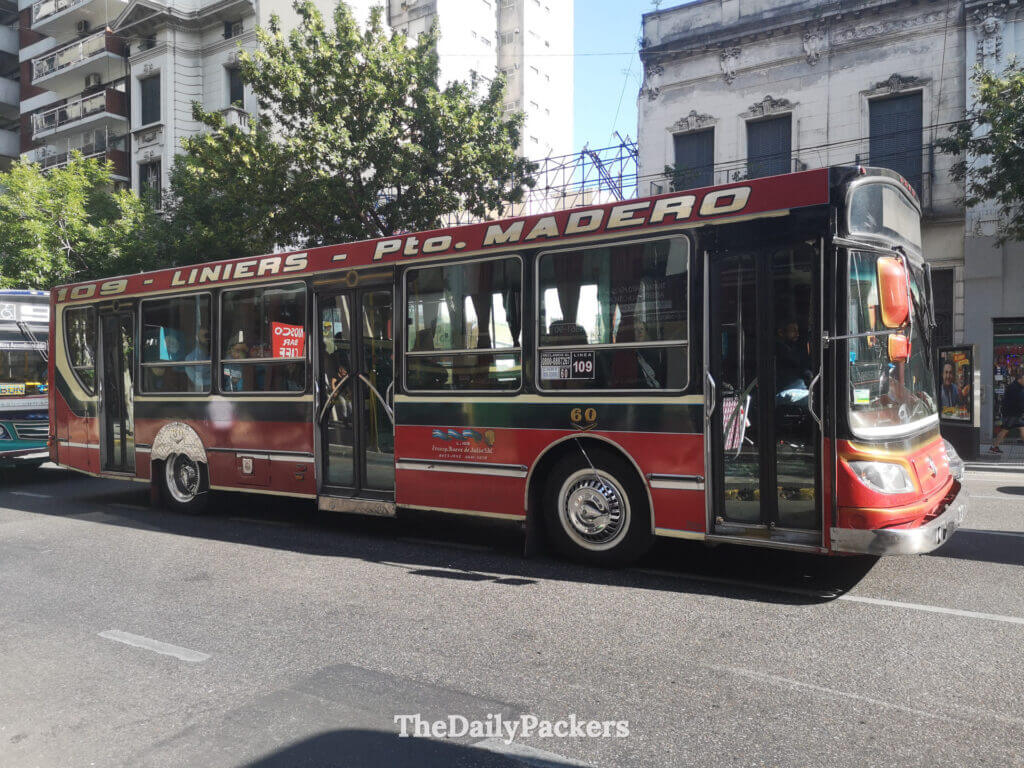
Buses are the lifeblood of Argentine cities and one of the most useful Argentina travel tips. They go everywhere, but they can be a bit confusing at first. We used apps like Google Maps or Moovit to figure out the routes.
When you see your bus coming, you have to stick your arm out to signal the driver, or they will just drive past! Once you hop on, tell the driver where you’re going (or the price of the ticket if you know it), and then tap your SUBE card on the reader.

Taxis and Rideshares
In cities like Buenos Aires, taxis are everywhere and very affordable. They use meters, so you don’t have to worry about haggling. In other parts of the country, “Remises” (private car services) are more common and often have a fixed price. Apps like Uber and Cabify also work well in the bigger cities and can sometimes be cheaper than a standard taxi.


Don’t forget to book your accommodations in advance – the best places always fill up quickly.
Staying Connected in Argentina
Getting an Argentinian SIM Card
Having a local 4G network makes a world of difference when you need to check a map or translate a menu on the fly. That’s why a SIM Card is one of the best Argentina travel tips. We bought our first SIM card in Buenos Aires, but the process is exactly the same across the country—we even picked up a second one in Mendoza later on without any trouble.
There are three main providers: Claro, Movistar, and Personal. While Personal is catching up, we found that Claro and Movistar offered the most reliable coverage, especially when traveling between provinces. Since our local friends were using Claro, we followed their lead and it worked perfectly for us.

How to Buy and Activate Your Card
You don’t need to find a fancy flagship store to get a “chip” (the local word for SIM card). Just head to any Rapipago or a larger Kiosco. The price is usually very low—just a few hundred pesos.
Once you have the card, pop it into your phone. In Argentina, there is a registration process you have to follow, but it only takes about 10 minutes:
- Start the registration: Dial *234# and follow the prompts.
- Register online: Go to the provider’s website (like claro.com.ar/simcheckin).
- Identity check: You’ll need to enter your passport number and upload a photo of your passport along with a quick selfie.
- Wait for the “OK”: Once submitted, your line should be active shortly after.

Topping Up and Data Packages
After your SIM is active, you need to “load” it with money at a Rapipago or via the provider’s app. Instead of just using your credit as you go, we highly recommend buying a “Pack” (data package). It’s much cheaper!
For example, we usually went for the 3GB package for 20 days. It cost us about 300 pesos (5€) at the time and gave us more than enough data to stay connected while we explored. You can activate these packages by visiting the provider’s “Packs” website or via the SMS links they send you. Today, you can get a 15 GB package for 10 700 pesos. (6,5€).

The Easy Way: Using an eSIM
If you don’t want to deal with physical cards or passport uploads, an eSIM is a fantastic alternative. You can set it up before you even leave home.
With an eSIM, you just download the app, buy the Argentina plan, and it activates the second you land and turn off airplane mode. It’s a bit more expensive than the local “Kiosco” price, but for the convenience of having data the moment you step off the plane, it’s often worth it—especially if you’re only in the country for a short time.

Best Time to Visit Argentina
Because Argentina is in the Southern Hemisphere, the seasons are the opposite of what you might be used to in Europe or North America. When it’s winter in Paris or New York, it’s the height of summer in Buenos Aires!
Summer (December to February): This is the peak season for a reason. It’s the best time to head south to Patagonia or Ushuaia for hiking and glacier trekking, as the weather is mild and the days are incredibly long. However, keep in mind that Buenos Aires and the northern regions can get very hot and humid during these months. Average Temperatures: 19°C to 30°C (66°F to 86°F), though it can easily hit 35°C (95°F) in the north.
Autumn (March to May): The crowds start to thin out, and the landscapes turn into a patchwork of gold and red. It’s the perfect season for wine tasting in Mendoza during the harvest or seeing the Iguazú Falls with comfortable temperatures. Average Temperatures: 14°C to 23°C (57°F to 73°F).
Winter (June to August): If you love snow, this is your time. The Andes become a playground for skiers, especially around Bariloche. While the south is quite cold and some hiking trails might be closed, the north (like Salta and Jujuy) is actually very pleasant, dry, and sunny during the day. Average Temperatures: 8°C to 16°C (46°F to 61°F), but much colder in the mountains.
Spring (September to November): Everything comes back to life in the spring. In Buenos Aires, the Jacaranda trees bloom in purple, and in the Lake District, you’ll see fields of wildflowers. It’s also the prime season for wildlife spotting, especially for whale watching on the Valdés Peninsula. Average Temperatures: 13°C to 22°C (55°F to 72°F).
Our Recommendation: If you want the best balance of good weather and lower prices, we suggest traveling during the shoulder seasons (October/November or March/April). You’ll get to see most of the country without the extreme heat or the heavy summer crowds!
Living Like a Local & Staying Healthy
Grocery Shopping in Argentina
If you head to a giant supermarket expecting to find everything in one go, you might be disappointed. While hypermarkets exist, they can be surprisingly empty of fresh produce or specific “healthy” items. In Buenos Aires, we once went to a massive Jumbo supermarket and found walls of wine and cookies, but not a single jar of peanut butter or a decent vegetable!

The “Argentine way” is to shop at specialty neighborhood stores:
- Verdulería: This is where you go for your fruits and vegetables. They are often cheaper and much fresher than the supermarket.
- Carnicería: For the world-famous Argentine beef, go straight to the butcher.
- Dietética: This was our best discovery! These are health food stores where you’ll find things like oatmeal, quinoa, spices, and that elusive peanut butter.


Tip: Prices and stock can vary wildly from one block to the next. If a shop doesn’t have what you need or it seems too expensive, just walk a few minutes to the next one—there’s almost always another option around the corner.
Getting Around on Two Wheels: BA Ecobici
In Buenos Aires, the city has a fantastic free bike-sharing system called BA Ecobici. To use it, you’ll need to download the app and register with your passport and a credit card. Even though the basic rides are free, they still require a card for the account.
Once you’re set up:
- Check the app for a nearby station with available bikes.
- Select the station in the app and tap “Unlock” to get a code.
- Enter the code on the bike stand and pull the bike out firmly.
- Watch the clock: You can use them for one hour on weekdays and two hours on weekends. We actually got our account suspended for two days because we went over the limit—so if you need more time, just return the bike and immediately take out a new one to “reset” your timer!

Handling Vaccines on the Road
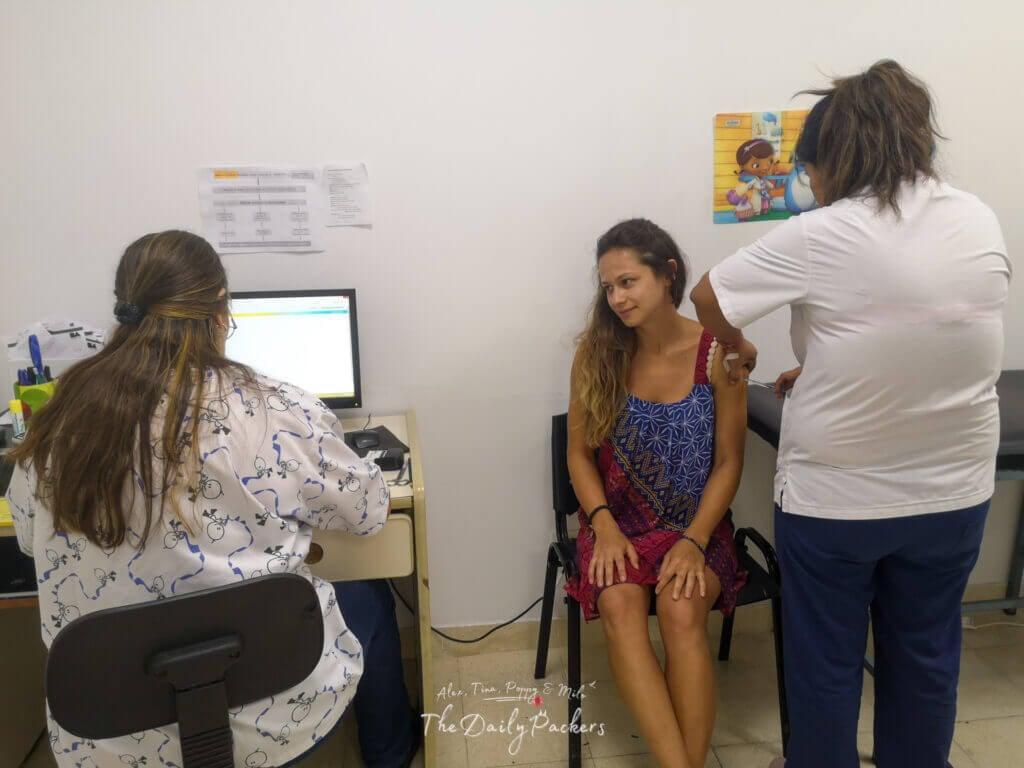
Sometimes travel plans require a bit of admin work. While we were in Buenos Aires, Tina needed to get her second Hepatitis B shot. If you find yourself needing medical care or a vaccine, the public health system (CeSAC) is surprisingly accessible for travelers.
We went to CeSAC N°22 in Buenos Aires. The process was quite human: you grab a ticket from an electronic terminal, register at the “Admittance” desk with your passport, and wait for your number to be called. Even without a local ID, the staff was helpful, and we were in and out in about two hours. It’s a good reminder that you don’t always need expensive private clinics for basic health needs while traveling!
About the authors
We are Alex and Tina, a French-Serbian couple who met in China back in 2014. We spent three incredible years there before making France our home. Our shared passion for travel has been the heartbeat of our relationship for over 12 years, taking us across 44 countries and counting.
We launched TheDailyPackers in 2019 as a way to document our adventures. In 2026, we reached a major milestone by officially turning our blog into our full-time job. While we are still growing toward financial independence through this platform, every article we write is fueled by our mission to make your voyages easier through in-depth guides, honest advice, and the lessons we’ve learned from our own mistakes.
Our journey has not been without its storms. In 2023, our world changed forever when our first son, Poppy, was stillborn on November 25th. It was, and remains, the hardest chapter of our lives. In 2025, we were blessed with our second little boy, Milo. He has since joined our traveling tribe, and you’ll be seeing him—and the reality of traveling with a little one-on the blog more and more.
We hope to inspire you to explore the world with curiosity and resilience. Thank you for being part of our story.
You may also like those related posts
How to Travel and Make Money with Affiliation in 2026
Morocco SIM card: Stay Connected in Just 10 Minutes
11 best things to do in Punta del Este, Uruguay, in 1 day
7 best Resorts in the Maldives to stay at in 2025
4 Best Places to Visit in December
12 Best things to do in Vannes, France, in 1 to 6 days
Alhambra Palace in Granada: A Complete Travel Guide
TMB Stage 6: Guide from Rifugio Bonatti to La Fouly
Pssst, did you know that…
If you purchase something through our links, we earn a small fee. However, you still pay the same. Win-win! And one day we may get to be full-time travel bloggers =)
Find Hotels with Booking.com
Do Yoga with KVY
Buy us a Coffee
Rent a car with DiscoverCars
Find Attractions with GetYourGuide
Find Flights with Expedia
Buy an eSIM with Airalo
Get insured with World Nomads
Get ready with Amazon.com