

Introduction
Avignon is the main city of the Vaucluse department and probably one of the most famous names in France, mostly thanks to that song we all sang in school, dancing “sur le pont d’Avignon.” The truth is, before actually visiting, we didn’t understand what all the fuss was about either.
But Avignon took us by surprise. It quickly became one of our favourite cities in France. And in this Avignon Travel Guide, we’ll show you why.
With around 94,000 inhabitants, Avignon is not a big metropolis, but that’s exactly what makes it such a pleasant stop—enough going on to keep you busy, but not overwhelming. It’s nicknamed the “City of Popes” for a reason: between 1309 and 1423, it served as the seat of the papacy. But what really won us over is the old town, surrounded by imposing ramparts, full of stone buildings, winding alleys, and incredible viewpoints.


Here are all your accommodation options in Avignon.
Getting there
Avignon is well-connected and easy to reach, whether you’re coming from within France or from abroad.
By Train: If you’re coming from Paris, the TGV (high-speed train) is the easiest and fastest option. It takes around 2 hours and 40 minutes from Paris Gare de Lyon to Avignon TGV station. From there, a quick shuttle train or bus takes you to the city center in under 10 minutes.
By Plane: Avignon does have a small airport, but it only operates limited seasonal flights. The most convenient international airports nearby are Marseille Provence Airport (about 1h15 by car or shuttle) and Montpellier Airport (around 1h30 away). Both offer good connections with European cities and are easy jumping-off points to rent a car or take a train.
By Car: If you’re road-tripping through the South of France, Avignon is a perfect stop. It’s well located between Arles, Nîmes, Aix-en-Provence, and the Luberon villages, and is easily accessible from the A7 motorway.
By Bus: Long-distance buses also stop in Avignon (Flixbus, BlaBlaCar Bus), which can be a good budget option if you’re flexible with time


Check all your transportation options online — from buses to trains and ferries — it makes planning so much easier.
Moving Around
Avignon’s city center is compact and super walkable — that’s honestly the best way to enjoy it. Most of the main attractions like the Palais des Papes, the bridge, and the gardens, are all within walking distance from each other.
If you’re staying a bit outside the city walls or arriving at the TGV station, local buses and shuttle trains will get you into the heart of town quickly. The Orizo bus network is easy to use and covers the surrounding areas too if you’re planning any short trips.
You won’t need a car to visit the city itself, but if you’re exploring the Provence region — lavender fields, Luberon villages, Pont du Gard — then renting a car is a great idea.
Villeneuve-lès-Avignon, located just across the Rhône River, is a beautiful and easy half-day or day trip from Avignon. You can get there in 10 minutes by car or bus (line 5 of the Orizo network). Another option is to rent a bike and cross the Daladier bridge — the view of Avignon’s skyline from there is pretty special.
Tip: Parking in the historic center can be tricky and expensive. If you’re coming by car, use one of the free park-and-ride lots (Parc Relais) just outside the walls and hop on a free shuttle to the city center. Easy and stress-free.


We recommend to rent a car through Discover Cars with free cancellation. Book your rental car here.
When to Visit
Avignon has a Mediterranean climate, meaning hot summers, mild winters, and lots of sunshine year-round. Here’s how the seasons break down:
- Spring (March to May): This is one of the nicest times to explore the city. The city wakes up from winter, and flowers start to bloom all around the old town and gardens. Daytime temperatures range from 15°C to 22°C (59°F to 72°F), with cooler mornings and evenings. It’s not too crowded, making it perfect for relaxed sightseeing.
- Summer (June to August): This is peak season, especially in July when the famous Festival d’Avignon takes place. Expect lively streets and packed terraces. Temperatures can climb to 30°C (86°F), sometimes more, with little rain. If you don’t mind the heat and crowds, the city’s energy is amazing during this time.
- Autumn (September to November): The crowds thin out, but the city stays warm and lovely. September still sees highs of 25°C (77°F), gradually dropping to around 13°C (55°F) in November. It’s a quieter, golden time to explore — especially if you want to combine your visit with some wine-tasting in nearby Châteauneuf-du-Pape.
- Winter (December to February): Winters are calm and mild. You’ll get temperatures between 5°C and 12°C (41°F to 54°F). Some museums and sites may run on reduced hours, but the festive lights around the city in December can make it a magical time to stroll.
Our take: If you’re after atmosphere and open terraces without the extreme heat or tourist rush, late spring or early autumn is the sweet spot.


Where to Stay
Avignon offers a good mix of charming stays inside the old city walls and more modern options just outside. Whether you’re on a tighter budget or looking for a special treat, here are a few places to consider:
(€) Hôtel Le Bristol – A solid and affordable option right next to the old town. Rooms are simple but comfortable, and the location is great if you want to explore on foot without spending too much.
(€€) Hotel De Cambis – Best Western Premier Collection – This boutique-style hotel blends contemporary design with a great location. You’ll be right in the city centre, close to all the main sights, with nicely designed rooms and good service.
(€€€) La Mirande – If you’re up for a splurge, this is the place. La Mirande is a beautifully preserved 18th-century mansion with a view of the Palais des Papes. The rooms are full of charm and elegance, and the courtyard dining is a true experience.
Tip: Staying within the city walls is ideal for soaking up the historic charm and being walking distance from everything.

Here are all your accommodation options in Avignon.
What to Eat
Avignon has a few specialties that might surprise you, especially if you’re expecting only typical Provençal dishes. Here are some local favourites to try:
- Papaline d’Avignon – This sweet treat is made from two thin chocolate shells filled with oregano liqueur from the Comtat region. It was created in 1960 as a nod to the papal legacy of the city.
- Papeton d’aubergine – A very local dish, this is a sort of eggplant flan made with eggplant caviar and eggs, often served as a side or starter. It’s light, soft, and full of Mediterranean flavour.
- La Bohémienne – Not to be confused with ratatouille, this simpler dish is made just with eggplant and tomatoes, slowly cooked in olive oil. It’s a humble but delicious classic of Avignon.
- Anis Pernod – A local anise-flavoured spirit. Usually served as an apéritif, it’s a bit of an acquired taste but has deep roots in the region.
If you’re plant-based like us, you’ll likely be skipping the liqueur but can easily enjoy the eggplant dishes, especially when paired with fresh bread and a glass of local wine.


Read: All our gears and equipments for hiking, blogging, vlogging and so much more…
Things to do in Avignon
Visit the Palais des Papes
The Palace of the Popes is one of the most iconic landmarks in Avignon and the largest Gothic building from the Middle Ages still standing. Both a fortress and a lavish residence, it served as the seat of Western Christianity during the 14th century when the papacy was based in Avignon.

Entry costs €12 per person and includes an interactive tablet that acts as a 3D audio guide. As you move through the rooms, the tablet shows reconstructions of how each space looked centuries ago, offering a fascinating window into the past. It’s a great way to explore the history of the church and architecture, and definitely worth the visit.


Tip: We use the DJI Action 4 to film our vlogs — compact, durable, and perfect for capturing every adventure.
Climb to Avignon Cathedral
Right next to the Palais des Papes stands the Cathedral, a beautiful Romanesque church built mostly in the second half of the 12th century. It serves as the seat of the Archbishop of Avignon and is crowned with a striking golden statue of the Virgin Mary.

From the Palace, head up the stairs leading to the Doms Garden and take the time to step inside this peaceful and historic cathedral. Its quiet interior offers a welcome break from the busy square outside, and it’s a perfect stop before exploring the gardens just above.

Here are all your accommodation options in Avignon.
Relax at Jardin des Doms
Right beside the cathedral, Jardin des Doms sits peacefully atop the Rocher des Doms. This lovely public garden is one of the best spots in Avignon to take a break from sightseeing. Shaded paths, fountains, and benches make it ideal for a relaxing walk or a quiet pause.
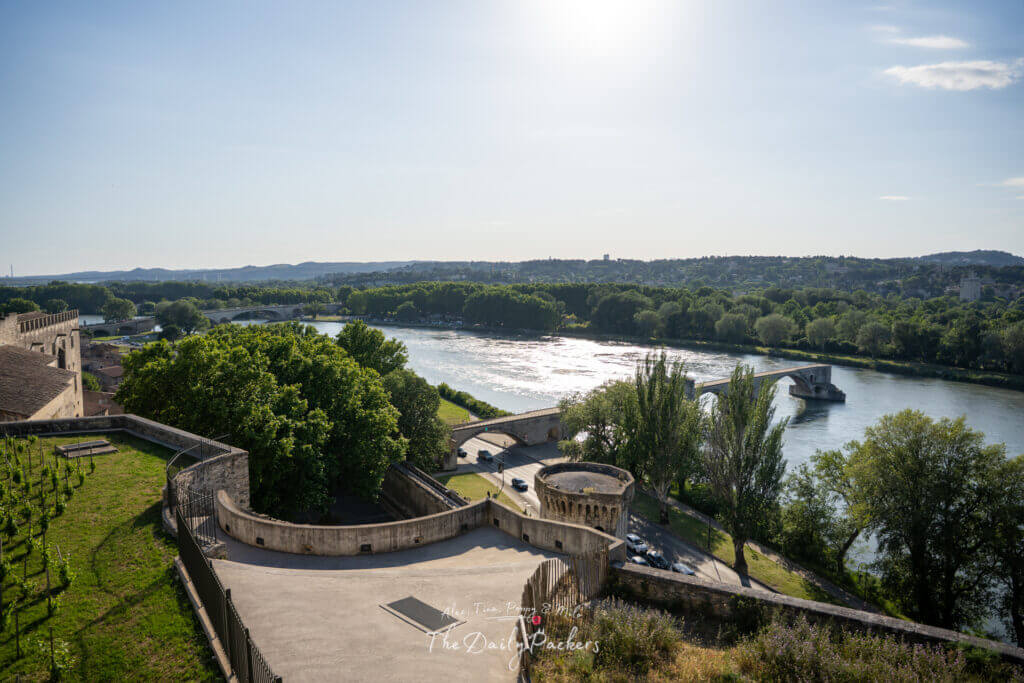
From here, you’ll get one of the best panoramic views over the Rhône River, the famous Pont d’Avignon, and even Villeneuve-lès-Avignon in the distance. It’s a perfect stop to unwind and soak in the beauty of the city.

Walk on the Legendary Pont d’Avignon
Pont d’Avignon, officially known as the Saint-Bénézet Bridge, is one of the city’s most iconic landmarks. Today, only four arches remain of what used to be a full bridge spanning the Rhône River. It no longer connects to the other side, but it still holds plenty of charm and history.
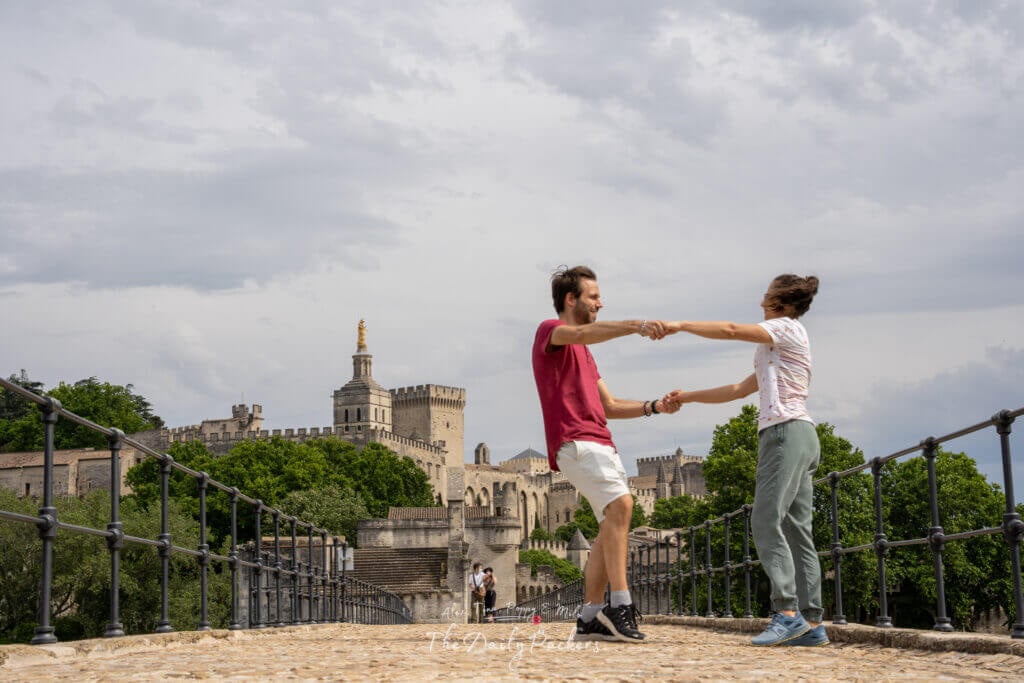
Built in the 12th century, the bridge includes two small chapels: Saint-Bénézet and Saint-Nicolas, stacked on top of each other. Interestingly, the famous French nursery rhyme got it wrong—we never danced on the bridge, but under it, as that’s where the celebrations used to take place.
Visiting the bridge isn’t free, which surprised us too, but if you’re into history and panoramic views, it’s worth a quick stop.

Tip: We never travel without our DJI Mini 3 PRO drone anymore — it’s totally worth having to capture places from a whole new perspective.
Walk Along Île de la Barthelasse for the Best City Views
Located right in the middle of the Rhône River between Avignon and Villeneuve-lès-Avignon, Île de la Barthelasse is a peaceful escape with one of the best views of the old town skyline. It’s especially popular at sunset when the city lights begin to reflect on the river.

You can start your walk from the “Parking de l’île de la Barthelasse” and follow the “Chemin des Bergers” along the water. It’s an easy stroll, and perfect if you want to take a quiet break from the city while still soaking in the view.

Here are all your accommodation options in Avignon.
Visit Basilique Saint-Pierre, a Gothic Jewel in the Old Town
Tucked in the heart of Avignon’s old city, the Basilique Saint-Pierre is a beautiful example of Provençal Gothic architecture. Built in 1358, the church stands out with its carved wooden doors and peaceful interior. It’s a quick yet worthy stop while wandering the cobbled streets of the old town.

Walk Along the Remparts d’Avignon, the City’s Historic Walls
The 14th-century ramparts of Avignon are one of the best-preserved medieval fortifications in France. These impressive stone walls still fully encircle the old city, offering a glimpse into Avignon’s past as a papal stronghold. Take a walk along their base or admire them before entering the historic center—they’re an iconic part of the city’s character.

Stroll Along Rue des Teinturiers, the Street of Dyers
Wander down Rue des Teinturiers, one of the most charming streets in Avignon. This cobbled lane follows the Sorgue canal, shaded by leafy trees and dotted with old watermills that once powered the textile workshops. The street’s quiet charm and historical vibe make it a perfect detour while exploring the old town.

Visit the Weekend Flea Market for Local Finds
If you’re in Avignon over the weekend, don’t miss the local flea market. It’s a vibrant place where you’ll see locals going about their routines and find some truly unique items. We especially loved the artisan carving olive wood into beautiful kitchenware and decor — one of the best souvenirs we brought home.

Tip: We use the DJI Action 4 to film our vlogs — compact, durable, and perfect for capturing every adventure.
Attend a performance at the Opéra Grand Avignon
Housed in a beautiful neoclassical building on Place de l’Horloge, the Opéra Grand Avignon offers a varied cultural program with operas, ballets, and concerts throughout the year. Even if you don’t catch a show, the façade and square are worth a stop.

Discover ancient art at the Lapidary Museum
Part of the Calvet Museum, this former Jesuit chapel displays an impressive collection of Roman and Greek antiquities, sculptures, and artifacts. It’s a peaceful place to appreciate classical art in a stunning architectural setting.

Tip: We use the DJI Action 4 to film our vlogs — compact, durable, and perfect for capturing every adventure.
Explore the Musée du Petit Palais
We didn’t have time to visit it ourselves, but it’s considered one of Avignon’s cultural highlights. The Petit Palais Museum showcases a rich collection of medieval and early Renaissance art, with over 390 paintings and 600 sculptures. If you love Italian and Provencal art from the 13th to 16th centuries, this is your spot.
Admire the Musée Calvet
Another museum we didn’t manage to visit but worth noting is the Musée Calvet. Even if you don’t go in, take a moment to admire the beautiful 18th-century mansion that houses it. Inside, the museum features fine arts, decorative arts, and archaeology collections — a great option for art lovers looking to explore Avignon’s history a bit deeper.

Discover Villeneuve-lès-Avignon
Just across the Rhône from Avignon, Villeneuve-lès-Avignon is a perfect half-day escape. Only 10 minutes by car, 15 minutes by bus, or a scenic 40-minute walk, this medieval town is full of charm. Wander around the well-preserved 14th-century Fort Saint-André perched on a hill, then explore the peaceful cloisters of the Chartreuse monastery.

The Pierre-de-Luxembourg Museum houses beautiful religious art, while the Saturday flea market is perfect for picking up local delicacies or antiques. The cobbled streets are lined with relaxed brasseries and specialty shops — ideal for a slow afternoon.
Tip: Don’t miss “La Magie des Pains,” a fantastic local bakery in Villeneuve-lès-Avignon. Perfect for grabbing a fresh croissant or baguette before exploring the town or heading up to Fort Saint-André.

Here are all your accommodation options in Avignon.
Visit Fort Saint-André
Climb up to one of Villeneuve-lès-Avignon’s most iconic landmarks. This 14th-century fort was built to defend the city and its strategic hilltop position offers sweeping views over the Rhône and Avignon. You can walk along the ramparts, climb the towers, and get a real sense of medieval architecture.

Tip: Grab the combined ticket to visit all four main sites in town—it’s great value and lets you dive deeper into the area’s rich history.

Wander through Abbey Saint-André
Step inside this peaceful abbey nestled within the Fort Saint-André grounds. Privately owned, the site is home to beautifully landscaped terraced gardens filled with Mediterranean plants, centuries-old olive trees, and seasonal blooms. It’s a lovely place to stroll, unwind, and soak in panoramic views over Avignon and the Rhône Valley.

Climb the Tour Philippe-le-Bel
Explore this medieval tower built by King Philip the Fair between 1292 and 1307 to assert his power over nearby Avignon. Inside, you’ll find vaulted rooms across three floors and a winding staircase that leads to one of the best panoramic viewpoints in the area. Be ready for a bit of a climb—but the rooftop view makes it worth every step.

Visit the Chartreuse Notre-Dame-du-Val-de-Bénédiction
End your stay in Villeneuve-lès-Avignon with a peaceful visit to the largest charterhouse in France. This vast monastery from the Carthusian order is open to explore entirely, offering cloisters, chapels, and quiet corners filled with centuries of history. A calm and contemplative way to wrap up your day.

Here are all your accommodation options in Avignon.
Explore Châteauneuf-du-Pape
If you’re traveling by car or have an extra day, we highly recommend stopping in the charming village of Châteauneuf-du-Pape. Wander through its quiet streets, then climb up to the panoramic viewpoint overlooking the Rhône Valley. Known for its world-class wines, this vineyard town is a perfect mix of history, views, and local flavour.

Itinerary
Day 1: Dive into the Heart of Avignon
Start your day at the iconic Palais des Papes, then head next door to the Avignon Cathedral. From there, stroll through the peaceful Jardin des Doms, a perfect spot to take a break under the trees. End your day with a visit to the famous Pont d’Avignon, where the song becomes real — even if no one really danced on the bridge.
Day 2: Cross the Rhône to Villeneuve-lès-Avignon
Begin with a peaceful walk on Île de la Barthelasse for the best views of Avignon. Then cross to Villeneuve-lès-Avignon, a hidden gem packed with history. Visit the mighty Fort Saint-André, wander through the serene gardens of the Abbey St. Andrew, explore the Chartreuse Notre-Dame-du-Val-de-Bénédiction, and climb the Tour Philippe-le-Bel for a panoramic finale.
Day 3: Culture and Cobblestones
Spend your last day back in Avignon exploring its quieter corners. Visit the Basilique Saint-Pierre, then pop into the Musée Calvet or admire it from the outside. Walk along the Remparts d’Avignon, stroll the shaded Rue des Teinturiers, and visit the Musée Du Petit Palais if time allows. If you’re by car or craving a vineyard escape, end your trip with a visit to Châteauneuf-du-Pape for a scenic walk and (why not) a glass of something local.
Here are all your accommodation options in Avignon.
About the authors
We are Alex and Tina, a French-Serbian couple who met in China back in 2014. We spent three incredible years there before making France our home. Our shared passion for travel has been the heartbeat of our relationship for over 12 years, taking us across 44 countries and counting.
We launched TheDailyPackers in 2019 as a way to document our adventures. In 2026, we reached a major milestone by officially turning our blog into our full-time job. While we are still growing toward financial independence through this platform, every article we write is fueled by our mission to make your voyages easier through in-depth guides, honest advice, and the lessons we’ve learned from our own mistakes.
Our journey has not been without its storms. In 2023, our world changed forever when our first son, Poppy, was stillborn on November 25th. It was, and remains, the hardest chapter of our lives. In 2025, we were blessed with our second little boy, Milo. He has since joined our traveling tribe, and you’ll be seeing him—and the reality of traveling with a little one-on the blog more and more.
We hope to inspire you to explore the world with curiosity and resilience. Thank you for being part of our story.
You may also like those related posts
Manosque, Provence, the best base to explore Lavender fields
Walhalla: How to visit Germany’s best Hall of Fame
9 Best Things to Do on Ilha do Cardoso, Brazil, in 4 days
6 Best things to do in Nuwara Eliya, Sri-Lanka, in 2 days
12 Must-See Villages on the French Riviera, France
Machu Picchu: How to Plan the Perfect Trip to Peru’s Icon
Mont Saint Michel: Everything you need to know
11 best things to do in Hangzhou, China, in 3 days or more
Pssst, did you know that…
If you purchase something through our links, we earn a small fee. However, you still pay the same. Win-win! And one day we may get to be full-time travel bloggers =)
Find Hotels with Booking.com
Do Yoga with KVY
Buy us a Coffee
Rent a car with DiscoverCars
Find Attractions with GetYourGuide
Find Flights with Expedia
Buy an eSIM with Airalo
Get insured with World Nomads
Get ready with Amazon.com