

Introduction
In June 2022, we set off on a 2-week road trip through the Baltic States. We started in Vilnius (Lithuania), rented a car, and slowly made our way north toward Tallinn (Estonia)—with plenty of beautiful stops along the way.
After our time in Riga, our next destination was Gauja National Park, and it turned out to be one of the highlights of our trip. We spent two nights in the area, which gave us just the right amount of time to explore the main sights and enjoy a few scenic hikes.
Gauja National Park is the largest and oldest national park in Latvia, and it’s easy to see why it’s so loved. The park is a natural treasure, full of biological diversity, sandstone cliffs, forests, natural springs, hiking trails, and cultural landmarks like castles and caves.
Whether you’re traveling as a family, couple, solo adventurer, or group of friends, this park truly has something for everyone. From relaxed sightseeing to full-on outdoor adventures, Gauja is the perfect place to slow down and connect with nature.
If you’re planning a trip to the Baltic States and want to experience the best of Latvia’s outdoors, you’ll most likely pass through Gauja National Park. So let’s dive into everything you need to know in this Ultimate Guide to Gauja National Park.

Read: The Perfect 2-Week Baltic States Itinerary
About Gauja National Park
Gauja National Park covers a vast area of 917.86 km², stretching along the beautiful Gauja River in northeastern Latvia. Established to protect the region’s relatively undisturbed nature, the park also aims to promote eco-tourism and sustainable development—making it one of the best places to experience Latvia’s natural beauty responsibly.
The park is anchored by three main towns that serve as perfect bases for exploring:
- Sigulda – often called the “Switzerland of Latvia,” known for its castles and hiking trails
- Līgatne – a charming town surrounded by forest, caves, and nature trails
- Cēsis – a historic town with a medieval castle, cobbled streets, and a local vibe
Each of these towns gives access to different sides of the park. On both the eastern and western edges, main roads run parallel to the park, with smaller scenic roads branching off and leading deeper into the heart of Gauja.


Here are all your accommodation options in Gauja National Park
Getting to Gauja National Park
The easiest and most flexible way to reach Gauja National Park is from Riga, making it an ideal stop after exploring Latvia’s capital. You can fly directly into Riga International Airport, rent a car, and be in the heart of the park in just over 1 hour—it’s about 61.6 km to Sigulda.
The drive is easy and well-signposted, with smooth roads the entire way. Having a car also gives you the freedom to explore the park at your own pace and access some of the more remote trails and sites.
If you prefer public transport, there are frequent trains from Riga Central Station to Sigulda. The journey takes 58 minutes to 1 h 10 and tickets cost around €2. You can check schedules on the Latvian Railways website.
Buses also run regularly from Riga SAO (main bus station) to Sigulda. The trip takes around 1 h 08 and costs approximately €2.85. You can find timetables online.
Do note: while it’s easy to get to Sigulda without a car, getting around within the park can be more challenging via public transport. Renting a car is highly recommended if you’re planning to hike or visit several areas.

We recommend to rent a car through Discover Cars with free cancellation. Book your rental car here.
Moving Around
As mentioned earlier, Sigulda, Līgatne, and Cēsis are the three main towns within Gauja National Park. Each offers its own charm and access to hiking trails, viewpoints, castles, and cultural sites. From these towns, you can explore nearby areas on foot or bike, and enjoy some easy, well-marked trails within the park.
However, to travel between these towns, you will need some form of transportation. If you’re not driving, there are public buses connecting Sigulda, Līgatne, and Cēsis. The buses are reliable and affordable, though schedules can be limited—so it’s worth checking times in advance on www.1188.lv.
That said, having your own car is the most convenient option, especially if you want to visit more remote spots or travel on your own schedule.
If you don’t want to rent a car and avoid hassle with public transporation, you can still consider visiting Gauja National Park as 1-day tour from Riga.

When to Visit
Gauja National Park is a year-round destination, with each season offering something unique—whether you’re after lush landscapes, fall colors, or snowy trails. Here’s what to expect throughout the year:
- Spring (April to June) is a beautiful time to visit Gauja. Nature comes back to life, trails are quiet, and wildflowers begin to bloom. It’s perfect for hiking, sightseeing, and enjoying the fresh air before the summer crowds arrive. Just note that some trails might still be muddy earlier in the season.
- Summer (July to August) is the most popular time to explore the park. Days are long and warm, ideal for hiking, biking, kayaking, and visiting castles. The towns of Sigulda and Cēsis come alive with open-air cafés and summer events. It’s a lively time to visit, but expect more people, especially on weekends.
- Autumn (September to October) is when Gauja truly shines. The fall foliage transforms the park into a sea of gold, orange, and red. The cooler temperatures make it perfect for peaceful walks, scenic drives, and photography, while the crowds begin to thin out.
- Winter (November to March) turns Gauja into a snowy wonderland. While some attractions may be closed, this season offers a peaceful escape, with cross-country skiing, winter hikes, and castles blanketed in snow. It’s a quiet and atmospheric time to visit—just bundle up for the cold.
Our recommendation: Visit between May and October for the best overall experience, especially if it’s your first time exploring the park.


Where to Stay
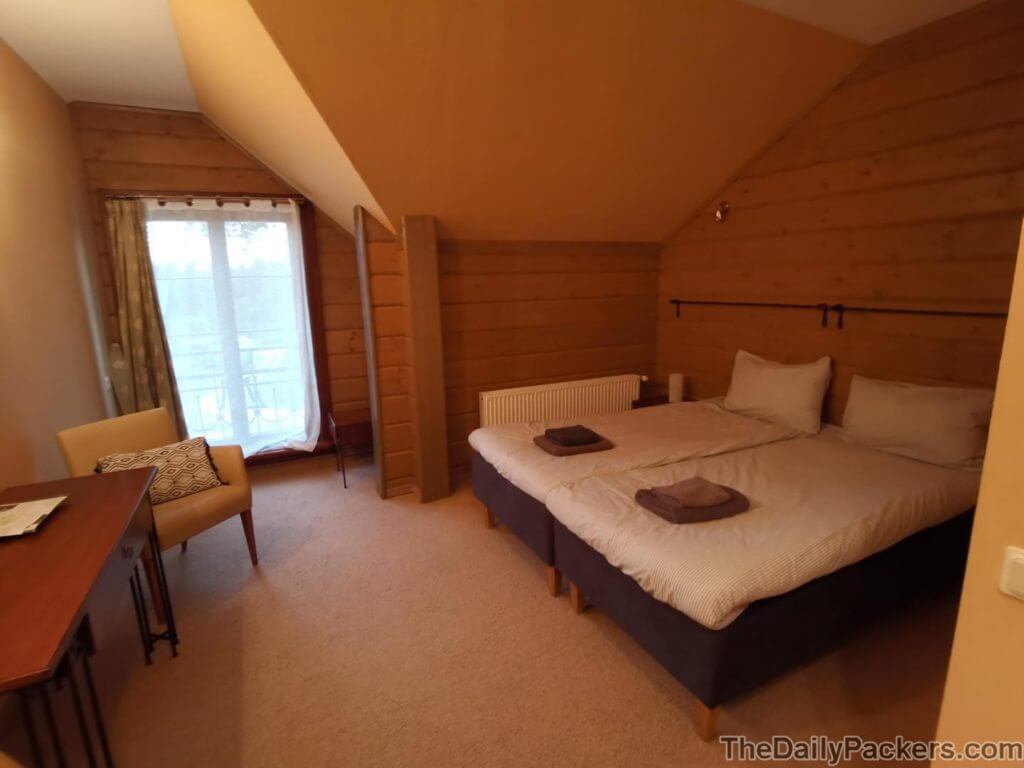
We personally stayed two nights in Gauja National Park, which gave us plenty of time to explore the main sights, enjoy the nature, and fit in some hikes without feeling rushed. Whether you’re looking for a cozy budget stay or something more comfortable in the countryside, there are great options across the park.
- (€) Green bear: A great budget-friendly option located near Sigulda. It’s simple, clean, and perfect if you’re spending most of your time out exploring. Bonus: it’s surrounded by nature.
- (€€) Karlamuiza Country Hotel: Located near Cēsis, this charming countryside hotel is set in a peaceful manor surrounded by apple orchards and forest. Spacious rooms, home-cooked meals, and direct access to walking trails make it a perfect mid-range retreat.
- (€€€) Ezerkalni: If you’re looking to treat yourself, Ezerkalni offers beautiful, upscale accommodation with forest views, a tranquil atmosphere, and high-end comforts—perfect for a relaxing stay immersed in nature.
Here are all your accommodation options in Gauja National Park
What to Eat
While Gauja National Park is all about nature and outdoor activities, you’ll still find some great spots to eat—especially in Sigulda, which offers the widest variety of cafés and restaurants in the area.
If you’re staying a few nights and prefer to cook your own meals, you’ll find several large supermarkets and even a hypermarket in Sigulda, where you can stock up on groceries, snacks, and picnic supplies. That’s what we did, and it gave us the flexibility to eat when and where we wanted, especially after long hikes.
But if you feel like dining out, here are a few local spots to try:
- For Casual Eats: We had a surprisingly good Italian lunch in a modern industrial-style building near the Sigulda train station. The space had a cool vibe with small boutiques and cafés, and it’s a nice option for a relaxed lunch or coffee break.
- For Local Cuisine: Try a traditional Latvian restaurant like Bucefāls—well-known in the area for its hearty local dishes like grey peas with bacon, pork chops, and rye bread. It has a rustic interior and cozy feel, perfect after a day outdoors.
- For Coffee & Cake: If you’re craving a sweet break, stop at Mr. Biskvīts, a local café with a nice selection of cakes, pastries, and light bites. It’s a great place to sit down and rest your legs for a bit.
- For a Scenic Meal: On a sunny day, grab a table on the terrace of Aparjods, a restaurant with great food and a beautiful setting. It’s also a lovely spot for dinner if you’re staying nearby.

About the town
Sigulda
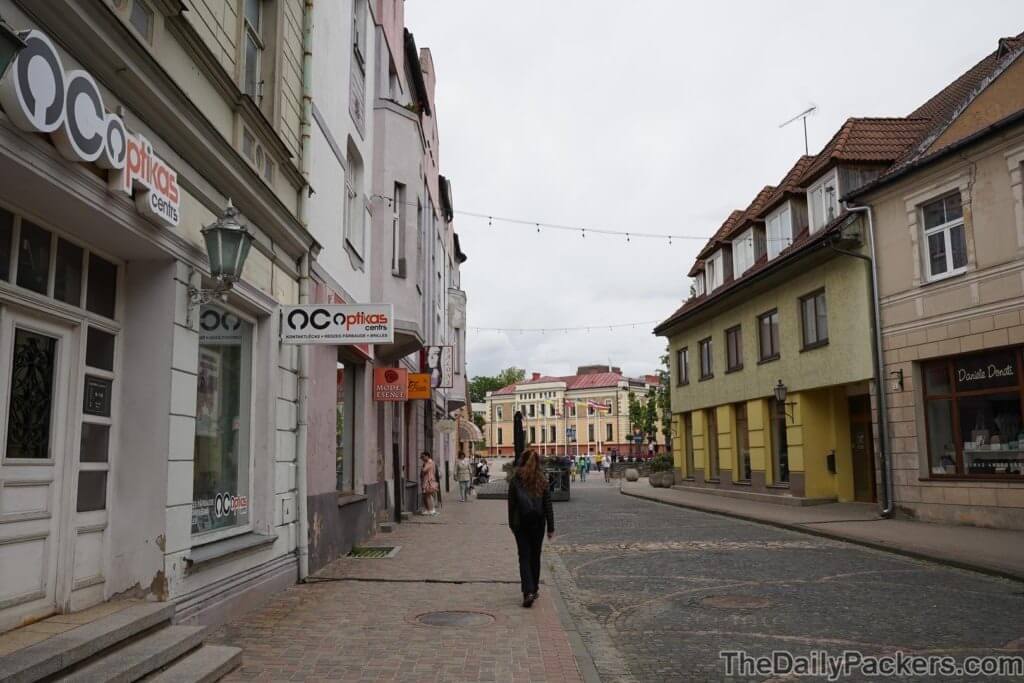
Sigulda is a charming small town with around 14,000 inhabitants, spread across 22.88 km². Often called the gateway to Gauja National Park, it’s one of the most popular starting points for exploring the region’s natural and cultural treasures.
What makes Sigulda special is the blend of scenic nature and historical sites. Here, you’ll find two medieval castles, scenic hiking trails, and even the largest cave in the Baltics. It’s a place where you can spend the morning wandering through castle ruins, and the afternoon hiking along sandstone cliffs and forest paths.
Compact, peaceful, and surrounded by nature, Sigulda makes a perfect base for a couple of days in the park.

Here are all your accommodation options in Gauja National Park
Līgatne
Līgatne is a small and peaceful village in Gauja National Park, covering just 7.07 km² and home to around 1,000 inhabitants. It was originally built around a paper mill on the River Līgatne in the 19th century, which still stands today as a reminder of the village’s industrial roots.
Over time, the village slowly expanded and was granted city status in 1993, though it still retains the charm and feel of a quiet countryside town. Surrounded by forests, caves, and nature trails, Līgatne is an ideal spot for those looking to experience the more off-the-beaten-path side of the park.


Check our Google Map of the Baltic States
Cēsis
Cēsis is a picturesque Latvian town with around 17,000 inhabitants spread over 19.28 km². Nestled on the edge of Gauja National Park, it’s best known for its medieval castle, cobbled streets, and artsy, laid-back vibe.
The highlight of any visit is the 13th-century Cēsis Castle, a historic fortress that has been rebuilt and restored many times over the centuries. You can explore its dungeons, towers, wall paintings, and enjoy sweeping views from the upper levels. The surrounding Castle Park is also worth a stroll, featuring a former brewery, a small cemetery, and the beautiful Transfiguration of Christ Orthodox Church.
Also located on the castle grounds is the 18th-century Castle Manor House, which now houses the Cēsis History and Art Museum—a great spot to dive into the town’s rich cultural past.

We recommend to rent a car through Discover Cars with free cancellation. Book your rental car here.
Best things to do Sigulda
Visit the Twin Castles of Sigulda
One of the top attractions in Sigulda is its unique castle complex, made up of two distinct parts: the New Castle and the Old Medieval Castle ruins.
The New Castle, built in 1878 in Neo-Gothic style, once served as the residence of the Kropotkin family, owners of the surrounding manor. With its pointed towers and elegant stonework, it stands as a striking contrast to the older ruins just behind it.
Just steps away, you’ll find the Sigulda Medieval Castle, originally constructed in 1207 as a castellum-type fortress by the Livonian Brothers of the Sword. It was later transformed into a convent-style complex. Today, the partially restored ruins can be visited for just €2 per person, and you can even climb the towers for views over the Gauja River valley.

Here are all your accommodation options in Gauja National Park
Hike the Sigulda Trail Through Forests, Caves & Castles
If you prefer hiking over driving, one of the best ways to discover the area around Sigulda is by following the Sigulda Trail. This scenic route winds through lush forest paths and rolling hills, offering not only peaceful nature but also some of the region’s most iconic landmarks.
Along the way, you’ll reach Krimulda Castle, the legendary Gutman’s Cave, and the stunning Turaida Castle—all within walking distance and connected by forest trails. It’s a rewarding day hike that combines history, nature, and beautiful viewpoints.
Once you reach Turaida, you have the option to take a bus back to Sigulda or, if you’re up for it, walk the trail back for a full loop experience.

We recommend to rent a car through Discover Cars with free cancellation. Book your rental car here.
Visit Krimulda Castle and Stay in a Historic Manor
Krimulda Castle is a fascinating blend of ancient ruins and a stately manor, tucked away in the hills across the Gauja River from Sigulda. The castle ruins date back to the 14th century, but were largely destroyed during a war in 1601. Today, you can still wander among the remains and imagine the stronghold that once stood here.
Right next to the ruins is the elegant Krimulda Manor, built in the style of a classical Latvian villa. Over the years, the area around the manor transitioned from a sunbathing terrace to a sanatorium and health retreat.
And here’s something special—you can even stay overnight at the manor, now operating as Krimuldas Muiža, offering guest rooms in a peaceful and historic setting surrounded by forest and hills.
To get there, you can either drive and park nearby or take the Sigulda cable car, which crosses the Gauja River and offers beautiful aerial views of the valley. The cable car runs every 20 minutes, from 10 AM to 6:30 PM in summer, and 10 AM to 5 PM in winter.


Tip: We use the DJI Action 4 to film our vlogs — compact, durable, and perfect for capturing every adventure.
Step into the Legends at Gutman’s Cave
Just a bit further along the trail, you’ll find Gutman’s Cave—the widest and highest cave in the Baltic countries. Formed over 10,000 years ago by meltwater cutting through the soft Devonian sandstone after the Ice Age, it’s not only a geological wonder but also considered the oldest tourist attraction in Latvia.
The cave is steeped in local legends and folklore, with its walls covered in historic inscriptions, some dating back centuries. It’s a quick stop, but a meaningful one, especially if you enjoy natural landmarks with a story to tell.
There’s a convenient car park right next to it, so even if you’re not hiking the full Sigulda trail, it’s very easy to visit by car.

Check our Google Map of the Baltic States
End Your Hike with History at Turaida Castle
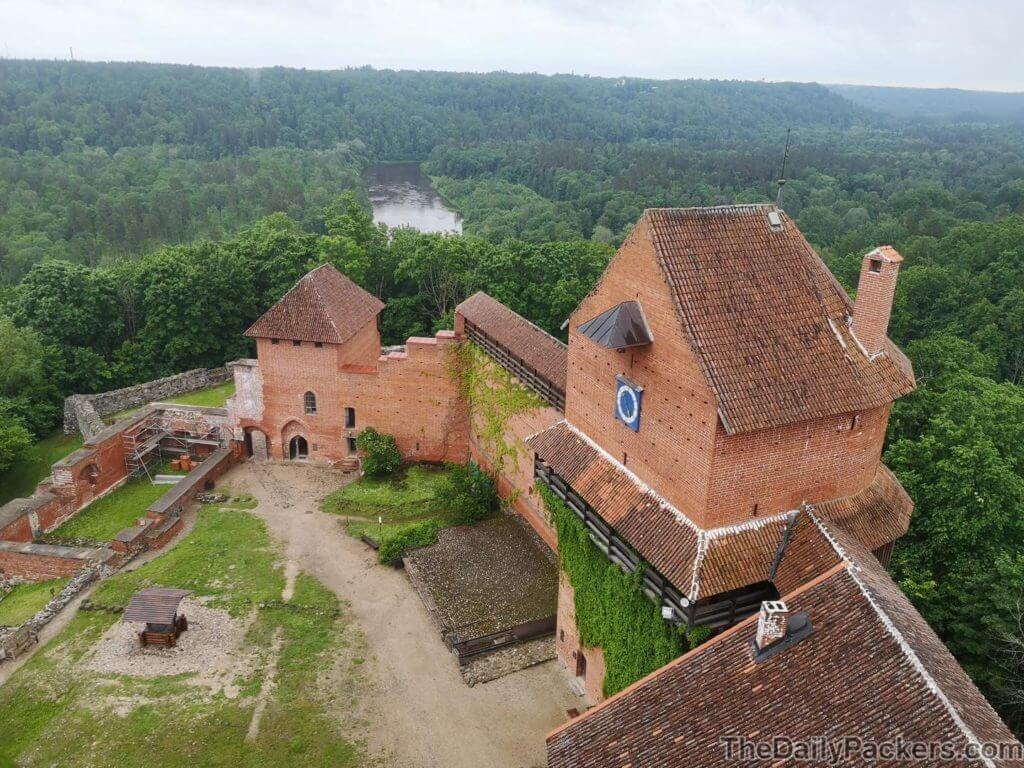
The final and most iconic stop along the Sigulda trail is Turaida Castle, a striking red-brick fortress perched on a hill overlooking the Gauja River valley. Originally built in 1214, the castle has been carefully reconstructed in recent years and now stands as one of Latvia’s most impressive historical sites.
There’s plenty to explore here:
- The Folk Song Park, dotted with sculptures and deeply tied to Latvia’s national identity—it was one of the symbolic locations during the Singing Revolution, which helped lead to the country’s independence from Soviet rule.
- The castle’s original watchtower, which you can climb for panoramic views of the surrounding forests and hills.
- A small museum inside the castle detailing its history and restoration.
- An exhibition inside a traditional homestead building about the Livonians (Livs), Latvia’s native Finno-Ugric people, who once lived along the coast and river valleys of the region.
Turaida is not just a castle—it’s a journey through Latvian culture, heritage, and resilience. Whether you arrive by foot, bus, or cable car, it’s a memorable way to finish your adventure through the Sigulda trail.
More things to do
If you have extra time in Sigulda or want to go beyond the main castles and caves, here are a couple of other fun and scenic activities to consider:
- Paradise Hill (Paradīzes Kalns): This short and easy 30-minute hike rewards you with a beautiful panoramic view over the Gauja Valley and its surrounding forests. It’s a peaceful spot, especially lovely in autumn when the foliage turns golden. If you don’t feel like hiking, you can also drive most of the way—just park near the cemetery, then walk about 600 meters to reach the viewpoint.
- Sigulda Bobsleigh, Luge, and Skeleton Track: One of the most unique experiences in Sigulda! This 6-storey Olympic-level bobsleigh complex is where professional athletes train, but it’s also open to visitors.
- In summer (May to September), you can hop on a wheeled bobsleigh and speed down the track.
- In winter (November to March), brave the real deal in a regular bobsleigh guided by a professional pilot.
Here are all your accommodation options in Gauja National Park
Best things to do Līgatne
Hike the Scenic Līgatne Gauja Trail
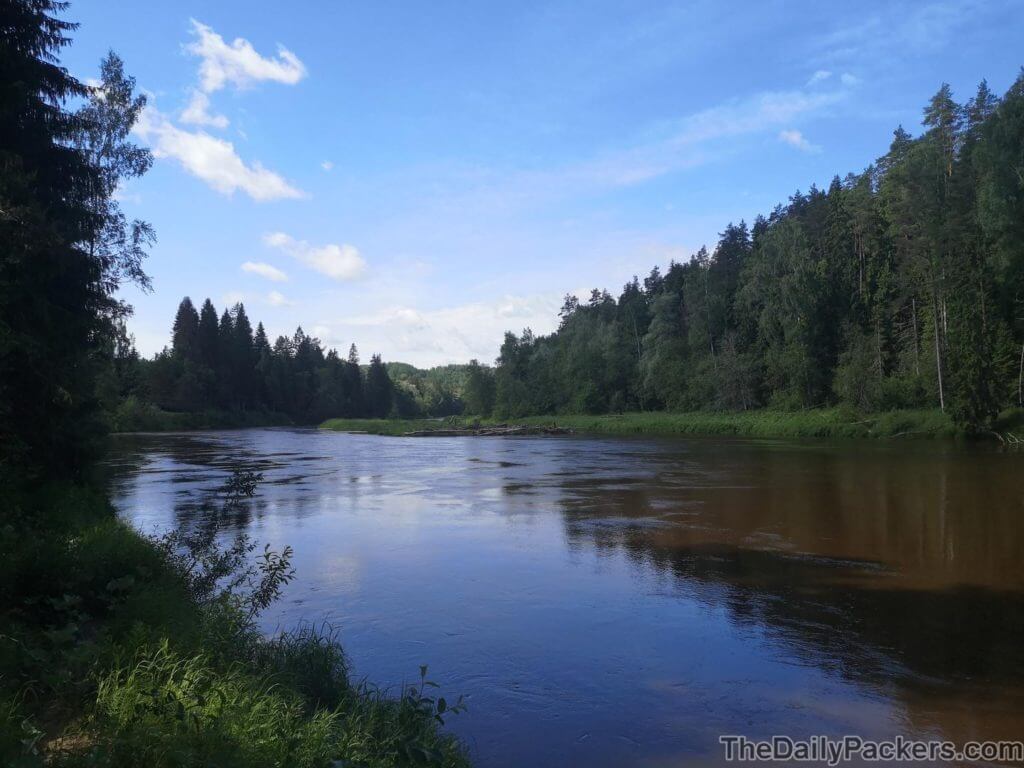
One of the best things to do in Līgatne is to explore the Gauja River Trail, a peaceful and scenic path that follows the curves of the river through lush forest. We discovered this trail during our stay—and for the most part, it was absolutely amazing.
The views along the river are beautiful, and the trail gives you that perfect sense of being immersed in nature. However, be mindful of recent weather. When the Gauja River is high—especially after heavy rainfall—parts of the trail can become difficult to pass, with small streams and muddy sections that are hard to navigate.
If it hasn’t rained much in the past few days, though, this trail is definitely one of the top hikes in the area. It’s quiet, green, and a great way to see a wilder side of Gauja National Park.
Tip: We use the DJI Action 4 to film our vlogs — compact, durable, and perfect for capturing every adventure.
Cross the Gauja River on the Unique Līgatne Ferry
Also known as the Līgatne Ferry, this charming little crossing is more than just practical—it’s a rare piece of living history. It’s the only ferry of its kind in the entire Baltic region, and taking a ride on it is a fun and memorable experience.
The ferry consists of two joined boats, topped with a wooden deck, and is guided across the river by a steel cable that prevents it from drifting downstream. What makes it special is that it runs entirely on the power of the river’s current—no motor required. As the ferry is angled against the flow, the stream itself propels it from one bank to the other.
It’s a simple, slow, and peaceful crossing—and a great way to connect with Līgatne’s traditional way of life.

Check our Google Map of the Baltic States
Spot Wildlife on the Līgatne Nature Trails
The Līgatne Nature Trails offer a gentle 5 km walk through a quiet, forested area that feels like a blend between a nature reserve and an open-air wildlife park. It’s a great activity for families or anyone traveling with kids, especially if you’re curious to see some of Latvia’s native animals up close.
Entrance costs €4.30, and along the trail, you’ll encounter enclosures with animals such as bears, wild pigs, foxes, deer, owls, and other birds. While the animals are kept in cages or fenced areas (so it’s not a completely wild experience), it’s still a peaceful and educational walk that gives you a better sense of the country’s fauna.
We visited and did see a few bears lounging around, some sleepy owls, and a group of wild pigs—definitely a fun and relaxed stop, especially for younger visitors.

Tip: We never travel without our DJI Mini 3 PRO drone anymore — it’s totally worth having to capture places from a whole new perspective.
Pop by the Historic Līgatne Paper Mill
While in Līgatne, it’s worth taking a quick 5-minute stop at the Līgatne Paper Mill, a site that played a major role in shaping the town’s identity. Founded in the 19th century, it was once one of the oldest and most tradition-rich paper producers not just in the Baltic States, but in all of Europe.
For decades, it was the only paper producer in Latvia and a key player in recycling wastepaper. More than just a workplace, the factory also provided housing and infrastructure for its employees—many of the old wooden houses you see in town today originally belonged to the paper mill.
Though the factory is no longer in operation, its legacy still defines much of Līgatne’s charm and character.

Admire the Sandstone Beauty of Lustūzis (Cave Rock)
Also known as Cave Rock (Alu Rock), Lustūzis is one of the most scenic natural spots near Līgatne. This impressive sandstone outcrop rises along the right bank of the River Līgatne, and its warm-toned layers are especially beautiful in the afternoon light.
You don’t need to hike far to enjoy the view—a wooden viewing platform right next to the road offers the perfect vantage point. It’s a quick stop, but well worth it if you’re exploring the area or looking for peaceful photo spots surrounded by nature.

We recommend to rent a car through Discover Cars with free cancellation. Book your rental car here.
Best things to do Cēsis
Travel Back in Time at Cēsis Castle
One of the main highlights of Cēsis is its castle complex, which includes both a new castle and the ruins of the old medieval fortress. The new castle now houses the Cēsis History and Art Museum, where you can learn more about the town’s past, its role in Latvian history, and the daily life of its former noble residents.
After visiting the museum, you can step outside and explore the ruins of the original 13th-century castle—complete with crumbling towers, stone walls, and underground passages. The site is atmospheric and fun to explore, especially with one of the traditional lanterns you can borrow for your walk through the ruins.
Entrance to both the museum and the castle ruins costs €10 per person. It’s not the cheapest stop, but it’s one of the best-preserved and most immersive medieval sites in Latvia—definitely worth it if you love history.


Relax in the Charming Castle Park of Cēsis
One of our favorite things to do in Cēsis—besides visiting the castle—was simply spending time in the Castle Park. This beautiful green space surrounds the castle grounds and offers a quiet, scenic spot to unwind. At the heart of the park is a small lake, with benches and walking paths that provide picture-perfect views of the castle ruins.
When we visited on a Sunday afternoon, we were lucky enough to stumble upon a local dance performance—a wonderful surprise that gave us a glimpse into Latvian culture and community spirit. It’s the kind of place where locals come to relax, and where visitors can enjoy a peaceful moment after exploring the town’s history.

Here are all your accommodation options in Gauja National Park
Admire the Transfiguration of Christ Orthodox Church
Within Castle Park, you’ll also find one of Cēsis’ most beautiful and unique religious landmarks: the Transfiguration of Christ Orthodox Church. Built in Byzantine style, this small yet striking church stands out with its vivid blue turrets and peaceful surroundings.
The church is decorated with icons of saints and holds a quiet charm that invites you to pause, even if just for a few moments. Whether you’re interested in architecture, photography, or just soaking in the local atmosphere, it’s a lovely addition to your walk through the park.

Tip: We never travel without our DJI Mini 3 PRO drone anymore — it’s totally worth having to capture places from a whole new perspective.
Stroll Through the Quiet Streets of Cēsis Old Town
Cēsis may be small, but its Old Town is full of charm. Take 30 minutes to an hour to wander the main streets, admire the mix of historic architecture, and discover the town’s slower pace of life. It’s not a place where you need a plan—just follow the cobblestones and let curiosity lead the way.
As we explored, we also stumbled upon a small park tucked away from the main square. And to our surprise, we spotted black swans gracefully gliding across the pond. It was the first time we’d seen them in person, and honestly—it was one of those small, magical travel moments we’ll always remember.

Stop by St. John’s Church in Cēsis
One of the most prominent landmarks in Cēsis is St. John’s Church, located right in the heart of the Old Town. Unfortunately, during our visit, the church was under renovation, so we couldn’t go inside. But from what we heard, you can usually climb the bell tower for a beautiful panoramic view over the town and surrounding area.
Even from the outside, the church is impressive, with its towering spire and peaceful setting—it’s definitely worth a quick stop as you explore the center of Cēsis.

Find the Old Man of Time Statue
Right next to St. John’s Church, keep an eye out for the statue of the Old Man of Time—a small but meaningful symbol of Cēsis. According to local legend, the Old Man of Time would walk the town’s streets at night, lighting lanterns along the way to keep the townspeople safe.
It’s a lovely little piece of folklore that adds a touch of magic to your stroll through the Old Town. Simple, quiet, and full of character—just like Cēsis itself.

See the Monument of Victory in the Heart of Cēsis
Located in the main square of the Old Town, the Monument of Victory stands as a powerful symbol of Latvia’s resilience and independence. Originally built in 1924 to honor the soldiers who fell in the Latvian War of Independence, the monument has had a turbulent history.
In 1952, during the Soviet occupation, the monument was replaced with a statue of Lenin, which remained in place until 1990—right before Latvia regained its independence. Finally, in 1998, the original monument was restored to its former glory, once again taking its rightful place in the heart of the town.
It’s a simple but meaningful stop that reflects Latvia’s complex past and the enduring spirit of its people.

Check our Google Map of the Baltic States
Discover the History of Cēsis Beer at the Old Brewery
Cēsis isn’t just about castles and charming streets—it’s also home to what is said to be the oldest brewery in Northern Europe. Known as Cēsu Alus, the brewery was first mentioned in 1590, making it a key part of the town’s history and identity.
While the modern brewery now operates outside the city, you can still see the original brewery building near the castle grounds. Though it’s no longer active, it’s a fun and easy stop if you’re curious about local traditions—and especially great if you’re a fan of beer history.

Here are all your accommodation options in Gauja National Park
Gauja National Park Itinerary
Day 1 – Sigulda
- Arrive from Riga to Sigulda
- Lunch in Sigulda
- Hike the Sigulda Trail to see all the top spots: Sigulda Castle, Gutman’s Cave, Krimulda Castle, and Turaida Castle
- Head to your accommodation
Day 2 – Līgatne & Cēsis
Morning – Līgatne
- Visit Līgatne Paper Mill (Papīrfabrika)
- Quick stop at Lustūzis (Cave Rock)
- Walk the Gauja River Trail
- Ride the Līgatne Ferry
- Explore the Līgatne Nature Trails
Afternoon – Cēsis
- Tour Cēsis Castle
- Stroll through Castle Park and see the Transfiguration of Christ Orthodox Church
- Explore Old Town
- Visit St. John’s Church and the Old Man of Time statue
- Stop by the Monument of Victory
- See the historic Cēsis Brewery
- Return to your accommodation
Read: The Perfect 2-Week Baltic States Itinerary
Mans maks ir kā sīpols – My wallet is like an onion
You may also like
Day 1 – Sigulda
- Arrive from Riga to Sigulda
- Lunch in Sigulda
- Hike the Sigulda Trail to see all the top spots: Sigulda Castle, Gutman’s Cave, Krimulda Castle, and Turaida Castle
- Head to your accommodation
Day 2 – Līgatne & Cēsis
Morning – Līgatne
- Visit Līgatne Paper Mill (Papīrfabrika)
- Quick stop at Lustūzis (Cave Rock)
- Walk the Gauja River Trail
- Ride the Līgatne Ferry
- Explore the Līgatne Nature Trails
Afternoon – Cēsis
- Tour Cēsis Castle
- Stroll through Castle Park and see the Transfiguration of Christ Orthodox Church
- Explore Old Town
- Visit St. John’s Church and the Old Man of Time statue
- Stop by the Monument of Victory
- See the historic Cēsis Brewery
- Return to your accommodation
Read: The Perfect 2-Week Baltic States Itinerary
About the authors
We are Alex and Tina, a French-Serbian couple who met in China back in 2014. We spent three incredible years there before making France our home. Our shared passion for travel has been the heartbeat of our relationship for over 12 years, taking us across 44 countries and counting.
We launched TheDailyPackers in 2019 as a way to document our adventures. In 2026, we reached a major milestone by officially turning our blog into our full-time job. While we are still growing toward financial independence through this platform, every article we write is fueled by our mission to make your voyages easier through in-depth guides, honest advice, and the lessons we’ve learned from our own mistakes.
Our journey has not been without its storms. In 2023, our world changed forever when our first son, Poppy, was stillborn on November 25th. It was, and remains, the hardest chapter of our lives. In 2025, we were blessed with our second little boy, Milo. He has since joined our traveling tribe, and you’ll be seeing him—and the reality of traveling with a little one-on the blog more and more.
We hope to inspire you to explore the world with curiosity and resilience. Thank you for being part of our story.
You may also like those related posts
Lorient La Base:The Complete Submarine Guide
Laguna Esmeralda Ushuaia: The Ultimate 1-Day Hiking Guide
The Ultimate Guide to Hiking Cerro Uritorco, 2026 Edition
Money in Argentina: Your Complete Guide to Exchange Rates and Cash
Salzburg Fortress: Complete Guide to Visiting Hohensalzburg
10 best things to do in Singapore, in 3 days for first timers
12 Most beautiful beaches in Corsica, France
19 Best things to do in Nimes, France, in 3 days or more
Pssst, did you know that…
If you purchase something through our links, we earn a small fee. However, you still pay the same. Win-win! And one day we may get to be full-time travel bloggers =)
Find Hotels with Booking.com
Do Yoga with KVY
Buy us a Coffee
Rent a car with DiscoverCars
Find Attractions with GetYourGuide
Find Flights with Expedia
Buy an eSIM with Airalo
Get insured with World Nomads
Get ready with Amazon.com