

Introduction
Embarking on a 3-day Uyuni Salt Flats tour is honestly one of the most surreal adventures you can have in South America. The Salar de Uyuni feels like another planet — an endless white desert that stretches so far you start questioning where the horizon even is. One moment you’re driving through blindingly bright salt flats, and the next you’re surrounded by colorful lagoons filled with flamingos, steaming geysers, and wild rock formations shaped by centuries of wind.
It’s the kind of trip where every hour feels like a new world.
During these three days, you’ll explore hidden corners of the Altiplano, watch sunsets that turn the salt flats into a giant mirror, sleep in a hotel made of salt, and wake up before sunrise to soak in hot springs at 4,800 meters under a sky full of stars. And yes — it genuinely feels magical.
All tours start around 10:00 AM in Uyuni. Since we arrived about two hours earlier by night bus from La Paz (after coming from Copacabana the day before), we had plenty of time to grab breakfast, stretch our legs, and buy a few snacks for the road.
Uyuni town itself is… well, simple. It’s more of a dusty village than a city, with one main street where you’ll find everything you need: restaurants, small shops, ATMs (when they work), and tour agencies. Nothing fancy — but it’s the perfect gateway to one of the world’s most incredible landscapes.

How to get to Uyuni
Uyuni is a small, remote town in southwestern Bolivia, and almost every traveler comes here for one reason: the salt flats. Luckily, getting there is straightforward — you just need to choose the option that fits your time, comfort level, and budget.
The most popular and budget-friendly way to reach Uyuni is by bus. If you’re coming from La Paz, the classic route is the overnight journey, which takes around 9 to 11 hours. We did this one with Todo Turismo, and it turned out to be surprisingly comfortable: warm blankets, decent snacks, heating, and a smooth enough ride to get a bit of sleep before arriving in time for the 10:00 a.m. salt flats tours. You can also reach Uyuni by bus from Potosí or Sucre, making it an easy stop if you’re traveling across Bolivia.

If you prefer something faster, flying is the quickest option. Boliviana de Aviación (BoA) operates daily flights from La Paz to Uyuni, and the journey takes only about an hour. It’s more expensive, of course, but perfect if you’re short on time. Just keep in mind that flights can sometimes be delayed due to weather.
There is also the train, which is a scenic but less practical option. It doesn’t leave from La Paz, so you’ll first need to travel to Oruro by bus and then board the train to Uyuni. The schedule isn’t daily, and it’s slower, but if you’re a fan of rail journeys, it can be a unique way to arrive.
If you’re coming from Chile, many travelers combine the Atacama Desert and Uyuni in one trip. You can either book a 3-day tour starting in San Pedro de Atacama or arrange a transfer to Uyuni via the Bolivian border. It’s more expensive, but the landscapes along the way are spectacular.
If your main goal is to explore the salt flats, the easiest and most reliable way to get to Uyuni remains the overnight bus from La Paz — simple, affordable, and perfectly timed for the start of the tours.


Read: Bus from La Paz to Uyuni: The Ultimate 10-Hour Journey Guide
Best Time to Visit the Uyuni Salt Flats
You can visit the Uyuni Salt Flats all year long, but your experience will change a lot depending on the season. There isn’t really a “bad” time to go — it just depends on what kind of landscape you dream of.
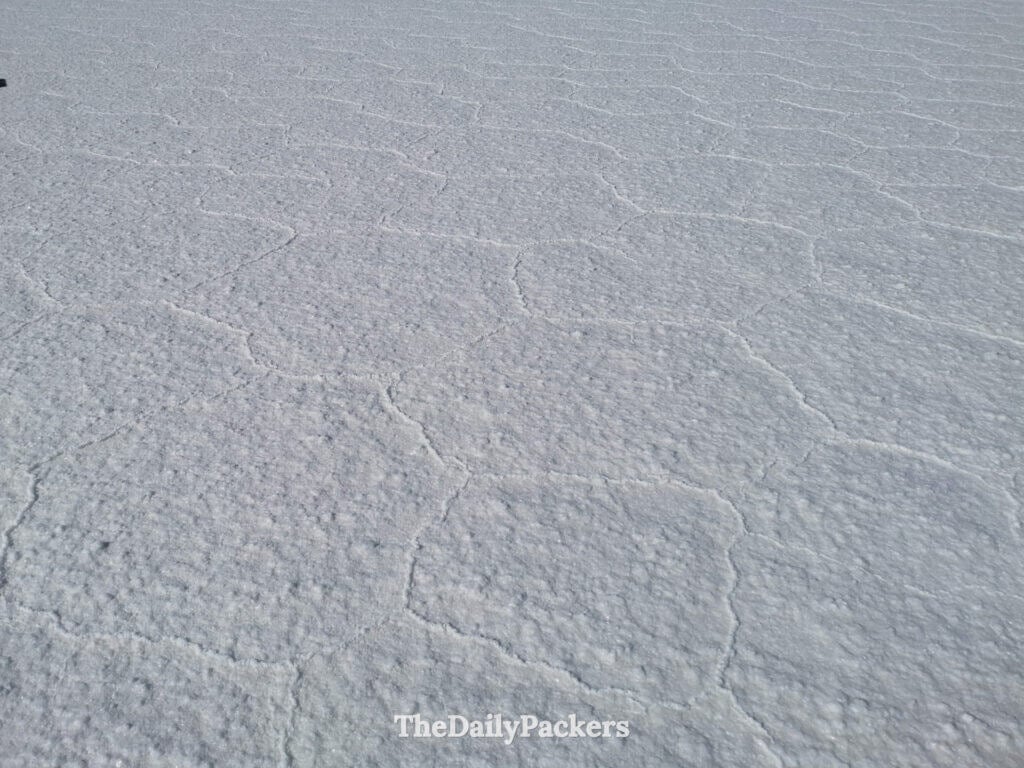
- Dry Season (May to October) This is the classic Uyuni Salt Flats look: endless white hexagons stretching forever in every direction. You get big blue skies, crisp horizons, and the best conditions for depth-illusion photos. Days are sunny, nights are freezing, and July–August are the coldest months of the year. We visited in July — the light was incredible, but trust me, the nights were ice cold. Bring layers.
- Rainy Season (December to March) This is when the Uyuni salt flats turn into the famous mirror. A thin layer of water creates a perfect reflection of the sky, and sunsets feel surreal. It’s warm during the day and chilly at night, but not as cold as winter. The only downside? Heavy rain can make some areas inaccessible, and the tour itinerary may change.
- Shoulder Months (April & November) Probably the best balance. You might catch reflections and dry areas in the same trip. Temperatures are milder, and there are fewer visitors compared to the peak season.
Best Time of Day: Sunrise and sunset are incredible in the Uyuni Salt Flats — soft pink skies, dramatic colours, and reflections if there’s water. Midday light is bright and harsh but perfect for perspective photos.
Tips: If you want the mirror effect, go between January and March. If you prefer the ultra-white desert look, go between June and October.


Check all your bus options on Busbud — it’s simple to compare routes, prices, and book your tickets in advance.
Where to stay in Uyuni
Uyuni isn’t the kind of place where you linger — most travelers (including us) only spend a couple of hours in town before heading straight into the salt flats. And honestly, that’s all you really need. The magic is out there in the desert, not in Uyuni itself.
But if you arrive the day before your tour or need a place to rest after the night bus from La Paz, here are a few solid accommodation options that will make your short stay comfortable:
- Hotel Nido del Flamenco: A clean, cozy, budget-friendly pick close to the center. Good if you just need a reliable place to sleep before your tour.
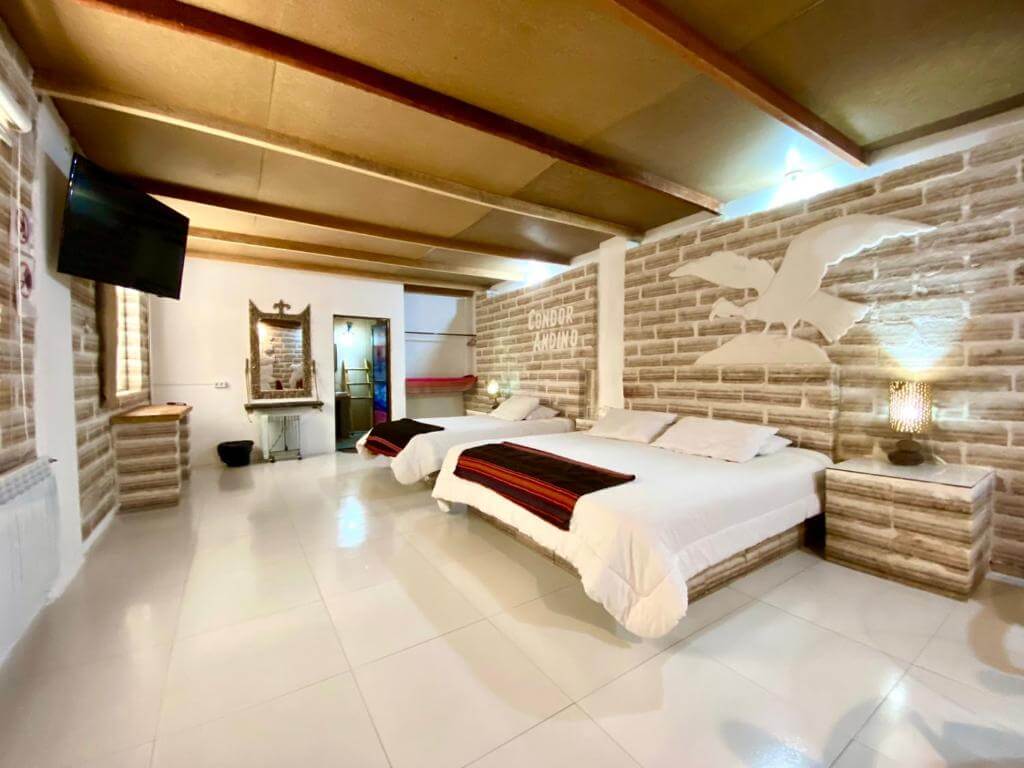
- Casa de Sal – Salt Hotel: A fun experience if you want a taste of the salt-hotel vibe without going too far from town. Think salt walls, salt furniture, and lots of quirky details.
- Hotel de Sal Atipax: More modern and comfortable, with great rooms and lovely staff — perfect if you want a quiet night after a long travel day.
If you can, avoid spending too much time in Uyuni itself and save your energy for the salt flats. That’s where the real adventure begins.

Here are all your accommodation options in Uyuni
Booking the Uyuni Salt Flats Tour
Booking a Uyuni Salt Flats tour is surprisingly easy, and almost every company offers a very similar itinerary. The differences come down to group size, language, price, and overall reliability — and that’s where reviews really matter.
We went with Salty Desert Aventours (often listed as Salty Desert Adventurous) because they had solid reviews, included free sleeping bags, and were reasonably priced. Another excellent company — and probably the one we’d choose today — is Andes Salt Expeditions. They’re one of the few operators you can book directly online through Viator, with over 700 reviews and a 4.8/5 rating, which already tells you a lot about their consistency.
Overall, we were happy with our choice. Not everything went perfectly, but honestly, those little hiccups are part of the adventure and gave us some of our best memories.

If you already know which company you want to join, you can book in advance. Otherwise, you can simply walk into Uyuni, compare prices, and book on the same day. Most Uyuni Salt Flats tours let you check in at their office around 9–9:30 am, choose your meal preference (regular or vegetarian), and confirm your group type.
For the 3-day Uyuni Salt Flats tour, you’ll usually have three options:
- Spanish-speaking tour
- English-speaking tour
- Private tour

Each comes with a different price point. We chose the Spanish Uyuni Salt Flats tour because it was cheaper and we assumed the guide wouldn’t give long lectures anyway, which turned out to be true. The driver-guide mostly explains logistics, and Tina speaks Spanish, so we never missed anything important.
If you don’t speak Spanish but want a smooth, stress-free experience, the English group with Andes Salt Expeditions is worth every cent. And because you can book it on Viator, you get secure payment, instant confirmation, and a reliable schedule — super handy if you’re short on time or arriving early from La Paz.
If we were to do it again today, we would book through Andes Salt Expeditions online.

Cost of the Uyuni Salt Flats Tour
Prices for the 3-day Uyuni Salt Flats tour vary depending on the company, the level of comfort, and whether you choose a Spanish-speaking or bilingual guide. One of the most reputable operators is Andes Salt Expedition, which you can even book online through Viator — a huge advantage if you prefer planning in advance. Their 3-day tour usually starts around €220 per person and includes quite a lot for the price.
You’ll have all your meals covered — two breakfasts, two dinners, and three lunches — and they can adapt everything to vegetarian, vegan, or gluten-free diets as long as you tell them before the Uyuni Salt Flats tour starts. Accommodation is also included: the first night is in the Magia del Salar Salt Hotel, where you get a private room with a queen-size bed or two singles and your own hot shower. The second night is more basic and shared, at Hostal Los Andes near Laguna Colorada, which is very normal for this remote part of Bolivia.
The Uyuni Salt Flats tour is done in a classic Toyota Land Cruiser (the iconic salt-flats 4×4), driven by a bilingual English-speaking guide. They also provide oxygen, which can be helpful at high altitude — especially on day two, when you’re sleeping close to 5,000 meters.
A few things are not included, so you’ll need to budget for them. The border transfer to San Pedro de Atacama (if you’re continuing to Chile) costs about 20 USD, and entrance fees to the national parks add another 30 USD. Sleeping bags are available for 10 USD, and you’ll probably want to buy a few extra bottles of water on the way.
Overall, expect to spend a bit more than the base €220 once you add the entrance fees and extras, but the experience is worth every bit — especially if you want a reliable guide, a salt-hotel stay, and a smooth, well-organized adventure.

Here are all your accommodation options in Uyuni
Uyuni Salt Flats Tour – Day by Day
Uyuni Salt Flats Tour Day 1
Day 1 of the Uyuni Salt Flats Tour starts at 10:00 am, right in front of the tour company office. You’ll meet your group, load your backpacks onto the roof of the 4×4 (wrapped in a massive tarp to protect them from salt), and hit the road.
We were six travelers plus our driver, Iber, and quickly realized how important this little “tour family” would become. For us, the group was: Patricia (Germany → Austria), Jo (UK), Megan (US), and Simone (Germany → Switzerland). Within an hour we were already laughing like we’d known each other for days.

Stop 1: Explore the Locomotive Cemetery
The first stop on every Uyuni Salt Flats tour is the Train Cemetery, a rusting graveyard of old steam locomotives that once transported minerals across Bolivia. Now they sit abandoned in the desert, covered in graffiti, scattered like giant metal skeletons.

It’s crowded and chaotic—don’t expect serenity here. For us, it wasn’t the highlight of the day, but it’s quirky and photogenic, and a fun place for some quick climbing and silly photos.

A short stop in a small artisan village follows, where you can pick up souvenirs or take a bathroom break before heading into the salt flats.

Here are all your accommodation options in Uyuni
Stop 2: Have Lunch in a Salt Hostel + See the Dakar Monument & Plaza de las Banderas
Before heading deep into the Salar de Uyuni, your tour will stop in a small settlement at the edge of the salt flats — and this is where several iconic sights are located.
You’ll first see the Dakar Monument, a massive salt sculpture created when the Dakar Rally passed through Bolivia. Even though the rally no longer comes this way, the monument remains one of the most photographed spots on the salar.

Right next to it is the Plaza de las Banderas, a colorful, wind-filled forest of flags from around the world. Travelers leave their national flag here, and the whole place has a festive, international vibe.

Just a few meters away, you stop at an old salt hotel that now serves as a lunch spot for all tour groups. The exterior walls, tables, beds — everything is made of salt bricks, which already sets the mood for your Uyuni Salt Flats adventure.
Lunch is provided by your Uyuni Salt Flats tour company. For us:
- Vegan option: fried eggplant, vegetables, quinoa salad, oranges
- Regular option: meat, sausages, potatoes

The food was surprisingly good and filling, and it’s a nice break before heading into the surreal white desert.
Toilets are available (5 Bs), though they’re usually quite basic — come prepared.


Stop 3: Enter the Uyuni Salt Flats
Then comes the moment everyone waits for: driving into the endless white desert of Salar de Uyuni.

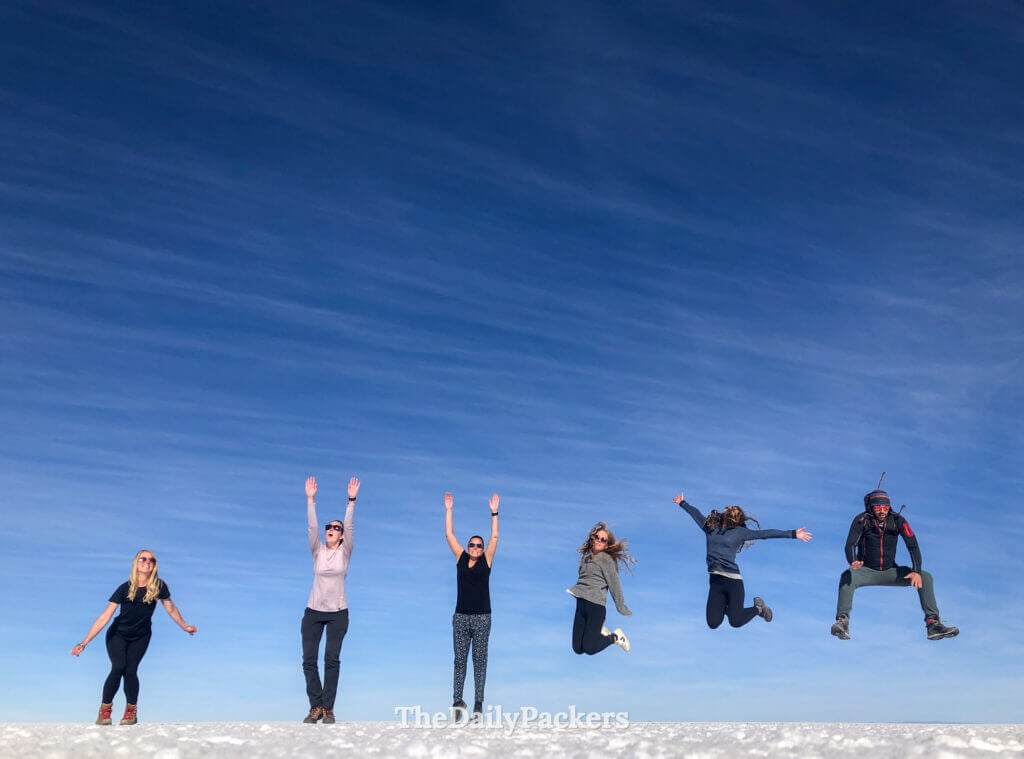
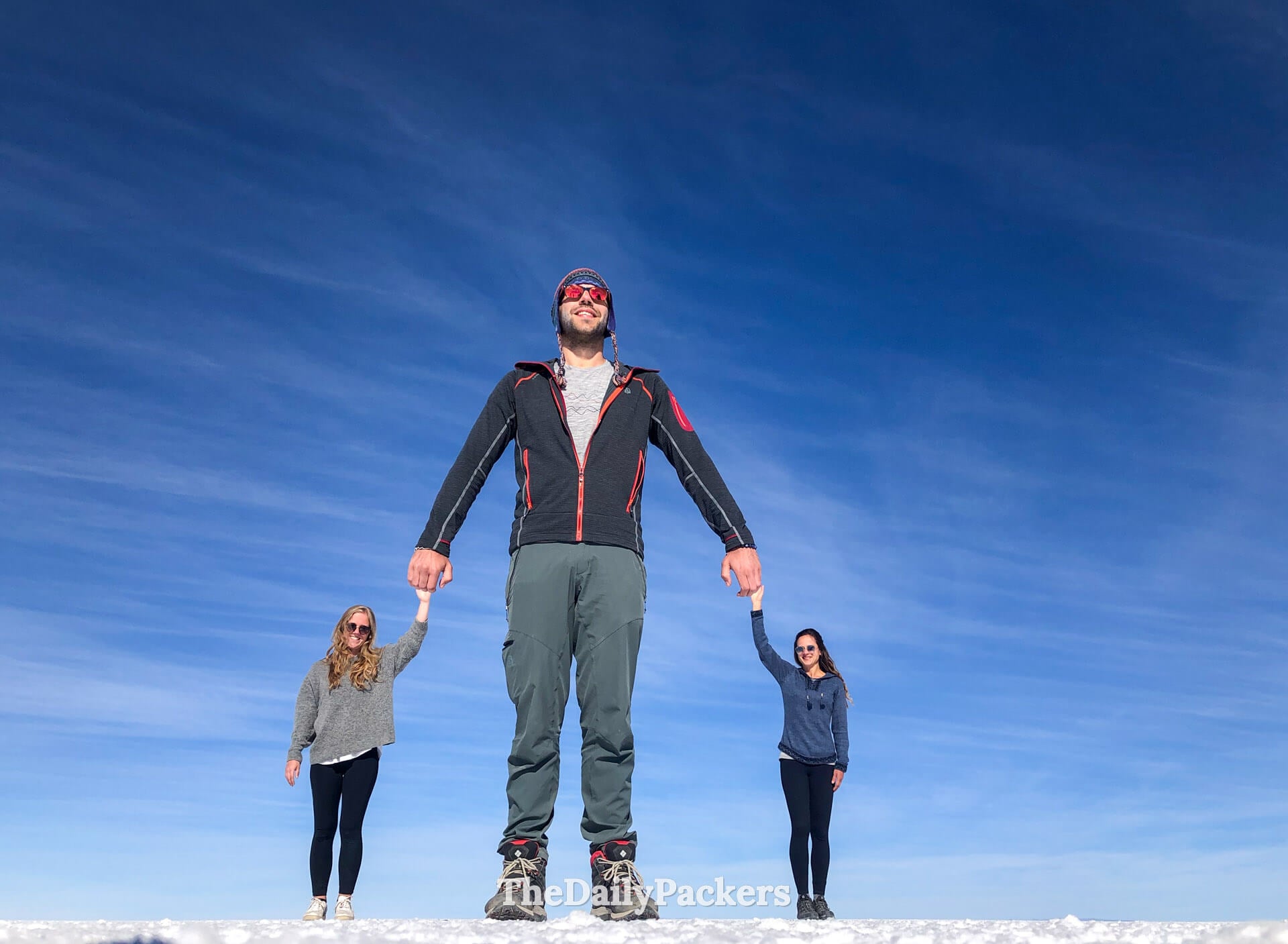
The 4×4 rides across blinding white hexagonal patterns for about 40 minutes until you reach an open area with no one around. This is where the famous perspective photos happen, and your driver will probably turn into a photographer / creative director.

Iber was honestly amazing — he knew all the angles, gave us ideas, and snapped tons of photos. If you want fun shots, bring large props (toy dinosaurs, Pringles cans, bottles, big figurines…). Tiny objects just don’t show well on camera.

In the dry season (when we visited), the Uyuni Salt Flats ground is pure white. In the rainy season, the flats flood and turn into a giant mirror. Both are spectacular in their own way.
Stop 4: Hike Incahuasi Island (Isla Incahuasi)
Incahuasi Island is one of those places you don’t expect to find in the middle of a salt desert. After driving across an endless white landscape for what feels like ages, this rocky island suddenly appears, covered in giant cacti and surrounded by nothing but shimmering salt.

The island is actually the fossilized remains of an ancient volcano that stood in the middle of a prehistoric lake more than 40,000 years ago. When the lake dried up and became the Salar de Uyuni, this small patch of land was left behind — along with coral-like formations, petrified algae, and cacti that grow up to 10 meters high.

There is a 30 Bs entrance fee, and the visit takes about 40 minutes, following a marked loop that climbs gently to a viewpoint. The trail is easy enough, though the altitude might make you breathe a little harder than usual. The reward is absolutely worth it: a panoramic view over the salt flats that makes you feel like you’re standing on another planet.

In our group, only four of us decided to go up — the others stayed below to save the entrance fee — but honestly, if you’re already here, it’s a shame to skip it. This little island is one of the most unique landscapes you’ll see on the entire Uyuni Salt Flats tour.

Step 5: Experience Sunset on the Uyuni Salt Flats
Once you leave Incahuasi, the Uyuni Salt Flats tour continues toward a quieter part of the salar, where the groups spread out enough that you start to feel alone again. This is where you stop for one of the most magical moments of the day: sunset on the Uyuni Salt Flats.
There’s something surreal about watching the sun drop over a horizon that seems to go on forever. The flats slowly shift from blinding white to soft gold, then to pastel pinks and purples. The ground becomes cooler, the wind gets a little sharper, and the entire landscape feels almost unreal — like someone turned the world into a giant watercolor painting.

During the dry season (when we visited), the salt crust cracks into hexagonal patterns that catch the light beautifully. In the rainy season, the salar transforms into a mirror, and sunset becomes twice as stunning, with the sky reflecting beneath your feet.

Our driver let us wander around, take photos, and simply enjoy the moment. It was one of those travel experiences where everyone falls quiet without being asked — just taking it in.
Once the sun disappeared, we hopped back in the 4×4 for the last drive of the day toward our salt hotel for the night.

Here are all your accommodation options in Uyuni
Night 2: Salt Hostel Overnight Stay
After sunset, you’ll drive about an hour to reach your accommodation for the night: a salt hostel. Dinner was simple. The vegetarian option was quite light (a small omelet and bread), while the regular meat plate looked much more filling. Our group bought a bottle of Bolivian wine (55 Bs), sweet but perfect for the moment.
Around 8 pm, the cold started creeping in. Thankfully, we had sleeping bags and multiple heavy blankets. In July, temperatures often drop below freezing at night.
- Double rooms with shared bathrooms
- Walls and beds made of salt bricks
- Salt flakes on the floor (very cool, not the most comfy to walk on)
- 3 toilets total & 2 showers for the entire building (there were 46 people the night we stayed)
- Showers cost 10 Bs, pressure was weak but the water was hot
- Electricity only in the common areas — no outlets in bedrooms
The briefing for the Uyuni Salt Flats Day 2 is straightforward: Breakfast at 7:00 am, departure around 8:00 am.

Uyuni Salt Flats Tour Day 2
Day 2 started early and cold — a classic Uyuni Salt Flats combo. Breakfast was light (again): a piece of bread, a small portion of scrambled eggs, and a bit of jam. Not exactly a feast, but at least you don’t climb into the 4×4 feeling overly full before a long day of driving through high-altitude landscapes.
By 8:10 am, we were on the road, leaving behind the white salt crust and driving into a new region where the salt becomes darker and grainier, slowly blending into the desert. It’s a completely different scenery from Day 1 — more rugged, more remote, and somehow even more impressive.


Tip: We use the DJI Action 4 to film our vlogs — compact, durable, and perfect for capturing every adventure.
Stop 1: Follow the railway to Chile
Around 8:45 am, the first stop of the Uyuni Salt Flats day 2 was the old railway track that still connects Bolivia to Chile. Trains rarely pass now, but the rails remain, slicing through the desert and giving you a sense of just how vast and isolated this region is.

You’ll only stay here about 10 minutes — just long enough to take photos and enjoy the quiet.


Stop 2: Admire Ollagüe Volcano
By 9:30 am, you will reach the viewpoint of Ollagüe, a semi-active volcano sitting right on the border with Chile. At 5,868 meters high, it dominates the region, smoking gently on good days.

The stop lasts around 45 minutes, which gives you time to stretch your legs, take photos of the rust-colored desert and snow-dusted peaks, and appreciate how tiny you feel in this landscape.

Stop 3: Spot flamingos at Laguna Cañapa
Just before 11am, you arrive at Laguna Cañapa, your first lagoon of the day and a stunning one at that.

The water is pale turquoise, ringed by white salt and framed by mountains. Pink flamingos feed in the shallow waters, their reflections dancing in the wind. You stay here about 15 minutes — enough to snap photos, watch wildlife, and breathe in the crisp air.

Here are all your accommodation options in Uyuni
Stop 4: Marvel at Laguna Hedionda
Only half an hour later, you reach Laguna Hedionda, one of the most beautiful lagoons of the entire tour. At over 4,120m altitude, the air is thin, the wind is strong, and the colors are surreal: deep blue water, pink flamingos, white salt crust, and brown mountains.
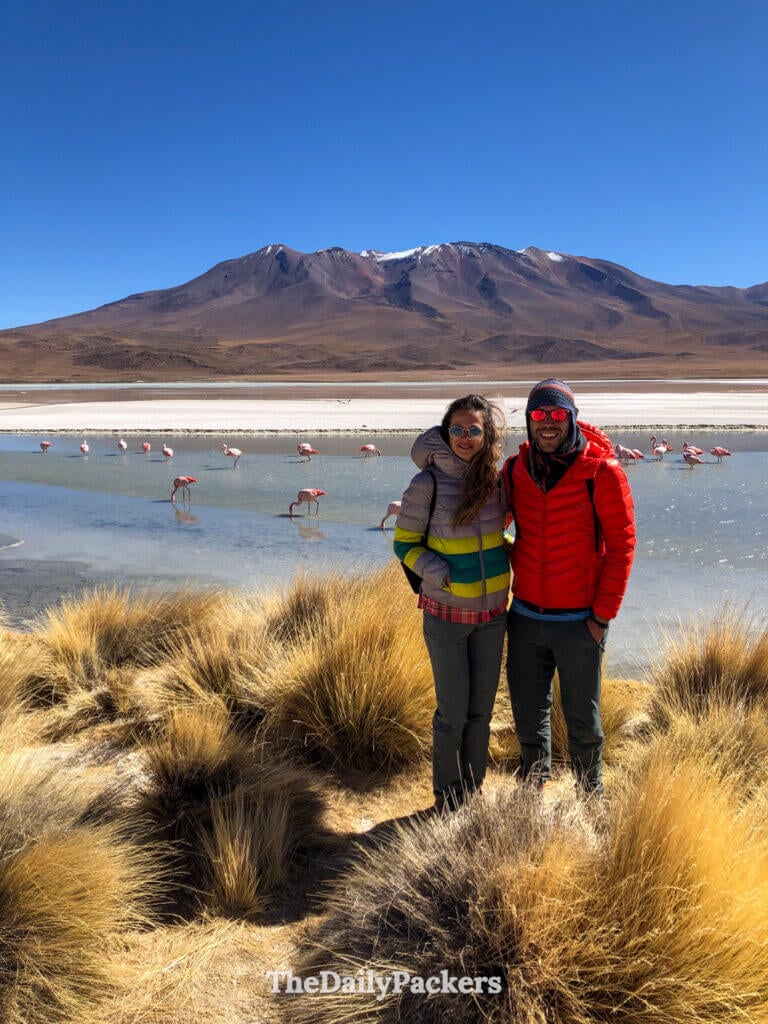
This lagoon is also home to three species of flamingos. You’ll spend around 40 minutes here, including your lunch break — which was surprisingly delicious
- Vegetarian lunch: fried veggie pancake, vegetables, fruit.
- Regular lunch: chicken with pasta.

Honestly? One of the best meals of the whole Uyuni Salt Flats tour.

Tip: We use the DJI Action 4 to film our vlogs — compact, durable, and perfect for capturing every adventure.
Stop 5: Laguna Honda
Just after 1:00 pm, a quick stop at Laguna Honda, a smaller and quieter lagoon at 4,114m. It’s not as impressive as the others, but still beautiful and worth the stop for panoramic photos.

Stop 6: Visit the Viscacha colony
Next, the Uyuni Salt Flats tour heads deeper into the desert until you reach a rocky outcrop where viscachas (long-tailed rabbit-like animals) lounge on the stones.

They look like a mix between a rabbit and a chinchilla — extremely cute, surprisingly calm, and clearly used to humans. You can get close for photos, but don’t touch them: they’re still wild animals.

Bonus Adventure — Our 4×4 breaks down
This part wasn’t in the itinerary of the Uyuni Salt Flats tour. About an hour into the desert, just when everything felt beautifully remote, our 4×4 sputtered… then died. Our driver jumped under the vehicle to inspect it, and within minutes, other cars from our company arrived to try to help.

Soon there were four cars, seven drivers, and an impressive amount of teamwork — plus a bit of shouting in Spanish — all trying to fix the problem. Unfortunately, the issue turned out to be serious: an oil leak that couldn’t be repaired on the spot.
So we split up between other groups to continue the day. We ended up in what they nicknamed the French car because it was full of French travelers. Quite the unexpected cultural exchange.

Step 7: Visit the Stone Tree (Árbol de Piedra) + spot wild foxes
Next on the Uyuni Salt Flats itinerary was the famous Árbol de Piedra, a surreal stone formation sculpted by thousands of years of wind erosion. Rising from the desert like a giant petrified bonsai, it’s one of those places that makes you feel like you’ve stepped onto another planet.

But the real surprise here wasn’t the rock — it was the wildlife.
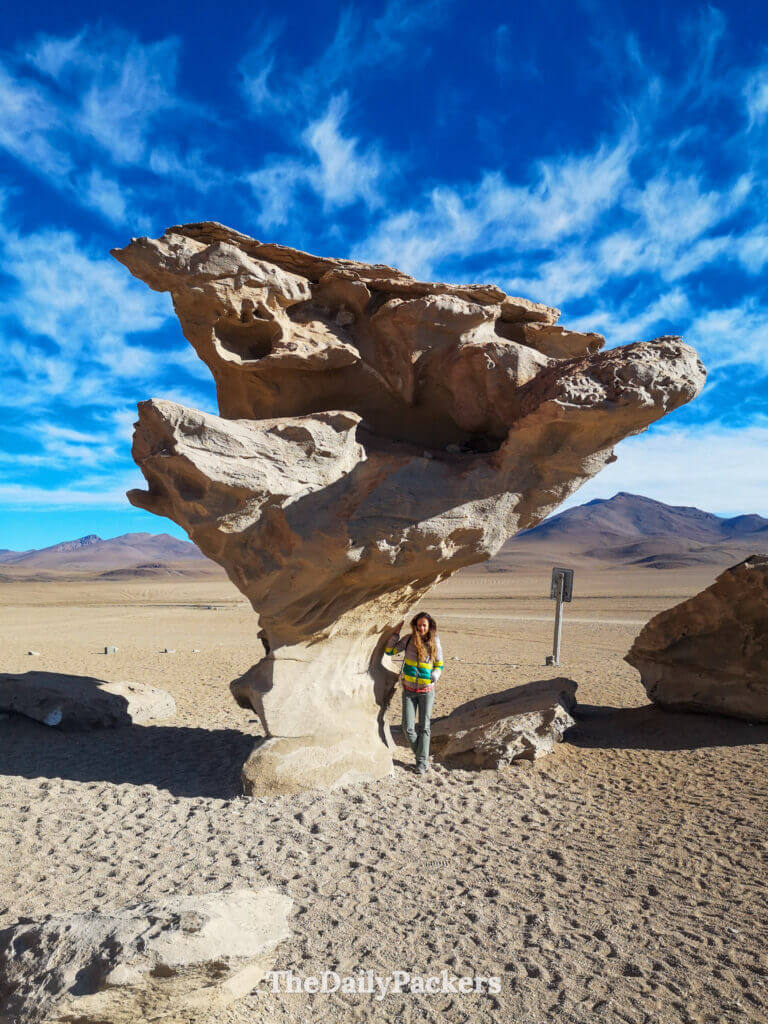
As we were taking photos and walking around the area, two wild desert foxes appeared out of nowhere. They approached the cars calmly, curious but cautious, sniffing around before wandering off again. It was completely unexpected and easily one of the most magical moments of Day 2. Just make sure to keep your distance — they’re beautiful, but still wild.

Stop 8: Laguna Colorada (Red Lagoon)
The final stop of the Uyuni Salt Flats day 2 is the incredible Laguna Colorada, inside the Eduardo Avaroa National Reserve (entry fee: 150 Bs).

The lake is deeply red because of algae and minerals, and with hundreds of flamingos feeding in the shallow waters, it’s one of the most striking places on the entire Uyuni Salt Flats tour.

Night 2: The highest and coldest night of the Uyuni Salt Flats tour
After leaving Laguna Colorada, the sun began to fall and temperatures dropped fast. You drive to a basic hostel sitting at 4,900 meters — higher than Mont Blanc — and the altitude hits immediately. Since our car broke down earlier, our bags were delayed and only arrived around 9:00 pm.
The hostel was bigger than the night before and had:
- simple double rooms
- tons of blankets
- 4 shared toilets
- electricity from 6–9 pm
- no heating
- no showers (you wouldn’t want one at –15°C anyway)
Thankfully, the common area had tea, biscuits, and a gas heater. Dinner was hearty: hot vegetable soup, spaghetti with tomato sauce, and — the surprise of the night — a bottle of red wine on the house.
Then came the altitude sickness. Patricia got sick first. Simone followed shortly after. All night long, the sound of people rushing to the bathroom echoed down the hallway.
As for the rest of us? We tried to sleep under four heavy blankets and a sleeping bag, freezing at first and boiling an hour later. It wasn’t the most comfortable night of our lives, but it was definitely unforgettable — and all part of the Uyuni Salt Flats experience.

Uyuni Salt Flats Tour Day 3
Your final morning on the Uyuni Salt Flats tour starts brutally early. At 5:00 am, you’ll be packing your bags in a freezing room, using your phone flashlight because the electricity only runs for a couple of hours each night. Breakfast is simple — cereals, yogurt, jam, bread — but honestly, you probably won’t feel like eating much. At this altitude, most people wake up with a strange stomach.
For context, half of our group was sick by this point. Jo was the first to stumble into breakfast looking pale, then Megan and Simone joined, not feeling great either. Even the group we temporarily joined when our car broke down had three sick people. We personally felt “off,” but it was hard to tell if it was altitude, fatigue, or our brain overthinking things.
Stop 1: The Geysers (5:30 am)
After a silent one-hour drive through pitch-black desert, you’ll reach the geysers — clouds of sulfur steam rising from boiling mud at nearly 5,000 meters. It’s magical but absolutely freezing, around –15°C. Most people only last a few minutes before diving back into the warmth of the car.
We tried to take a photo, but my hands were shaking so much from the cold that it looked like abstract art.

Tip: We use the DJI Action 4 to film our vlogs — compact, durable, and perfect for capturing every adventure.
Stop 2: Hot Springs (6:30 am)
By sunrise, you’re at the hot springs. The water is a glorious 38°C, surrounded by a frosty desert landscape. Many travelers hop in — it’s a classic Uyuni Salt Flats moment.

But stepping out into –15°C with wet hair? That’s another story. Our entire group skipped it. We stood there watching braver people slide into the steaming water while sipping hot tea and trying not to freeze.
If you’re tougher than us, go for it — most people who do say it’s one of their favorite moments of the Uyuni Salt Flats tour.

Stop 3: Salvador Dalí Desert (7:20 am)
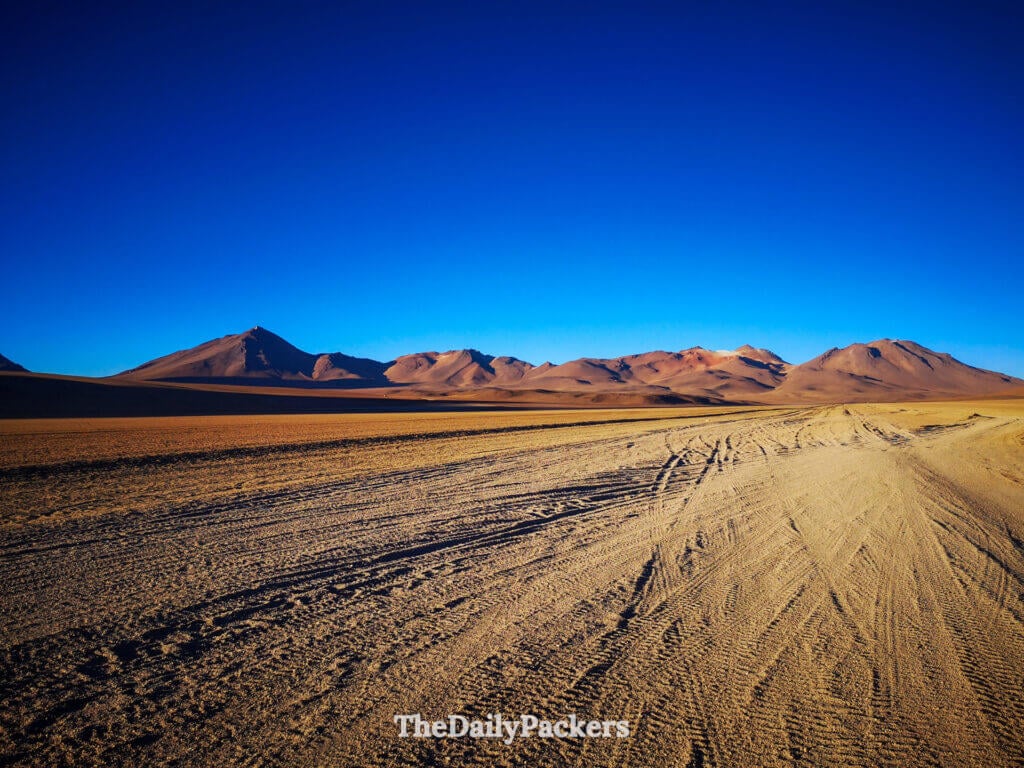
Twenty minutes later, you arrive at the Salvador Dalí Desert: smooth dunes, isolated rocks, and pastel colors that look straight out of a surrealist painting. It’s just a quick photo stop, but the landscape is so otherworldly that even half-asleep, you’ll be blown away.
Stop 4: Laguna Verde (8:15 am)
Next up on your Uyuni Salt Flats itinerary is Laguna Verde, sitting at 4,300 meters with the perfectly conical Licancabur Volcano behind it. On windy days, the lake turns a brilliant green due to its mineral content — on calm days, it stays turquoise. Either way, it’s stunning.

Stop 5: Bolivian Border (8:30 am)
This is where your Uyuni Salt Flats tour officially ends. Keep your Day 2 national park ticket, because you need it stamped out to exit. After that, you’ll line up outside a tiny shack that serves as the Bolivian immigration office.
Here’s where things get emotional — you say goodbye to the part of your group returning to Uyuni, while you continue toward Chile. We hugged Jo, Megan, and Simone goodbye as they braced themselves for another 7-hour ride back across the desert.

From here, you hop on a 23-seat minibus that waits until every seat is filled. Once it’s full, you drive 5 minutes to the Chilean border.
Expect to wait around an hour before entering the immigration building. Inside:
- your passport gets stamped
- your bags are opened and checked
- no fresh fruit is allowed into Chile
Border control took us about 15 minutes once we reached the front — much more efficient than getting into Bolivia.
By about 11:05 am, you’ll be in the minibus heading toward San Pedro. By noon, you arrive at the tiny desert town, dusty, exhausted, and ready for a real shower.
Stepping out of the bus feels surreal — after three days of volcanoes, lagoons, wild foxes, geysers, flamingos, salt deserts, and frozen nights, you suddenly find yourself in a warm, bohemian town full of cafés and backpackers.
Your Uyuni Salt Flats tour ends here, but the feeling of driving through some of the world’s most unreal landscapes stays with you long after.


If You’re Not Going to Chile (Returning to Uyuni Instead)
If you’re not crossing into Chile, your Day 3 will continue differently after Laguna Verde. Most Uyuni Salt Flats tours operate mixed groups, meaning your 4×4 may include travelers going to Chile and travelers returning to Uyuni. So once you reach the border area, the group usually splits — Chile-bound passengers switch to the shared minibus, and the rest return to Uyuni with another driver.
That’s exactly what happened to our group: after a round of hugs and a couple of “good lucks,” we watched Jo, Megan, and Simone hop into their minibus to San Pedro de Atacama while the rest of the Uyuni-returning travelers were reorganized into the remaining jeeps.
From there, your route back to Uyuni takes about 6–7 hours, passing through high-altitude deserts, flamingo lagoons, and endless stretches of volcanic landscapes. The scenery is still spectacular, but the mood is usually calmer — a mix of tired smiles, altitude fatigue, and the quiet satisfaction of knowing you just completed one of the most epic trips in South America.
Your driver will make a few quick stops for bathrooms, snacks, and photos before rolling into Uyuni sometime between 3:00 pm and 5:00 pm. Once in town:
- your Uyuni Salt Flats tour officially ends at the office
- you can catch a night bus to La Paz
- or spend the night in Uyuni before moving on
Is the Uyuni Salt Flats Tour Worth It?
Absolutely – the 3-day Uyuni Salt Flats tour is one of those trips that stays with you long after you’ve left Bolivia. The landscapes alone are worth the journey: the blinding white desert of the Salar, the colorful lagoons filled with flamingos, the towering volcanoes, the geysers, and the endless desert plains. It’s dramatic, surreal, and unlike anything else on Earth.
But what truly makes the Uyuni Salt Flats tour unforgettable isn’t just the scenery — it’s the people you share it with. We were incredibly lucky with our little 4×4 family. Traveling with Jo, Megan, Simone, and Patricia turned the experience into something much more special. We shared cold mornings, ridiculous laughs, quiet sunsets, and all the small moments in between. Without them, it simply wouldn’t have been the same trip.
That’s the magic of the Uyuni Salt Flats: the landscapes are extraordinary, but the connections you make on the road often become the highlight. If you’re on the fence, go. It’s worth every second — for the adventure, the beauty, and maybe even the unexpected friendships.
What to Bring on the Uyuni Salt Flats Tour
Packing for the Uyuni Salt Flats is all about staying warm, staying comfortable, and staying functional at nearly 5,000 meters. Days can be sunny and warm, but nights are brutally cold, so layers are everything. I wore thermal leggings, a merino t-shirt, warm socks, gloves, a beanie, and a packable down jacket — and even then, sunrise and nighttime were freezing.
Bring a reusable bottle (1L is enough — you can refill during the tour) and your favourite snacks for the long drives. We lived on nuts, crackers, and chocolate between meals.
A few essentials made our life much easier: toilet paper, hand sanitizer, a small bar of soap (the hostels didn’t provide any), sunscreen, lip balm, and a headlamp for the dark dorms with limited electricity.
And finally, bring cash. You’ll need it for the Incahuasi Island fee, the national park entrance, bathroom stops, hot showers, and snacks. Cards are useless once you leave Uyuni, so better bring more than you think you’ll spend.
With the right gear, you’ll be able to focus on what truly matters: the insane landscapes, the crazy colours of the lagoons, and the feeling of being somewhere that doesn’t look like Earth.
About the authors
We are Alex and Tina, a French-Serbian couple who met in China back in 2014. We spent three incredible years there before making France our home. Our shared passion for travel has been the heartbeat of our relationship for over 12 years, taking us across 44 countries and counting.
We launched TheDailyPackers in 2019 as a way to document our adventures. In 2026, we reached a major milestone by officially turning our blog into our full-time job. While we are still growing toward financial independence through this platform, every article we write is fueled by our mission to make your voyages easier through in-depth guides, honest advice, and the lessons we’ve learned from our own mistakes.
Our journey has not been without its storms. In 2023, our world changed forever when our first son, Poppy, was stillborn on November 25th. It was, and remains, the hardest chapter of our lives. In 2025, we were blessed with our second little boy, Milo. He has since joined our traveling tribe, and you’ll be seeing him—and the reality of traveling with a little one-on the blog more and more.
We hope to inspire you to explore the world with curiosity and resilience. Thank you for being part of our story.
You may also like those related posts
Unique Guesthouse Montevideo: In memory of dear Mario 2020
Santa Teresa Park & Laguna Negra 1-day Trip Guide, Uruguay
Curitiba to Joinville: The Ultimate 2h Bus Guide
How to Find Your Travel Visa Requirements in 2025
W-Trek Day 3: From Paine Grande to Frances
12 Best things to do in Sao Paulo, Brazil, in 1 to 2 days
Plitvice Lakes: Croatia’s most beautiful park in 2 days
11 Best things to do in Essaouira, Morocco, in 1 to 2 days
Pssst, did you know that…
If you purchase something through our links, we earn a small fee. However, you still pay the same. Win-win! And one day we may get to be full-time travel bloggers =)
Find Hotels with Booking.com
Do Yoga with KVY
Buy us a Coffee
Rent a car with DiscoverCars
Find Attractions with GetYourGuide
Find Flights with Expedia
Buy an eSIM with Airalo
Get insured with World Nomads
Get ready with Amazon.com