

Why You’ll Love Visiting Coimbra: Portugal’s Heart of Culture
Coimbra was actually a last-minute addition to our Portugal itinerary, but looking back, it was one of the best decisions we made. It quickly became one of our favorite cities in the country, and for good reason.
The first thing you’ll notice is how lively the city is. Because it’s a famous university town, the streets are filled with students and performers. One of our favorite memories is walking back to our accommodation at night and seeing students playing instruments on the corners. Our place was right on the main street, and even though it was perfectly quiet inside, we loved stepping out into the middle of live music and people dancing in the cobblestone streets.
Beyond the atmosphere, you’ll love the history. It’s home to one of the world’s oldest universities in Portugal, and honestly, the architecture is breathtaking.
Whether you’re a history buff or just someone who loves a city with a real soul, Coimbra has a way of making you feel like you’ve stepped into a storybook.
Best things to do in Coimbra
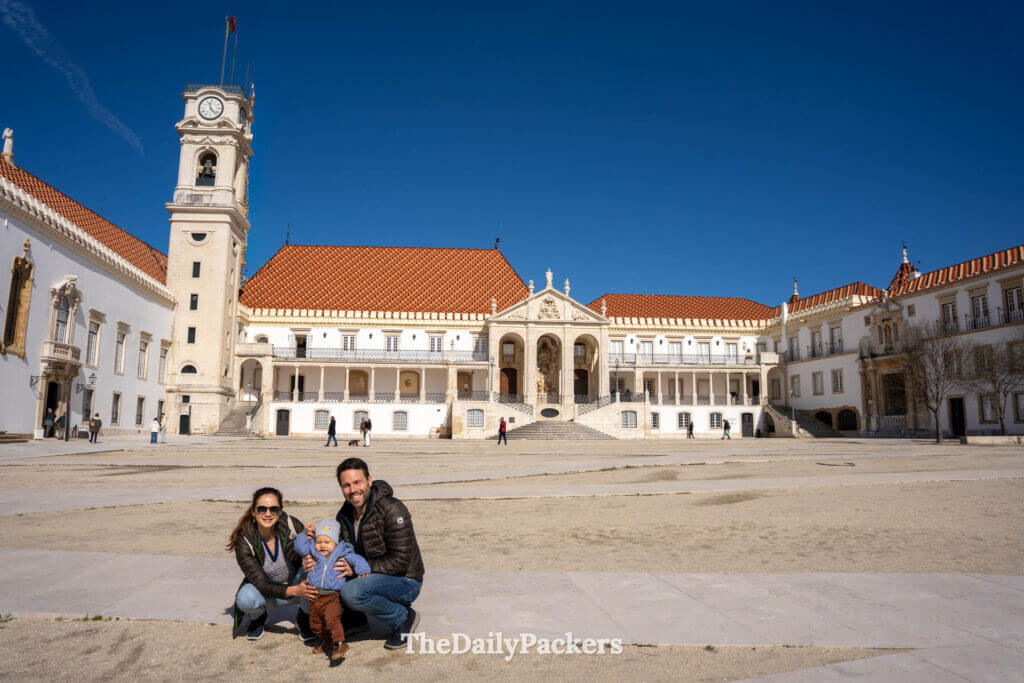
Explore the University of Coimbra
The university is the heart and soul of the city, sitting right at the top of the hill. We were blown away by how grand it feels; it’s actually one of the oldest in the world!
You should definitely get a combined ticket so you can see the Royal Palace, which has some incredible tiled rooms, and the Saint Michael’s Chapel. The chapel is small but covered in stunning 17th-century azulejos (tiles) and has a massive, ornate organ that looks like something out of a movie.

Don’t miss the Science Museum either; the Chemistry Laboratory is perfectly preserved and feels like a time capsule.
You can buy the university ticket either online or at the university’s ticket office, which is outside the university. Don’t just arrive and go in as we did. First, get your ticket one way or another.

Be Amazed by the Joanina Library
This is part of the university complex, but it deserves its own moment. It’s widely considered one of the most beautiful libraries ever built. When you walk in, you’re surrounded by dark wood, gold leaf, and thousands of ancient books.
A quick tip for you: they are very strict about photos; you cannot take any on the top floor (you can see how it looks on the university website, though). We actually liked this because it forces you to just stand there and take it all in without looking through a screen. Also, listen to the story about the bats that live there; they actually help protect the books by eating insects at night!

Wander the Botanical Garden
The Jardim Botânico da Universidade de Coimbra is a stunning, peaceful escape that honestly feels like a hidden jungle right in the middle of the city. We spent quite a bit of time here exploring the different levels. You should definitely look for the bamboo forest trail; it’s incredibly tall and makes you feel like you’ve been transported straight to Asia.

A quick tip for you: If you are traveling with a little one, this is one place where you should ditch the stroller. We found out the hard way that it is not stroller-friendly at all because of the many steps and narrow, uneven paths. We ended up using our baby carrier, which made it much easier to enjoy the stairs and hidden corners.

Walk Under the São Sebastião Aqueduct
Just outside the entrance to the Botanical Garden, you’ll find the Aqueduto de São Sebastião, also known as the Arcos do Jardim. These massive stone arches were built in the 16th century on the site of an old Roman aqueduct to bring water to the upper part of the city.
It’s a great spot to stop for a photo, and usually, you’ll see plenty of students hanging out on the grass nearby. It serves as a perfect landmark to orient yourself as you move between the University area and the newer parts of town.

Relax at Praça da República & Sereia Garden
This square is the absolute heart of student life in Coimbra. You’ll see students in their traditional black capes (which actually inspired the robes in Harry Potter!) meeting up between classes or playing music. It’s the perfect spot to feel the pulse of the town.
Right next to the square is the Jardim da Sereia (Mermaid Garden). It was under renovation when we visited, but it’s historically a very peaceful place. It was originally built by monks for meditation, and you can still see the grand entrance with statues representing Faith, Charity, and Hope. Even if parts are closed, the area around it is great for a slow stroll.

Get Local Vibes at Mercado Municipal D. Pedro V
If you want to see the “real” Coimbra, you have to visit this market. It’s been around since the 1800s and spans two floors. On the bottom floor, you’ll find mountains of fresh vegetables and local butchers, while the top floor is where the fishmongers and fruit stalls are.
We highly recommend chatting with the vendors if you can, some of them, like “Dona Tina,” have been working there for over 50 years!

See the Fonte da Manga
This bright yellow structure is one of the most unusual sights in Coimbra, and we almost missed it! Tucked away behind the Santa Cruz Church, the Fonte da Manga is a 16th-century Renaissance masterpiece. It looks like a little yellow castle floating on water, surrounded by four small towers and tiny bridges.
It’s actually one of the first Renaissance architectural pieces in Portugal. Legend has it that King João III sketched the design himself on his shirt sleeve (the manga) because he didn’t have any paper handy. Whether that’s true or not, it’s a very photogenic spot that feels a bit like a Wes Anderson movie set.

Visit Santa Cruz Church
You can’t miss the Igreja de Santa Cruz, which sits prominently in the town square. This is a National Monument and holds a huge place in Portuguese history because the first two kings of Portugal are buried here. The facade is incredibly intricate, but the real magic is inside.
When you walk in, you’ll see walls covered in beautiful blue-and-white tiles (azulejos) that tell stories from the Bible and Portuguese history. Make sure you also visit the silent cloister (the Cloister of Silence); it’s incredibly peaceful and has some of the most delicate stone carvings we saw on our whole trip.

Catch a Fado Show at Café Santa Cruz
If you are looking for a truly local experience, you have to spend an hour at Café Santa Cruz. This isn’t just any café; it’s located inside an old 16th-century chapel right next to the Santa Cruz Church. The high vaulted ceilings and stained glass make it one of the most unique places we’ve ever had a drink.
But the real reason to go is the Fado de Coimbra. Unlike the Fado you might hear in Lisbon, the Coimbra style is traditionally sung only by men, mostly students or former students, and it’s more melancholic and poetic. We sat there with a drink (it cost us about 6€ for a couple of drinks) and just let the music wash over us. It’s an experience that feels deeply personal and authentically Portuguese.

Get Lost in the Old Town
The Old Town (or Almedina) is a labyrinth of narrow, winding streets that climb steeply from the river up to the university. We spent hours just wandering here without a map. You’ll walk through the Arco de Almedina, the main gateway of the old city walls, and immediately feel like you’ve traveled back in time.

The streets are lined with tiny shops selling local crafts and bars where you can grab a quick “imperial” (small beer). One thing we loved was seeing the laundry hanging from the balconies and the colorful tiles on the houses.
Just be prepared for a workout—the “Quebra Costas” (literally “Backbreaker”) stairs are no joke! If you’re visiting with a baby, this is another area where you’ll want to use a carrier rather than a stroller because of the endless steps.

Visit the New Cathedral of the Holy Name of Jesus (Sé Nova)
Don’t let the name “New” fool you, this cathedral was actually built in the late 1500s! It sits right in the university area and was originally a Jesuit church. The facade is massive and impressive, but the real treat is inside. It feels very grand and open, with high ceilings and beautiful altarpieces. Because it’s so close to the university buildings, you’ll likely find yourself walking past it several times a day.

Old Cathedral of Saint Mary of Coimbra (Sé Velha)
This is one of the most important Romanesque buildings in all of Portugal. It looks more like a fortress than a church, which makes sense given the era it was built in. We loved the golden altarpiece and the quiet, stone cloister. It has a much more “mysterious” and ancient feeling than the New Cathedral. If you stand in the square outside, you can really feel the weight of the history around you.

Stroll Through Mondego Green Park & Cross the Bridge
If you need a break from the steep hills, head down to the riverbank. Parque da Cidade Manuel Braga and Mondego Green Park are the perfect spots for a long, flat walk. We loved coming here in the late afternoon when the sun starts to set over the water. It’s very popular with local families, and it’s the best place in the city to let your kids run around freely.
While you’re there, you have to cross the Ponte Pedonal Pedro e Inês. It’s a modern pedestrian bridge with a colorful glass railing that zig-zags across the river. Because the two sides of the bridge don’t meet in a straight line, it creates a cool visual trick where it looks like you’re walking toward a gap in the middle. Plus, it offers the absolute best panoramic view of Coimbra’s colorful houses stacked up the hillside.

Cross the River to Santa Clara
Once you’ve crossed the bridge, you’re in the Santa Clara neighborhood. This side of the river feels much quieter and more local. We recommend visiting the Mosteiro de Santa Clara-a-Velha. These are the ruins of a 13th-century convent that was flooded by the river for centuries. You can actually see how the mud and water partially buried the Gothic arches—it’s eerie but beautiful.
If you have more time, head to the Jardins da Quinta das Lágrimas (Garden of Tears). It’s a very romantic park with a tragic legend about the forbidden love between Prince Pedro and Inês de Castro. It is said that Inês was murdered here, and her tears created the fountain that still flows today. Even without the ghost stories, it’s a stunning place to walk through ancient woods and exotic plants.


The Perfect Itinerary: How to Spend Your Days
Coimbra is a city where you really want to balance seeing the big sights with just soaking in the atmosphere. We stayed for 2 nights, but honestly, we think 3 nights would be perfect. This gives you two full days to explore without rushing.
Day 1: The University & The Historic Soul
Start your morning by heading straight up the hill to the University. You can actually get there by following the route that passes by the local market, the Republic Square, and the botanical garden.
Spend the end of the morning wandering the Royal Palace, the Chapel, and of course, the Joanina Library. You can grab lunch at a nearby restaurant before continuing the visit with the Science Museum either and the Chemistry Laboratory.
Spend your afternoon getting lost in the Old Town (Almedina), wandering through the ancient gates and narrow alleys. End your day at Café Santa Cruz for a Fado show—it’s the perfect way to feel the heart of the city.

Day 2: Across the River & Local Vibes
On your second day, cross the Mondego River to the Santa Clara side. Visit the ruins of the Santa Clara-a-Velha Monastery and the romantic Quinta das Lágrimas. If you are traveling with kids, Portugal dos Pequenitos (a park with miniature Portuguese houses) is right here and a huge hit.
In the afternoon, walk back across the Pedro e Inês bridge and stroll through Mondego Green Park. If you have a car, this is also a great time to take a quick 20-minute drive to the Conimbriga Ruins, which are some of the best-preserved Roman ruins in Portugal.

The Best Time to Visit: Weather & Local Events
Even though we visited between the end of February and the beginning of March, we honestly wouldn’t recommend that time of year if you have the choice. It turned out to be quite cold and rainy along our trip in Portugal, even if we were lucky during our time in Coimbra.
If you’re planning your trip, you’ll find that spring, from April to June, is really the sweet spot. The city is waking up, the Botanical Garden is lush, and the temperatures are a comfortable 18°C to 23°C (64°F to 73°F). You might even catch the Queima das Fitas in May, where the whole city turns into a giant student festival.
We would suggest you avoid July and August if possible. It gets incredibly hot, often hitting 30°C (86°F) or more, and the narrow streets of the old town get very crowded with tourists. Plus, with the students away on summer break, the city loses a bit of that unique energy that makes it so special.
If you can’t make it in the spring, September is another fantastic option. The weather cools back down to a pleasant 24°C (75°F), the students are back in their black capes, and the light over the Mondego River is beautiful. Winter, from December to February, is the quietest time, with temperatures around 12°C (54°F), but as we learned, be prepared for grey skies and plenty of rain.


Tip: Aim for late May or early June to get the best weather and the true student vibe without the summer “melt.”
How to Get to Coimbra
How you get to Coimbra depends on where you are coming from, but it is one of the easiest cities to reach in Portugal. Whether you are coming from the north or the south, you have a few great options.
If you’re coming from Lisbon, you can take the fast Alfa Pendular train (about 1 hour 45 minutes) or the Intercidades (about 2 hours). From Porto, it’s even quicker, just over an hour. All these trains stop at Coimbra-B station, which is slightly outside the center. Don’t worry, though! Your ticket includes a free 5-minute shuttle train that takes you straight to the main Coimbra-Cidade station right in the heart of town.
But we drove into Coimbra as part of our road trip from Porto (stopping in Aveiro) and then continued south toward Obidos. The A1 highway connects the city perfectly to both Porto (1h 20m) and Lisbon (2h).
Express buses like Rede Expressos are also very comfortable and often cheaper than the train. They drop you off at the central bus station, which is about a 10-15 minute walk from the historic center.


We recommend to rent a car through Discover Cars with free cancellation. Book your rental car here.
Getting Around the City Like a Local
Coimbra is a city made for walking, but you need to be prepared for some serious hills! The historic center is very steep, so we highly recommend wearing your most comfortable shoes.
We did almost everything with our stroller, but we have to be honest: it can be a challenge. In the Old Town, there are many steps where you’ll need to carry the stroller or, better yet, use a baby carrier. When we visited the University, we actually left our stroller at the entrance and switched to the carrier to explore the buildings and the library.
The city has a good bus network, but most sights are close together. You might see the Elevador do Mercado, a funicular that connects the market area to the university hill. It’s a great way to save your legs, but it’s known for being broken quite often! If it’s working, definitely take it for the 2.50€ fare; if not, just take your time walking up and enjoy the views.

Where to Stay
When you’re deciding where to base yourself in Coimbra, you’ll mainly be choosing between the Baixa (Downtown) and the Alta (Upper Town). We found that 3 nights is the perfect amount of time to really soak in the city, it gives you two full days to explore the hills and the riverfront at a relaxed pace.
Baixa (The Historic Downtown) is the lower part of the city, nestled between the river and the university hill. It’s incredibly convenient if you’re arriving by train, as it’s mostly flat and very walkable. You’ll be surrounded by traditional shops, the municipal market, and plenty of lively squares.
Our Choice: Entre Ruas Apartments. We absolutely loved staying here. The location is right on the main street, so you’re in the middle of all the action. Despite the central spot, the sound isolation was fantastic; we could see the students playing music from the window, but slept in total peace. Plus, they have parking, which is a rare and precious find in the center!

If you want to feel like you’ve stepped back in history, stay in the Alta (The Upper Town). This is the neighborhood surrounding the University. It’s full of narrow, atmospheric alleys and has the best views of the city.
Sapientia Boutique Hotel: This is a stunning option if you want to be right next to the University. It’s elegant and has a beautiful rooftop with views over the Mondego River.
Solar Antigo Luxury Coimbra: This guest house is housed in a historic building and retains all that old-world charm, with stone walls and traditional decor. It’s a very romantic spot if you don’t mind the climb!


What and where to Eat
Our Favorite Spots to Eat
- Nau Coffee – Specialty Coffee & Brunch: This was our go-to spot near the University. It has a great local vibe and is perfect if you’re looking for a break from traditional heavy meals.
- COSÌ Gelataria: For the best ice cream in town, look no further. It was our favorite treat after a long day of climbing hills!
- Restaurante Fangas Veg: A great option if you want a break from meat; they do fantastic vegetarian tapas.
- Hotel Oslo Coimbra (Rooftop Bar): We didn’t stay here, but we highly recommend going up for a drink at sunset. The view over the city is unbeatable.

What No One Tells You
Every city has its little secrets, and Coimbra is no exception. After spending a few days navigating its hills, we picked up a few lessons that we wish someone had told us before we arrived!
Traveling with a baby
We learned a very important (and scary) lesson about traveling with a baby here. While we were in the shower, little Milo slipped and hit his chin. In half a second, there was blood everywhere. Thankfully, he was perfectly alright, but it was a huge wake-up call for us to be extra careful on those slippery bathroom tiles. Now, we always pack a small non-slip mat or use an extra towel on the shower floor for him.
You will see people with strollers in Coimbra, and we used ours for most of the city, but you need a plan. The Old Town is a literal maze of stairs. We found that the best strategy is to leave the stroller at the entrance to major sites, such as the University, and switch to a baby carrier. Your back might hurt a little more, but you’ll actually be able to see the sights instead of just staring at a flight of 50 stone steps!

The Real-Life “Hogwarts” Uniforms
Something you’ll notice immediately, and that no one really prepares you for, is the way the students dress. It is very common to see them walking around in traditional black capes and suits called trajes. It looks exactly like something out of a Harry Potter movie!
What’s even better is that they don’t just wear them for graduation; they wear them for everyday university life. Seeing groups of students in these flowing black capes walking through the ancient stone arches makes the whole city feel like it’s stuck in a different century.

What it Costs: Budgeting for Your Day
Coimbra is one of those refreshing European cities where your money actually goes a long way. Compared to Lisbon or Porto, we found the prices here much more reasonable, especially for eating out and finding a place to stay.
To give you a real idea of what to expect, here is exactly what we spent during our 2-night stay for the two of us and Milo:
- Accommodation: We paid 208€ for 2 nights at the Entre Ruas Apartments. Considering the central location and the quality, it felt like a great deal.
- The University Experience: Tickets for the university circuit (including the library, palace, and museums) cost us 33€. It’s the biggest expense but absolutely worth it.
- Food & Drinks: We spent about 28.30€ on a full brunch at Nau Coffee and around 7.50€ on ice cream at COSÌ. A coffee and Fado experience at Café Santa Cruz cost us 6€.
- Groceries & Small Bites: We spent 77.61€ on groceries to have some meals at the apartment and about 1.86€ on fresh bread from the local bakery.
- Sightseeing & Transport: Entrance to the Coimbra Cathedral was 2.50€, and a card for the elevator (when it works!) was 2.50€. We also grabbed a large bottle of water for 1.50€ while exploring.
If you want to save a bit of money, do your “big” meal at lunch. Many restaurants in the Baixa offer a prato do dia (dish of the day) for a fraction of the dinner price. Also, remember that your University ticket is valid for two days, use it to spread out the sights so you don’t feel like you’re rushing just to get your money’s worth!
















Great guide! I enjoyed learning about Coimbra’s history, university, and local culture. The travel tips and recommendations are very useful for anyone planning a trip to this beautiful Portuguese city.
Thank you very much Nathalie. We are glad that you enjoyed our guide on Coimbra as tt is one of our favourite city in Portugal 🙂